DWDM Technology: How Dense Wavelength Division Multiplexing Works
Here is something that happened last year. A futures trading firm asked us to quote a 16-channel DWDM solution. They were leasing 11 fiber pairs connecting Shanghai headquarters to regional branches, paying around ¥82,000 monthly. China Telecom pricing. They had a lower quote from China Unicom at ¥71,000 but rejected it because Unicom's route added 8km of extra distance.
We set them up with our 16ch 100GHz mux plus fixed-wavelength transceivers. Cut down to 2 fiber pairs. Monthly lease dropped to ¥14,800. Equipment investment was ¥67,400. Payback came out to 13.7 months.
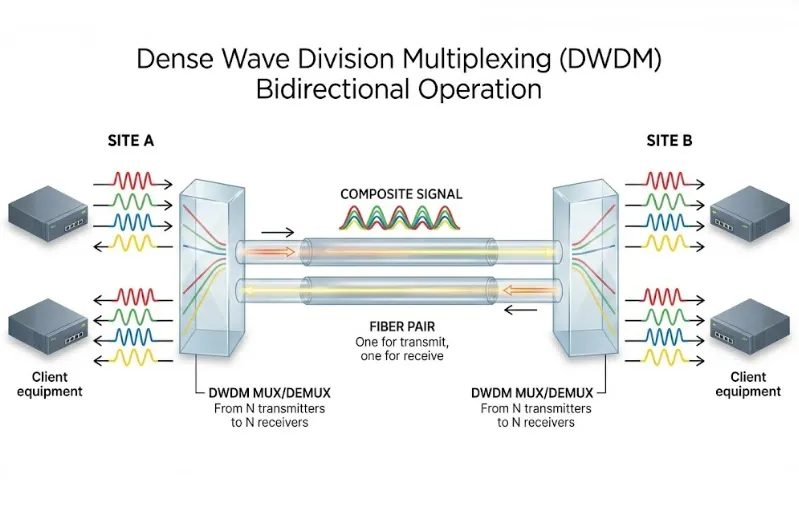
One detail worth mentioning. Futures trading companies obsess over latency at a level that borders on pathological. Their compliance team required dual-path redundancy, so those 2 fiber pairs were actually primary plus backup. Halfway through the project their technical lead suddenly asked: does the DWDM mux add latency? I told him passive mux is just a stack of thin-film filters. Light passes through in single-digit nanoseconds. Two orders of magnitude smaller than your switch backplane delay. Only then did he sign off. Most customers never ask this. Financial sector customers always do.
Do You Actually Need DWDM

I will give you the conclusion upfront: Under 80km with bandwidth needs below 80G, deploying DWDM probably means your vendor played you.
CWDM SFP+ modules now run ¥120 on Taobao for 10G. DWDM starts at ¥280. Mux equipment costs nearly double. For point-to-point links under 40km, using 40-channel DWDM when 8-channel CWDM handles the job means you are paying extra for nothing except the vendor's commission.
Last year a customer had two data centers 15km apart. Wanted 4 backup links at 10G. Some vendor quoted them a 40-channel DWDM system with OLP protection. ¥89,000. I asked: you have exactly one fiber pair between those sites, where exactly would OLP switch over to? You are using 4 channels out of 40, what happens to the other 36? They ended up with CWDM. Mux plus modules totaled ¥2,340. Our product.
The 80km threshold is hard. CWDM lasers lack TEC temperature control. Wavelength drifts with ambient temperature. Short distances no problem. Long distances the drift accumulates into crosstalk. More critically, CWDM cannot use EDFA amplification. The erbium gain window sits in C-band. CWDM wavelengths are outside that window entirely. Past 80km you have no choice. DWDM only.
Parameters That Actually Determine Your Spend
Channel Spacing
100GHz spacing fits 40 channels in C-band. 50GHz fits 80. Sounds like 50GHz is better value per channel right? Filter precision requirements double. Cost runs 40% higher. Wavelength stability requirements on transceivers also tighten considerably.
I tested a batch of white-label 50GHz modules last quarter. Spec sheet said center wavelength 1550.12nm. Actual measurements ranged from 1550.08 to 1550.19nm. Spread of ±0.055nm. At 50GHz spacing your channel boundary sits at ±0.2nm. That batch already consumed a quarter of the margin before leaving the factory. Wait until seasonal temperature swings hit your data center. Crosstalk city.
To be direct: unless you genuinely need 100+ wavelengths, 40ch 50GHz is a waste of money. Most enterprise DCI scenarios fit comfortably in 40 channels at 100GHz. 30% cheaper. More stable. Done.
Power Budget
How often this gets ignored genuinely frustrates me. Customers wave the transceiver datasheet around saying "it supports 80km transmission, no problem." That 80km rating assumes lab conditions. Pristine fiber. Zero contamination on connectors. Perfect fusion splices. Your fiber plant was installed in 2015, got cut twice by construction crews and re-spliced, and those connector end faces have not seen a cleaning swab in three years. That is not lab conditions.
| Item | Quantity | Loss per unit | Total Loss | Notes |
|---|---|---|---|---|
| Fiber attenuation | 65 km | 0.22 dB/km | 14.3 dB | Your fiber might be 0.22 dB/km (theoretical 0.2) |
| Fusion splices | 8 | 0.08 dB | 0.64 dB | If done very well |
| Connector insertion pairs | 6 | 0.45 dB | 2.7 dB | Clean connectors; dirty ones can hit 0.7 dB |
| Demux insertion loss | 1 | 3.8 dB | 3.8 dB | Measured 40ch value ≈ 3.8 dB (spec sheet 3.5) |
| Aging margin | - | - | 2 dB | - |
| Total | - | - | 27.24 dB | - |
Standard 10G DWDM SFP+ power budget is 26dB. You are over. Either pay extra for high-power transceivers (add ¥80 per unit) or pray your connectors stay clean forever.
I have told customers a hundred times: spend ¥500 to get an OTDR trace done before deployment. Mark every splice point and every anomaly. Far cheaper than troubleshooting an intermittent link later. If even 10% of customers listened, our support ticket volume would drop by half.
Doing The Math On Upgrades
Forget those ROI calculators floating around online. All idealized garbage. Real procurement involves considerations like:
Option A: Lease More Fiber, Keep CWDM
First, fiber lease pricing is not fixed. China Telecom currently quotes ¥4,200/pair/month, but sign a 3-year commitment with upfront payment and you can push that to ¥3,650. Unicom undercuts harder, willing to go ¥3,200 to steal customers. Lease 3+ pairs and there is a bundle discount.
Second, CWDM equipment depreciates over 3 years. That spend categorizes as either opex (if leased) or capex (if purchased). Completely different accounting treatment. Some companies already exhausted this year's capex budget. They would rather pay slightly higher monthly cost routed through opex because that is not their KPI constraint. You show them a TCO comparison, they do not care. Wrong line item.
Option B: Upgrade to DWDM
One-time equipment spend ¥60-80K depending on configuration. Goes on capex. Reselling old CWDM gear? Do not kid yourself. Unless it is Cisco or Huawei OEM equipment, there is no secondary market. Our own CWDM mux units come back from customers trying to offload them. One sat on the used equipment site for three months before selling at ¥180. Yes. Barely above e-waste recycling value. Offset nothing.
Also some customers have two years remaining on fiber contracts. Early termination penalty is typically 15-30% of remaining lease value. Leave that out of your ROI calculation, and when the project kicks off finance jumps in saying there is an additional ¥30,000 penalty due. Management faces turn various colors.
So the real math looks like this:
| Item | Option A: Expand CWDM (Lease + new CWDM) | Option B: Upgrade to DWDM (Terminate + upgrade) | Notes / Assumptions |
|---|---|---|---|
| New fiber pairs leased | Lease 2 new pairs ¥3,400 / pair / month | Keep 1 pair (terminate 1 pair) | - |
| Fiber lease cost (3 years) | 2 × ¥3,400 × 36 = ¥244,800 | Penalty (2 years) ¥3,400 × 20% × 24 = ¥16,320 + 1 pair ¥3,400 × 36 = ¥122,400 Total fiber: ¥138,720 | Early termination penalty applied in B |
| Equipment cost | 2 sets new CWDM 2 × ¥4,800 = ¥9,600 | DWDM (40ch) = ¥52,000 | Quotes provided |
| Transceivers | - | 28 × ¥320 = ¥8,960 | Additional for upgrade |
| OPEX impact (annual routing / allocation) | ¥88,000 / year 3 years ≈ ¥264,000 equivalent pressure | - | Finance prefers spreading via OPEX |
| Upfront / CapEx pressure | Low (mostly OPEX) | High - ~¥77,280 upfront (DWDM + transceivers) | Finance may object to front-load in Option B |
| 3-Year Total Estimated Cost | ≈ ¥254,400 | ≈ ¥138,720 | - |
| Savings vs Option A (3 years) | - | ¥115,680 savings | But trades OPEX for CapEx |
ACG Research published a 2024 report claiming DCI scenarios achieve 48-62% TCO reduction. (Source: cisco.com/go/routed-optical) They studied 12 enterprises. Conclusions are directionally correct but every situation differs significantly. Run numbers using your actual data. Do not copy-paste someone else's model.

What Your Procurement Checklist Is Missing
Dispersion Compensation
10G intensity-modulated signals running beyond 80km need DCM. The problem: DCM introduces 4-6dB insertion loss. Your power budget was already tight. Add DCM and you blow past the limit. Then what? Add EDFA. Cheapest desktop EDFA runs ¥18,000. Rack-mount starts at ¥35,000. Vendors do not include this in initial quotes. You find out after the system is installed and behaving erratically.
We had a customer get burned on this last year. Guangzhou to Dongguan, 86km, 10G×16ch. Worked fine initially. Summer arrived, bit error rate spiked, spent three days troubleshooting before discovering elevated temperatures changed fiber dispersion coefficient enough to push pulse spreading beyond receiver tolerance. Ended up spending ¥22,000 on DCM plus an amplifier to fix it.
100G coherent systems sidestep this entirely. DSP handles dispersion compensation digitally. Sometimes running the numbers, jumping straight to 100G costs less than patching up 10G expansion. Price gap is not as dramatic as a few years ago.
Transceiver Compatibility
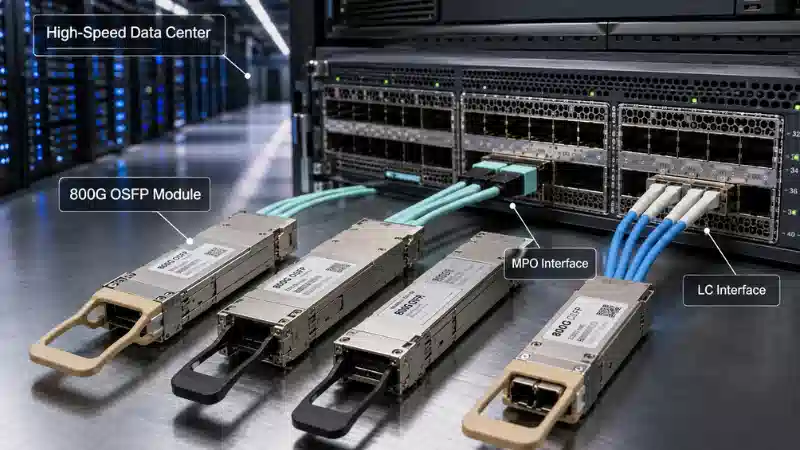
Our mux is pure passive optics. Light goes through, done. Does not care what brand transceiver you plug in. But certain active platforms lock transceivers. Cisco is the worst. NX-OS detects whether you inserted genuine Cisco optics. Non-genuine either refuses to light, rate-limits, or spams warning logs relentlessly. Huawei is better. CE-series switches let you disable the check via command line.
Test works perfectly in your lab using your own transceivers. Deploy at customer site into their Cisco chassis, link stays down. Do not come complaining to us. Not a mux problem.
Separately Licensed Features
Some vendor DWDM platforms sell the NMS software separately. OSC module separately. Dynamic power equalization separately. I saw a case where base unit quoted at ¥89,000 looked competitive. Customer signed. Went live, discovered no remote monitoring capability. NMS license: ¥35,000/year. Automatic power adjustment: another ¥12,000.
Before signing anything clarify:
- NMS perpetual or subscription?
- Firmware updates included or charged?
- On-site support per incident cost?
- Spare parts advance replacement available?
Which Vendor To Pick
Cannot give you a standard answer because it depends on who you are.
Carriers / Large IDCs: Go directly to Ciena or Huawei. Ciena pushes technology hardest. WaveLogic 6 already does 1.6T per wavelength. North American hyperscalers mostly use them. Huawei offers better price-performance but faces policy restrictions in certain regions. Nokia absorbed Infinera and now has comprehensive portfolio. Also worth evaluating.
Mid-size Enterprise: If budget allows, Adtran FSP 3000. Open architecture, no transceiver lock-in. Tighter budget means working with specialists like us who focus on passive components. Mux plus third-party transceivers. Runs stable.
Small Deployments / Budget Constrained: Honestly just buy mux on Taobao. A large portion of our factory output ends up sold through Taobao resellers anyway. They add ¥100-200 markup and flip it. If your volume is small (under 5 sets), buying through Taobao is actually faster than going through our official purchase order process.
Actual procurement comparison table, not the idealized version:
| Spec | 8ch 100GHz | 16ch 100GHz | 40ch 100GHz | 40ch 50GHz |
|---|---|---|---|---|
| Our direct price | ¥2,400/pair | ¥3,650/pair | ¥7,200/pair | ¥9,800/pair |
| Taobao reseller | ¥2,600-2,900 | ¥3,900-4,300 | ¥7,800-8,500 | ¥10,500-12,000 |
| Stock status | Always available | Always available | Some wavelength configs wait | Usually made to order |
| Lead time | 3 days | 3 days | 5-10 days | 15-20 days |
| MOQ | 1 set | 1 set | 1 set | 3 sets minimum |
| Warranty | 3 years | 3 years | 3 years | 3 years |
| Telcordia cert | Extra cost | Included | Included | Included |
Note the MOQ on 40ch 50GHz. Volume too low for us to stock. We batch orders from multiple customers before running production. Rush orders possible. 20% premium.
Final Notes
FOCC makes passive optical components. Mux/demux, splitters, patch cables. Active equipment like EDFA, OTN platforms, coherent transceivers, we do not manufacture. If you need those I can recommend partners we have worked with. That revenue is not ours. No reason to pretend otherwise.
Same with transceivers. I recommend buying compatible optics. OEM Cisco DWDM SFP+ runs ¥1,800 per unit. Third-party runs ¥320. We have tested modules from several compatible optics vendors running on the same link as genuine Cisco. BER indistinguishable. Money you save on transceivers is better spent on our mux anyway.
Questions? Add technical support on WeChat: FOCC-Tech01. Send your link topology and distance. We respond same day with configuration recommendations. Faster than filling out forms and waiting for callbacks.