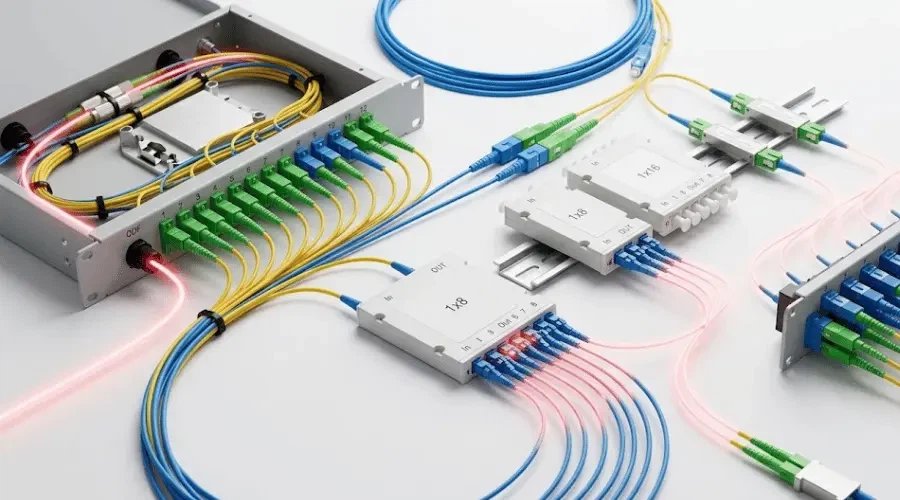
In recent years, fiber optic communication technology has developed rapidly and has become a shining highlight in the field of communications. With its unique advantages such as wide bandwidth, large capacity, immunity to electromagnetic interference, and low cost, fiber optic communication has quickly become the main transmission method for various communication networks.The future development of fiber optic communication still holds enormous potential.

Networking, High Capacity and High Speed
my country's main fiber optic communication backbone has been completed, with a capacity reaching Tbit/(s·km), which is almost unused. In the mid-1980s, the rate of digital fiber optic communication reached 144 Mbit/s, capable of transmitting 1980 telephone lines, exceeding coaxial cable carrier speeds. Consequently, fiber optic communication became the mainstream technology and was widely adopted, completely replacing cables in transmission backbones. With the development of wavelength division multiplexing (WDM) technology, the current practical level has reached 40 × 10 Gbit/s. Laboratory levels far exceed this, with 80 × 40 Gbit/s transmission experiments already completed. The development of WDM technology is booming, and it is estimated that commercial technology at 160 × 40 Gbit/s will become a reality in the near future.
Long Waveletization
The minimum loss value of silica optical fiber is already close to the theoretical value. To achieve long-distance communication, new optical fiber materials are needed. Generally, optical fibers with extremely low loss above 2μm are called ultra-long wavelength optical fibers (or infrared optical fibers), and systems constructed with such fibers are called ultra-long wavelength optical fiber communication systems.
IP-Based Delivery Services
In recent years, with the rapid development of the Internet, IP services have experienced explosive growth. Predictions indicate that IP will carry various services, including voice, image, and data, forming the foundation of future information networks. Simultaneously, optical transport networks, with WDM as their core and Intelligent Optical Networks (ION) as their goal, further introduce control signaling into the optical layer, meeting the future network's demand for multi-granularity information exchange, improving resource utilization and network application flexibility. Therefore, how to build a next-generation optical network that can effectively support IP services has become a widely discussed topic.
Compared to traditional services, IP services exhibit significant self-similarity, data asymmetry, and server congestion. Therefore, for the optical networks carrying IP services, the next major challenge is not only the obvious demands for ultra-high capacity and broadband access, but also the need for the optical layer to provide higher intelligence and implement optical switching at optical nodes. The aim is to establish an economical, efficient, flexibly scalable optical network that supports service QoS through the adaptation and integration of the optical and IP layers, meeting the requirements of IP services for information transmission and exchange systems. Intelligent optical networks draw upon the intelligent features of IP networks, adding a control plane layer to the existing optical transport network.
This control plane not only establishes connections for users, provides services, and controls the underlying network, but also boasts outstanding characteristics such as high reliability, scalability, and high efficiency. It supports different technical solutions and diverse service requirements, representing the development direction of next-generation optical network construction.
Therefore, driven by the dual stimulus of the rapid growth in bandwidth demand from satellite services and the ultra-large bandwidth resources provided by WDM transmission technology, the evolution of traditional optical networks towards a new generation of optical networks suitable for transmitting IP services is inevitable. Furthermore, due to the fierce competition facing the global communications industry and related fields, major telecom giants and communication equipment manufacturers have elevated the research and innovation of more flexible, reliable, and lower-cost next-generation optical networks for Internet services to a strategic development level. Renowned universities and research institutions both domestically and internationally are also focusing their research on next-generation optical networks and their key supporting technologies. The pace of evolution from traditional optical communication networks to next-generation optical networks is accelerating, with the aim of providing the Internet with a faster, wider, more flexible, more efficient, and more intelligent next-generation optical network.

Fully Photochemical
Traditional optical networks achieve full optical connectivity between nodes, but the use of electronic components at network nodes still limits the increase in the total capacity of current communication networks. Therefore, a true all-optical network has become a very important research topic. An all-optical network replaces electrical nodes with optical nodes, and communication between nodes is also entirely optical. Information is always transmitted and exchanged in the form of light. Switches no longer process user information bit by bit, but determine routing based on wavelength. All-optical networks offer excellent transparency, openness, compatibility, reliability, and scalability, providing enormous bandwidth, ultra-large capacity, extremely high processing speed, and low bit error rate. The network structure is simple, and networking is very flexible, allowing new nodes to be added at any time without installing signal switching and processing equipment. Of course, the development of all-optical networks cannot be independent of numerous communication technologies; it must be integrated with the Internet, ATM (Automated Teller Machine) networks, mobile communication networks, etc. Currently, the development of all-optical networks is still in its early stages, but it has already shown promising prospects. From a developmental perspective, the formation of a true optical network layer primarily based on WDM and optical switching technologies, establishing a purely all-optical network, and eliminating electro-optical bottlenecks has become an inevitable trend in the future development of optical communication. It is the core of future information networks, the highest level of communication technology development, and the ideal level.
Device Integration
The development of optoelectronic devices and integrated optoelectronic devices needs to be vigorously promoted because the development of fiber optic communication technology depends on the progress of optoelectronic devices.
With the continuous increase in network speeds, optical communication systems with a single-wavelength electronic speed of 40 Gbit/s are already commercially available, while systems with a speed of 160 Gbit/s are under development in laboratories. Therefore, optoelectronic devices must adapt to these speeds, including the development of high-speed modulated lasers. Realizing ROADM (Reconfigurable Optical Add-Drop Multiplexer) requires the development of wavelength-tunable optical filters, wavelength-tunable lasers, and optical switches, offering significant room for innovation.

Integrating many discrete optoelectronic devices creates integrated optoelectronic devices, which offer advantages such as rich functionality, small size, high speed, and high reliability. Small-scale integrated optoelectronic devices already exist, but larger-scale integrated optoelectronic devices need to be developed. There are two processes for integrated optoelectronic devices: monolithic integration and hybrid integration. Hybrid integration reduces complexity and increases yield. The key technology for hybrid integration is the Planar Lightwave Circuit (PLC), a printed circuit board with an optical waveguide on which discrete optoelectronic devices can be mounted. Currently, commercially available integrated optoelectronic devices include 8-wavelength laser modules, AWG optical filters with wavelengths exceeding 100 wavelengths, AWG+ optical attenuators, and 32×32 optical switches. The development of integrated optoelectronic devices is currently in its early stages, and my country should strengthen its exploration and research in this field.