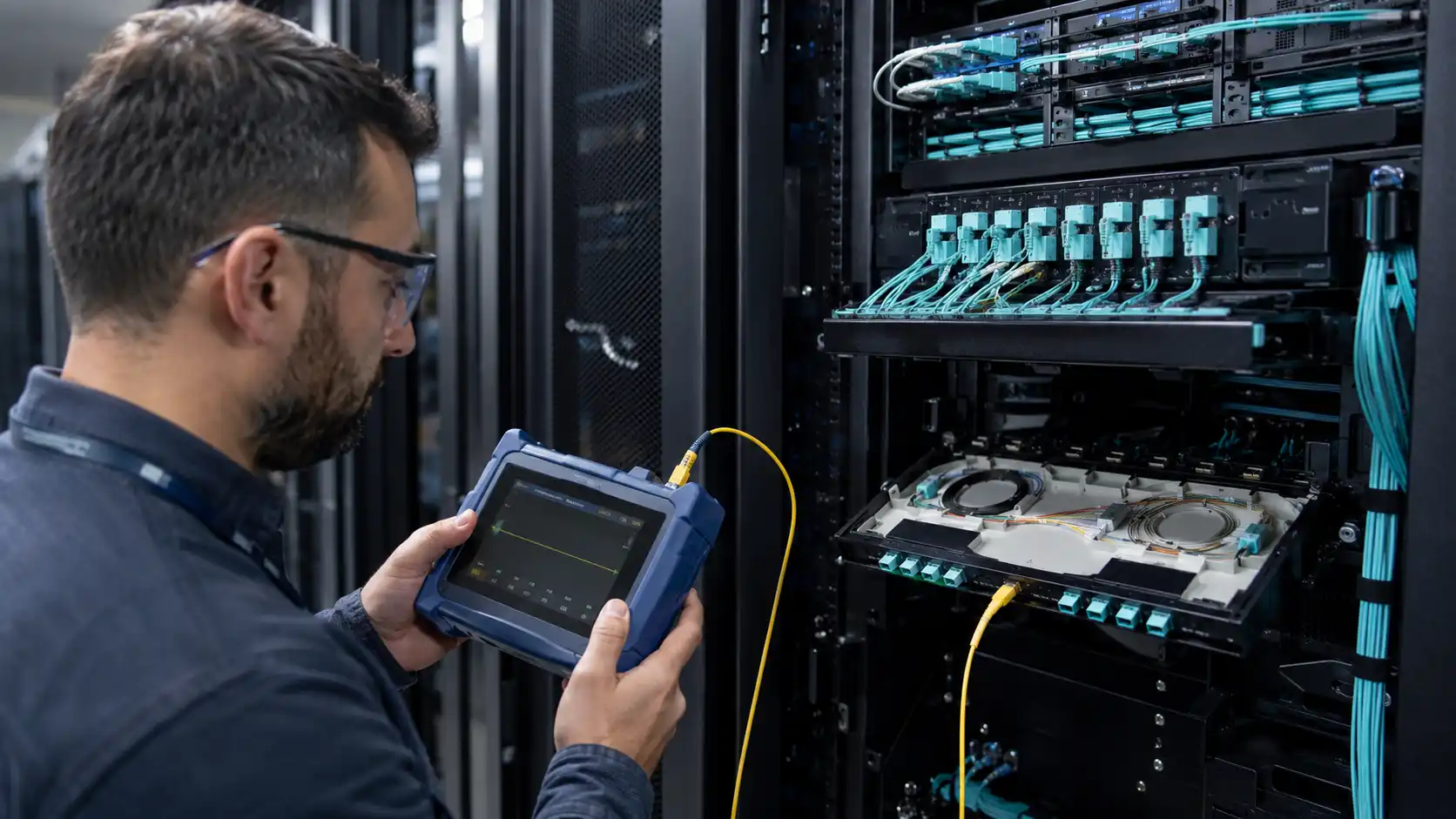
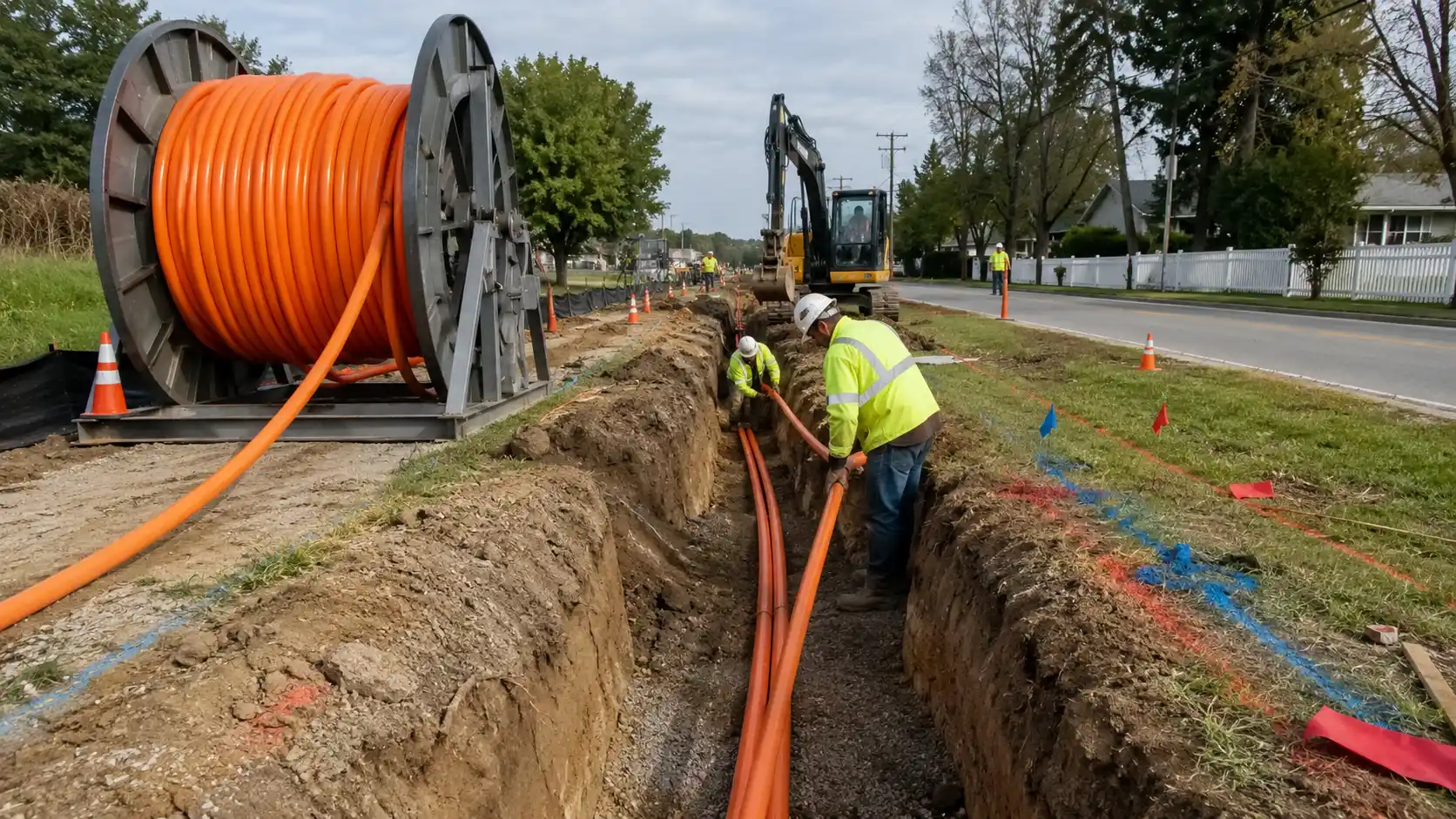
When selecting single mode fiber cable for a new installation, the choice between OS1 and OS2 comes down to your specific link distance, installation environment, optical transceiver, and future network requirements. OS1 fiber is commonly used for shorter indoor single mode links, while OS2 fiber provides lower attenuation and is preferred for longer-distance, outdoor, and scalable network deployments.
This guide explains the real differences between OS1 and OS2 fiber - including attenuation values defined by international standards, cable construction, distance capability, compatibility, and a practical selection process. If you need a quick overview of fiber cable assemblies and how single mode patch cords fit into these categories, the sections below will help.

Quick Answer: When to Choose OS1 vs OS2 Fiber
Choose OS1 fiber when your project involves indoor building cabling with shorter single mode links - for example, equipment rooms, office backbones, or internal campus connections - and when OS1 attenuation performance is sufficient for your link budget.
Choose OS2 fiber when your project requires longer transmission distances, lower attenuation, outdoor or indoor/outdoor routing, campus backbone, metro or telecom networks, or when you want more optical margin for future expansion and higher-speed optics.
A practical rule: if your route stays inside a single building and is short, OS1 can work well. If the route crosses buildings, runs outdoors, or may grow in the future, OS2 is almost always the safer investment because it provides a larger link budget margin.
What Are OS1 and OS2 Fiber Cables?

OS1 and OS2 are performance categories for single mode fiber cable, defined in the international structured cabling standard ISO/IEC 11801. Both use 9/125 µm single mode fiber, meaning a small optical core with a 125 µm cladding diameter. The underlying glass fiber in both categories is typically manufactured to ITU-T G.652 specifications - the most widely deployed single mode fiber standard globally.
The OS1/OS2 distinction is not about the glass fiber itself, but about the cabled fiber performance - specifically, how much signal loss (attenuation) the complete cable assembly is allowed to introduce per kilometre. This is an important nuance: the same G.652D fiber can appear in both OS1-rated and OS2-rated cable products, depending on the cable construction and the resulting cabled attenuation.
Do not confuse OS1 and OS2 with OM fiber types. OS1 and OS2 are single mode categories, while OM3, OM4, and OM5 are multimode fiber categories designed for different applications and transceiver types. If you are comparing multimode options, see our guides on OM1 multimode and OM2 multimode patch cords.
OS1 vs OS2 Fiber: Comparison Table

| Fiber type | Single mode (9/125 µm class) | Single mode (9/125 µm class) |
| Maximum attenuation (per ISO/IEC 11801) | 1.0 dB/km at 1310 nm and 1550 nm | 0.4 dB/km at 1310 nm, 1383 nm, and 1550 nm |
| Common cable construction | Tight-buffered (indoor) | Loose-tube or indoor/outdoor designs |
| Typical application | Indoor building backbone, equipment rooms | Outdoor backbone, campus, metro, telecom, data center interconnect |
| Distance potential | Shorter (limited by higher attenuation) | Longer (enabled by lower attenuation) |
| Relative cost | Usually lower | Usually higher (varies by construction and fiber count) |
| Future-proofing | Adequate for stable, short indoor links | Better for network expansion and higher-speed upgrades |
Always confirm the exact cable datasheet, transceiver specification, and link budget before making a final selection. The table above gives a practical overview, but your project conditions determine the right choice.
OS1 vs OS2 Fiber: Attenuation and Distance
Attenuation - the loss of optical signal as light travels through the fiber cable - is the most measurable difference between OS1 and OS2. According to ISO/IEC 11801, OS1 cabled fiber allows a maximum attenuation of 1.0 dB/km at 1310 nm and 1550 nm, while OS2 allows a maximum of only 0.4 dB/km at 1310 nm, 1383 nm, and 1550 nm.

In practical terms, this means that over the same cable length, an OS2 link loses significantly less signal than an OS1 link. The lower loss gives OS2 more room in the link budget, which translates to longer achievable distances or more margin for connection points along the route.
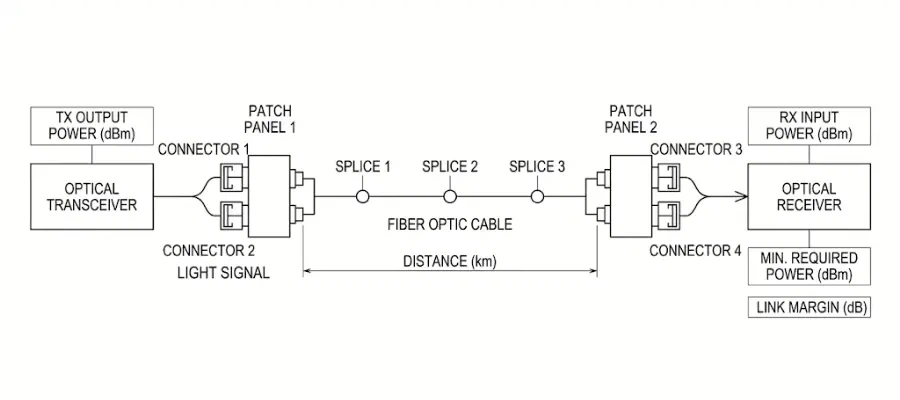
However, do not treat distance as a fixed number based on cable category alone. In real networks, the maximum reach of a link depends on several factors working together: the optical transceiver's launch power and receiver sensitivity, the operating wavelength, the fiber attenuation per kilometre, the number and quality of connectors, splice losses, patch panel losses, any bend losses in the route, and the engineering safety margin you build into the design. For example, a 10GBASE-LR SFP+ module operating at 1310 nm has a different power budget and reach than a 10GBASE-ER module at 1550 nm - even on the same cable.
In real projects, the route length is often longer than the floor-plan distance suggests. Cable paths through risers, trays, ducts, and patch panels add metres that are easy to underestimate during planning.
OS1 vs OS2 Fiber: Cable Construction
OS1 cable is most commonly built with tight-buffered construction, which makes it easier to handle inside buildings, terminate at patch panels, and route through equipment rooms. Tight-buffered cables have each fiber individually coated with a protective layer, providing good flexibility and direct connectorisation.
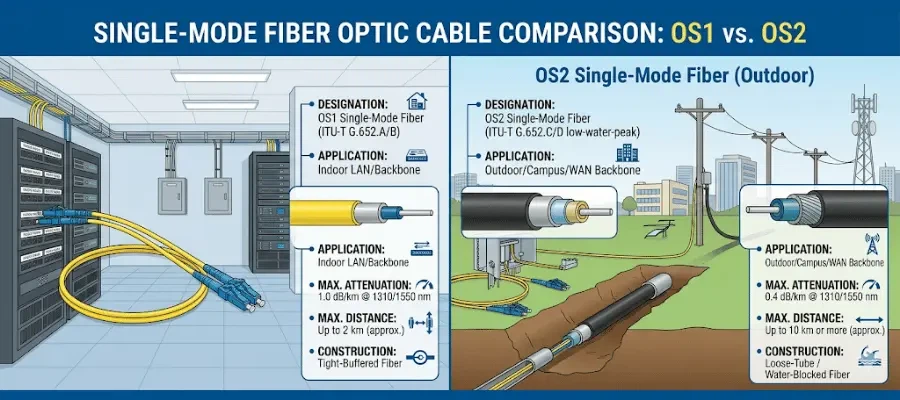
OS2 cable is more commonly associated with loose-tube construction, where fibers sit inside gel-filled or dry-blocked tubes that protect against moisture, temperature variation, and mechanical stress. This design is better suited for outdoor, underground, aerial, and campus duct environments. Many bulk fiber optic cables used in outdoor backbone networks are loose-tube OS2 designs.
That said, OS1 and OS2 should not be understood only as "indoor vs outdoor" labels. An OS2-rated cable can also be manufactured with indoor-rated jackets (LSZH, PVC, or plenum) suitable for in-building use. The critical factors are the jacket material, flame rating, water-blocking design, tensile strength, and compliance with local building codes - not simply the OS designation.
OS1 vs OS2 Fiber: Applications

Where OS1 is commonly used
OS1 is a practical choice for indoor structured cabling where distances are limited and environmental stress is low. Typical applications include office building backbone links between telecom rooms, internal data center patching over short distances, enterprise LAN backbone cabling within a single floor or building, and short campus building links where the entire route remains indoors.
Where OS2 is commonly used
OS2 is the standard choice when lower loss, longer reach, or outdoor exposure is involved. Common applications include outdoor campus backbone and building-to-building links, telecom access and aggregation networks, ISP backhaul, metropolitan area networks, data center interconnect (DCI) between facilities, and any link where future expansion is likely.
For modern data centers specifically, OS2 is often preferred even for internal patching because the lower attenuation supports high-speed optics (100G, 400G) and dense patching with more connectors in the path. A short link with too many patching points can still fail the link budget if OS1 attenuation is marginal.
OS1 vs OS2 Fiber: Standards and Specifications

The OS1 and OS2 designations originate from ISO/IEC 11801, the international generic cabling standard for customer premises. The underlying single mode fiber is typically specified to ITU-T G.652, which defines the geometrical, mechanical, and transmission attributes of standard single mode fiber. Other relevant standards include IEC 60793-2-50 (optical fiber classification), TIA-568 (North American structured cabling), and EN 50173 (European structured cabling).
When reviewing a cable datasheet, look beyond the "OS1" or "OS2" label. Verify attenuation at 1310 nm and 1550 nm, mode field diameter, bend performance (especially for tight routing), operating temperature range, cable jacket rating and fire classification, tensile strength, and whether the cable uses water-blocking or armoured construction. For fiber optic connectors and patch cords, also check the connector polish type - UPC or APC - as this affects return loss and compatibility.
OS1 vs OS2 Fiber: Compatibility and Mixing
OS1 and OS2 fiber can be physically connected if the fiber optic adapters and connector types match - LC to LC, SC to SC, and so on. However, a mixed OS1/OS2 link must be evaluated based on the weakest segment's attenuation performance and the total end-to-end loss.
Before mixing OS1 and OS2 in the same link, check that the connector type (LC, SC, FC, ST), connector polish (UPC or APC), and fiber type (single mode throughout) are consistent. Then calculate the total insertion loss including all connectors, splices, and patch panels in the path, and compare this against the transceiver's available power budget with an appropriate safety margin.
For mission-critical networks, keeping the cable plant consistent (all OS2, for example) and documenting every segment reduces troubleshooting risk and simplifies future upgrades.
How to Choose Between OS1 and OS2 Fiber
Step 1: Measure the actual route length
Start with the real cable route, not the straight-line distance between endpoints. Include all routing through cable trays, risers, ducts, cabinets, and patch panels. If the total route is short and entirely indoors, OS1 may be sufficient. If the route is long, crosses between buildings, or may be extended in the future, OS2 is the better default.
Step 2: Evaluate the installation environment
If the route leaves the building at any point, treat cable construction and jacket rating as mandatory design checks. For indoor environments, confirm the flame rating meets local building codes (LSZH, OFNR, OFNP, etc.). For outdoor environments, verify water-blocking, UV resistance, tensile strength, and temperature range. For harsh industrial or field environments, consider FTTA solutions with ruggedised connectors.
Step 3: Match the fiber with the optical transceiver
Fiber cable and optical transceiver modules must be selected together. A 10GBASE-LR SFP+ has a different reach and power budget than a 100GBASE-LR4 QSFP28, even though both use single mode fiber. Do not choose cable based only on a generic "OS1 distance" or "OS2 distance" - always compare the transceiver datasheet with the complete fiber link.
Step 4: Calculate the link budget
A basic link budget includes fiber attenuation (length × dB/km), connector loss (typically 0.3–0.5 dB per mated pair for standard connectors), splice loss (typically 0.1 dB per fusion splice), any patch panel or cross-connect losses, bend loss allowance, and an engineering safety margin (usually 2–3 dB). If the total loss is below the optical module's available power budget, the link should operate reliably. If the margin is too tight, consider lower-loss cable, fewer connection points, higher-quality connectors, or a different transceiver.
Step 5: Plan for future expansion
If your network may later require longer distances, additional intermediate patching points, or migration to higher-speed optics (such as 100G or 400G), OS2 provides more headroom. Future-proofing is not only about speed - it also means leaving enough optical margin for equipment upgrades and extra connection points that get added over time.
OS1 vs OS2 Fiber: Selection Scenarios
| Scenario | Key requirement | Recommended cable | Why |
|---|---|---|---|
| 300 m indoor riser backbone in an office building | Short distance, indoor, cost-sensitive | OS1 may be sufficient | Route is short, entirely indoors, and the link budget is comfortable with 1.0 dB/km attenuation |
| Data center patching with high-speed optics and dense cross-connects | Low loss, scalability, high connector count | OS2 preferred | Multiple patch points consume budget; 0.4 dB/km leaves more margin for 100G/400G optics |
| 2 km campus duct route between two buildings | Outdoor, longer distance, environmental protection | OS2 with outdoor loose-tube construction | Route is exposed to outdoor conditions; lower attenuation supports the distance with margin |
| Telecom access or metro backbone network | Long distance, low loss, carrier-grade reliability | OS2 | Low attenuation is essential for long-haul links; loose-tube construction provides environmental protection |
Common Mistakes When Choosing OS1 or OS2 Fiber
Choosing only by distance.
Distance matters, but it is only one variable in the link budget. The transceiver power budget, connector count, splice quality, and safety margin all affect whether a link works reliably. A 500 m link with six patch points and dirty connectors can fail even on OS2 cable.
Assuming OS2 is only for outdoor use.
OS2 cable can be manufactured with indoor-rated jacket materials. Many modern data centers and campus buildings use OS2 fiber indoors because the lower attenuation provides better scalability - especially as link speeds increase.
Ignoring the link budget.
Selecting the right cable category does not guarantee link performance. Too many connectors, poor splices, tight bends, or dirty end faces can erode the optical margin below what the transceiver requires. Always calculate and document the link budget.
Confusing OS1/OS2 with OM fiber types.
OS1 and OS2 are single mode categories. OM3 and OM4 are multimode categories. They are not interchangeable and require different transceivers.
Assuming OS2 automatically supports 100G or 400G.
The fiber cable is only one part of the link. High-speed operation depends on the optical transceiver, wavelength plan, connector quality, fiber condition, and total link budget working together.
Before You Order: OS1/OS2 Cable Specification Checklist
Before placing a cable order, confirm the following specifications with your supplier to make sure the product matches your installation requirements:
- Cable category: OS1 or OS2
- Fiber count (number of cores)
- Fiber standard: G.652D or as specified
- Cable construction: tight-buffered, loose-tube, or indoor/outdoor
- Jacket type and fire rating: LSZH, PVC, OFNR, OFNP, or outdoor-rated
- Connector type if ordering patch cords: LC, SC, FC, ST
- Connector polish: UPC or APC
- Insertion loss and return loss per the manufacturer's test report
- Length tolerance
- Operating temperature range
- Any special requirements: armoured, water-blocked, rodent-resistant, etc.
If you need help specifying the right cable, you can contact our technical team for datasheet support and link budget guidance.
FAQ: OS1 vs OS2 Fiber
What is the main difference between OS1 and OS2 fiber?
The main difference is cabled attenuation performance. OS1 allows a maximum of 1.0 dB/km, while OS2 allows a maximum of 0.4 dB/km, as defined in ISO/IEC 11801. This lower attenuation makes OS2 suitable for longer distances and more demanding link budgets.
Is OS2 always better than OS1?
Not necessarily. For short indoor links where the link budget is comfortable, OS1 can be sufficient and more cost-effective. OS2 provides better performance for longer distances, higher connector counts, and future expansion - but every link should be evaluated on its own requirements.
Can OS2 fiber be used indoors?
Yes. OS2 fiber can be used indoors if the cable jacket, flame rating, and construction comply with the relevant building codes. The OS2 designation defines attenuation performance, not building-code compliance - that depends on the cable jacket and construction.
Can OS1 and OS2 fiber be mixed in the same link?
They can be physically connected if the connector types and polish are compatible. However, the total link performance should be calculated based on the attenuation of each segment plus all connector and splice losses. For critical links, a consistent cable category throughout the path is preferred.
Do OS1 and OS2 use the same connectors?
Yes, both can use the same fiber optic connector types - LC, SC, FC, ST, and others. You must also ensure the connector polish type (UPC or APC) is consistent across the link.
Does OS2 automatically support 100G or 400G?
No. The cable category is only one factor. 100G and 400G support depends on the optical transceiver module, wavelength, link distance, connector quality, and the total link budget. OS2 provides the lower attenuation needed for these high-speed optics, but the complete link must be validated.
References and Technical Sources
- ISO/IEC 11801-1:2017 - Generic cabling for customer premises (defines OS1 and OS2 categories)
- ITU-T G.652 (2024) - Characteristics of a single-mode optical fibre and cable
- IEC 60793-2-50 - Optical fibres, product specifications for class B single-mode fibres
- TIA-568 - Commercial Building Telecommunications Cabling Standard (North America)
- EN 50173 - Information technology, generic cabling systems (European standard aligned with ISO/IEC 11801)
Reviewed by: FOCC Fiber Optic Technical Team. Last updated: 2025.