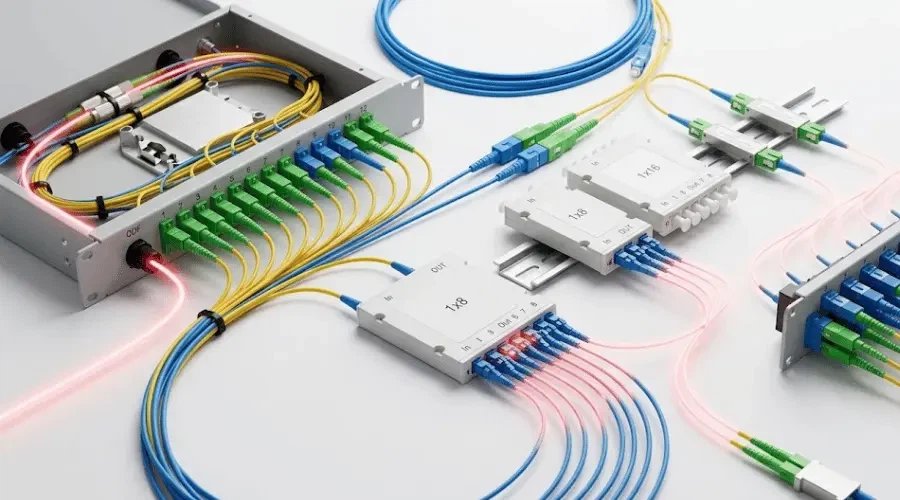
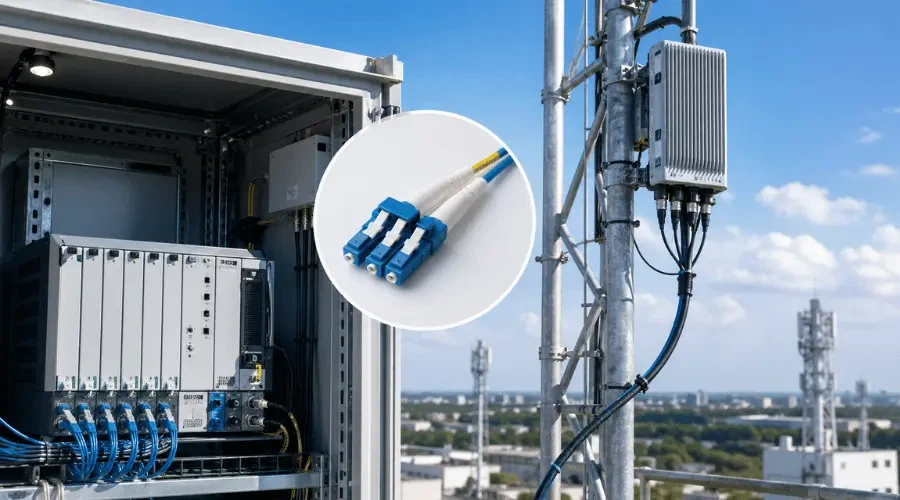
Optical attenuators occupy a peculiar position in fibre infrastructure-devices engineered specifically to degrade signal performance. The fundamental premise seems counterintuitive in an industry obsessed with minimising loss: deliberately introducing insertion loss into transmission paths where engineers have spent decades eliminating every fractional decibel of attenuation. Yet receiver saturation remains a persistent operational reality, particularly in single-mode deployments where high-power laser sources routinely exceed photodetector input thresholds by margins that would destroy sensitive APD elements outright.
The Saturation Problem Nobody Talks About
Specification sheets for optical transceivers list maximum receive power alongside minimum sensitivity. The minimum gets all the attention during link budget calculations. Maximum receive power sits there quietly, usually around -3dBm to -1dBm for typical 10G SFP+ modules, waiting to cause problems when someone installs a 40km optic on a 2km span.
I've seen this exact scenario three times in the past eighteen months. Data centre operator orders long-reach transceivers because procurement got a volume discount. Technicians install them on inter-building links that barely stretch 500 metres. Launch power hits the receiver at +2dBm. The link refuses to establish. Everyone assumes the transceiver is defective.
It's not defective. The photodiode is being blinded.
The error codes rarely help. Most switch firmware reports "no signal" or "link down" identically whether the receiver sees too little light or too much. Experienced techs learn to check both conditions. Everyone else replaces transceivers until someone accidentally grabs an appropriate reach module.
Attenuators solve this. A 10dB fixed attenuator on the receive side drops that +2dBm to -8dBm-safely within operating range. The link establishes. The problem disappears. The solution costs perhaps fifteen dollars.
Multimode Doesn't Care
Worth stating explicitly: multimode infrastructure almost never requires attenuators.
VCSEL sources in multimode transceivers launch maybe -3dBm to 0dBm. Multimode receivers handle -1dBm maximum input comfortably. The math doesn't produce oversaturation scenarios under normal conditions. Even direct patch connections between adjacent ports-absolute minimum loss configurations-stay within acceptable bounds.
Single-mode is where the trouble lives. DFB lasers pushing +3dBm launch power into fibres designed for 80km transmission distances. Deploy those optics across a 50-metre cross-connect and the receiver doesn't stand a chance.
The Return Loss Trap
Gap-loss attenuators are cheap. They're also problematic in ways their pricing doesn't reflect.
The operating principle is elegant: create an air gap between fibre endfaces, allow the beam to diverge, collect only a portion of that diverged light into the receiving fibre. Attenuation achieved. Simple physics.
The physics also produces Fresnel reflections at those air-glass interfaces. Light bounces back toward the source. In a CATV headend running analogue video, those reflections manifest as ghosting. In a DFB laser cavity, they cause mode hopping and linewidth degradation. In an EDFA, they can trigger parasitic lasing if the reflected power is sufficient.

I spent an afternoon troubleshooting intermittent BER spikes on a DWDM span where someone had installed a gap-loss attenuator without checking return loss specs. The attenuator itself measured fine-proper insertion loss, correct attenuation value, mechanically sound. But its return loss was 14dB. The transmitter's laser was unhappy about 4% of its power bouncing back into the cavity on every pulse.
Replaced it with a doped-fibre attenuator. Problem vanished.
For single-mode applications-especially anything running coherent modulation or high symbol rates-return loss specifications matter more than the attenuation value printed on the housing. Minimum 45dB return loss for serious deployments. 55dB or better if you're running anything above 100G.
Fixed Versus Variable: A False Economy
Fixed attenuators cost five to twenty dollars depending on connector type and quality. Variable attenuators start around fifty dollars for manual adjustment types and climb rapidly from there.
The instinct is to buy fixed values matching calculated requirements. A 7dB fixed attenuator costs less than a variable unit. Why pay extra for adjustability you don't need?
Because you calculated wrong.
Or because the transceiver specifications were optimistic. Or because the patch panel adds unexpected loss. Or because someone swapped fibre routes during a maintenance window and nobody updated the documentation. Or because the original link budget assumed connectors that weren't actually installed.
I've watched technicians stack fixed attenuators-a 5dB and a 3dB mated together-trying to approximate the attenuation their link actually requires. The cascaded reflections from multiple air-gap devices compound the return loss problem described above. Two cheap attenuators performing worse than one proper variable unit would.
Variable attenuators make sense for testing and commissioning. You dial in exactly the attenuation required, verify link performance, then optionally replace with a fixed unit matching that measured value. For permanent installations where the optical power budget is well-characterised and stable, fixed attenuators are fine. For everything else, variable units earn their cost premium through operational flexibility.

Where MEMS Changed Everything
Traditional variable attenuators used mechanical mechanisms-rotating neutral density filters, adjustable air gaps, blocking elements moved into the beam path. These worked. They also drifted, wore out, required recalibration, and responded slowly to adjustment commands.
MEMS-based variable optical attenuators replaced all that complexity with a micromirror. Electrostatically actuated, sub-millisecond response times, no mechanical wear surfaces, negligible polarisation dependence. The technology matured rapidly through the DWDM buildout era when equipment vendors needed per-channel power equalisation in optical amplifier chains.
A MEMS VOA inside an EDFA isn't there to prevent receiver saturation. It's there to flatten gain tilt-ensuring that channels at 1530nm don't emerge from the amplifier 3dB stronger than channels at 1560nm simply because the erbium gain spectrum isn't flat. Forty or eighty of these devices, one per wavelength, adjusting continuously as channel loading changes.
The alternative was gain-flattening filters. Passive, wavelength-selective, fixed attenuation profiles matching the inverse of the expected gain shape. These work beautifully when channel loading is static. When customers add and drop wavelengths dynamically, the gain shape changes, and fixed filters can't compensate.
MEMS VOAs made reconfigurable optical networks commercially viable. That's not an overstatement. Without dynamic per-channel power control, ROADM architectures would produce unmanageable optical signal-to-noise ratio disparities across wavelength-dependent path lengths.
Liquid Crystal: The Road Not Taken
Liquid crystal variable attenuators emerged as a competing technology to MEMS. No moving parts whatsoever-attenuation controlled by voltage-induced birefringence changes in the LC material. Faster response than mechanical approaches, no wear mechanisms, solid-state reliability.
They've found niches. Laboratory instrumentation. Certain specialised applications. They never displaced MEMS in mainstream telecom deployments.
Temperature sensitivity killed them for field applications. LC material properties shift with temperature, requiring compensation circuits and frequent recalibration in environments without climate control. Data centre conditions are manageable; outside plant enclosures experiencing -40°C winters and +50°C summers are not.
The insertion loss was also higher than MEMS alternatives. Half a dB here, three-quarters of a dB there-it accumulates in systems where every tenth of a dB matters for OSNR.
Placement Matters More Than Specification
Attenuators belong at the receiver end of the link. Not the transmitter end. Not somewhere in the middle.
This isn't arbitrary. Placing attenuation at the receiver serves two purposes beyond the obvious saturation prevention: any reflections from the attenuator's own interfaces get attenuated on their return path to the source, and power measurements at the receiver remain straightforward-you measure before the attenuator, after the attenuator, done.
Put the attenuator at the transmitter end and you've accomplished nothing for return loss management. Every connector and splice downstream contributes reflections that reach the source at full amplitude. The attenuator blocks forward power but does nothing for backwards-propagating light that was never attenuated.
I've encountered installations where someone placed attenuators immediately after the transmitter "to protect the fibre" from excessive power. Fibre doesn't need protection from a few milliwatts. Receivers need protection. The placement made no optical sense but persisted through multiple maintenance cycles because it was documented and nobody questioned documented practice.
Calibration Realities
The attenuator package says 10dB. The actual attenuation might be 9.7dB. Or 10.4dB. Or 11.2dB depending on wavelength, temperature, and how much the manufacturer cared about specification compliance.
For most applications, this tolerance band is irrelevant. You need approximately 10dB of attenuation to bring receiver power into range. Whether you achieve 9.5dB or 10.5dB doesn't affect link viability.
For precision applications-acceptance testing, OSNR measurements, amplifier characterisation-attenuator accuracy matters significantly. High-end variable attenuators from test equipment vendors include thousands of calibration points mapping actual attenuation to dial settings across multiple wavelengths and power levels. The instruments cost accordingly.
I've used a $15,000 programmable attenuator for characterising receiver sensitivity. The attenuation accuracy was ±0.05dB across the C-band with 0.01dB resolution. That precision is necessary when you're measuring whether a receiver's sensitivity is -28.0dBm or -28.3dBm. It's absurd overkill for preventing saturation in a production link.
Match the instrument to the application. Don't deploy laboratory-grade attenuators in patch panels. Don't troubleshoot DWDM systems with attenuators from the bargain bin.
The Pencil Wrap
Wikipedia mentions wrapping fibre around a pencil as a temporary attenuation method. This appears occasionally in field troubleshooting when proper attenuators aren't available.
It works, sort of. Bend-induced attenuation is real physics. Tight bends force light into the cladding, reducing transmitted power.
Don't do this.
The attenuation is unpredictable-dependent on bend radius, number of wraps, fibre type, and wavelength. It's unstable-the fibre relaxes, attenuation changes. It's destructive-repeated stress fractures the glass. It introduces mode coupling in multimode fibre, messing with launch conditions in ways that affect measurement accuracy.
If someone wraps fibre around a pencil to make a link work, that's a sign to stop and acquire proper equipment. It's not a solution. It's desperation documented as technique.
What Changes With 400G and Beyond
Higher symbol rates increase sensitivity to return loss. The phase noise from back-reflected power matters more at 64-QAM than at OOK. Attenuator return loss specifications that were acceptable for 10G become problematic at 400G.
Coherent DSP receivers have wider dynamic range than direct-detect receivers, reducing some saturation concerns. The optical signal processing that enables coherent detection also provides more tolerance for power variation. This doesn't eliminate the need for attenuators-it shifts the application profile.
Silicon photonics integration is putting VOA functionality on-chip in transceiver designs. If the transmitter includes an integrated variable attenuator, external attenuation becomes unnecessary for some deployment scenarios. The transceiver itself adjusts launch power to match link requirements.
That integration won't eliminate the external attenuator market. Legacy equipment lacks integrated power control. Test applications require calibrated external attenuation. Retrofit installations need solutions that don't require transceiver replacement.
But the balance shifts. Purpose-built attenuator modules remain necessary; their market penetration changes as transceiver intelligence increases.
Honest Assessment
Attenuators aren't complicated devices. They reduce optical power. The physics is straightforward. The implementation options are well-understood.
The complications arise from deployment context: choosing appropriate attenuation values without adequate power measurements, selecting attenuator technologies mismatched to application requirements, placing devices in positions that don't address the actual problems, accepting return loss specifications that create new issues while solving old ones.
Every attenuator installation is an admission that something else in the link design didn't match operational reality. The receiver is too sensitive for the transmitter power. The span is too short for the optic specification. The channel loading differs from the original design assumptions.
Attenuators patch over these mismatches. They do it effectively, cheaply, and reliably when properly selected. They're not elegant. They're pragmatic.
In production optical networks, pragmatic solutions that work beat elegant solutions that don't. Attenuators work.