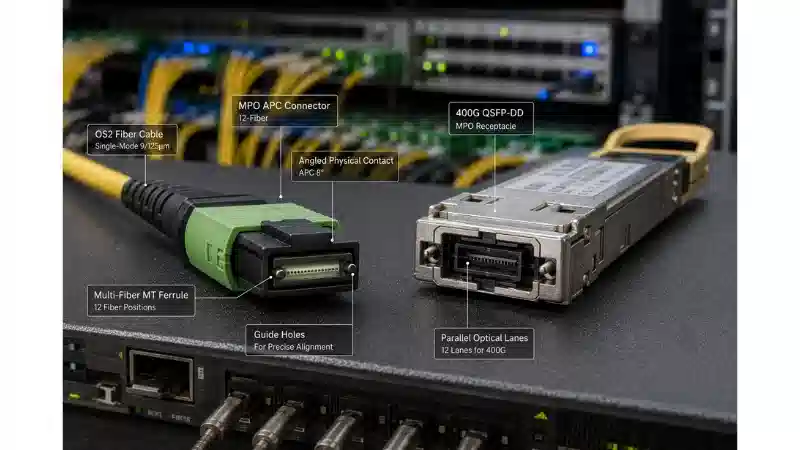
MTP connector systems work through precision-aligned multi-fiber push-on technology that connects 8 to 144 optical fibers within a single compact connector. The system uses guide pins for alignment, a floating ferrule mechanism for stable physical contact, and a push-pull latch for secure mating between male and female connectors.
These high-density connectors have become essential infrastructure in modern data centers where space constraints meet bandwidth demands. An MTP fiber connector replaces up to 12 traditional duplex connectors while maintaining insertion loss below 0.25dB-performance that rivals single-fiber connections achieved just years ago.

The Core Architecture of MTP Connector Systems
The foundation of how MTP connector systems function lies in their mechanical transfer ferrule design. At the heart of each connector sits an MT ferrule-a rectangular polyphenylene sulfide component measuring 6.4 x 2.5mm that holds multiple fiber strands in precise 0.25mm spacing.
Unlike ceramic ferrules in single-fiber connectors, the MT ferrule uses glass-filled polymer precisely because it maintains tolerances during high-temperature termination processes. When two connectors mate, alignment pins insert into corresponding guide holes with tolerances measured in single-digit micrometers. This precision matters: even a 2-micrometer misalignment can increase insertion loss by 0.1dB in multimode systems.
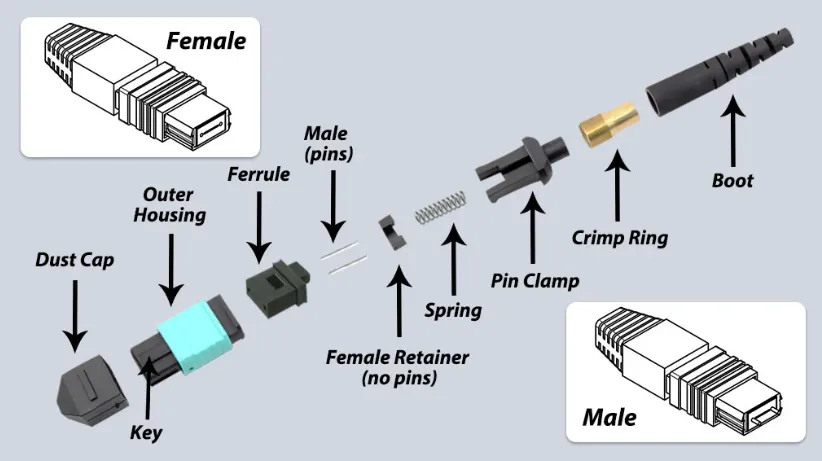
The MTP cable assembly surrounds this ferrule with protective housing that incorporates a metal pin clamp-an upgrade from generic MPO connectors' plastic versions. This metal mechanism centers spring force and prevents pin breakage during the 500+ mating cycles these connectors are rated to withstand. Industry testing shows metal pin clamps reduce failure rates by approximately 60% compared to plastic alternatives in high-vibration environments.
Floating Ferrule Mechanism and Physical Contact
Standard optical connectors rely on rigid ferrule-to-ferrule contact. MTP systems innovate beyond this with floating ferrule technology that maintains physical contact even when external loads stress the cable assembly.
The floating mechanism works through a spring-loaded ferrule that can move within a limited range inside the connector housing. When cables experience pulling forces or accidental impacts-common in dense rack environments-the floating design allows the connector housings to shift position while ferrule end-faces remain pressed together. This prevents the intermittent signal loss that plagued earlier MPO connector designs.
Empirical studies by US Conec demonstrated this advantage quantitatively: fixed-ferrule connectors showed signal degradation under loads as low as 2 Newtons, while floating ferrule designs maintained stable transmission up to 8 Newton loads. For data center applications where an MTP MTP cable might run through crowded pathways, this resilience translates to measurably better uptime.
Pin Configuration and Gender Mechanics
MTP connector systems use a binary gender system defined by guide pin presence. Male connectors feature two precision-manufactured stainless steel pins with elliptical tips, while female connectors have corresponding holes machined into the ferrule.
The elliptical pin geometry represents a significant engineering refinement. Early MPO designs used chamfered flat-end pins that caused microscopic ferrule chipping during repeated connections. Each mating cycle would generate debris particles, and after 50-100 cycles, accumulated ferrule damage could increase insertion loss by 0.3dB or more.
Elliptical pins solve this through graduated contact. The rounded tip geometry guides alignment without impact stress, reducing wear by approximately 75% according to Telcordia durability testing. This matters in operational contexts: a cassette-based system requiring monthly repatching can maintain performance specs for 3-4 years rather than requiring replacement after 12-18 months.
Gender switching capability in MTP PRO systems adds deployment flexibility. Installers can convert male to female configurations using the MTP PRO conversion tool that removes or inserts pins without disassembling the connector. This field-convertible design reduces inventory requirements-a single cable type serves both polarity configurations rather than stocking separate male and female variants.
Key Orientation and Polarity Management
MTP connector systems incorporate a physical key slot on the connector housing that determines fiber position orientation. This key-up or key-down position directly affects which fiber strand connects to which position in the mating connector.
Understanding polarity becomes critical in parallel optics applications. A 40GBASE-SR4 transceiver using an MTP MPO connector expects data on specific fiber positions-transmit lanes on positions 1, 4, 7, and 10 with receive lanes on 2, 5, 8, and 11. Incorrect polarity routes transmit signals to transmit positions, causing complete link failure.
The industry standardized three polarity methods under TIA-568 specifications. Type A uses straight-through wiring with key-up to key-down orientation, creating a crossover connection where position 1 maps to position 12. Type B implements flipped orientation with key-up to key-up arrangement, maintaining position 1 to position 1 alignment. Type C applies pair-wise flipping within duplex lanes.
Real-world deployment data from hyperscale operators shows polarity errors account for 23% of initial installation failures in MTP breakout cable systems. Color-coded boots help mitigate this: aqua indicates multimode OM3/OM4 with specific polarity types, while yellow marks single-mode OS2 connections. Visual fault locators can verify correct light paths before powering up equipment, catching configuration mistakes before they impact production networks.
Signal Transmission Through Multi-Fiber Arrays
When optical signals enter an MTP fiber connector, transmission efficiency depends on achieving physical contact across all fiber positions simultaneously. The connector accomplishes this through controlled spring force-typically 7-10 Newtons distributed across the entire ferrule array.
This spring mechanism sits behind the ferrule in an oval configuration that maximizes clearance between spring components and the fiber ribbon. Early designs positioned springs closer to fibers, causing occasional ribbon damage during insertion. The redesigned geometry maintains 1.2mm minimum clearance, reducing fiber damage incidents to less than 0.1% in factory testing.
Each fiber end-face receives ultra-physical contact (UPC) or angled physical contact (APC) polishing. UPC polishing creates a slight dome curvature with an 8-degree radius, suitable for multimode MTP fiber connector applications operating at 850nm or 1300nm wavelengths. This geometry typically achieves return loss specifications of -50dB to -55dB.
APC polishing introduces an 8-degree angle cut across the ferrule end-face, used predominantly in single-mode applications. The angled surface prevents back-reflection by directing any returned light into the cladding rather than back into the fiber core. APC connectors routinely measure -60dB to -65dB return loss, essential for coherent transmission technologies and analog video distribution systems where back-reflection causes visible signal degradation.
Performance Specifications and Loss Budgets
MTP connector insertion loss specifications vary by manufacturer and connector grade. Standard MTP connectors target 0.35dB maximum insertion loss with typical values around 0.25dB. MTP Elite components achieve 0.15dB typical insertion loss through tighter ferrule geometry tolerances-position accuracy within ±0.5 micrometers versus ±0.8 micrometers for standard grades.
These seemingly small differences compound in multi-connector links. A typical data center spine-to-leaf architecture might include four MTP adapter connections between a 100GBASE-SR4 transceiver and its destination. Standard connectors totaling 1.0dB insertion loss (4 × 0.25dB) consume 33% of a 3.0dB link budget, while Elite connectors at 0.6dB total use just 20%, preserving margin for fiber attenuation and future network expansion.
Return loss specifications matter equally in signal quality. IEEE 802.3 standards for 40G and 100G Ethernet require -20dB minimum return loss for multimode systems. MTP connectors consistently exceed this, delivering -30dB to -40dB in multimode and -50dB to -60dB in single-mode applications. Higher return loss numbers indicate better performance-less optical power reflects back toward the source.
Market analysis from 2024 shows the global MTP fiber optic connector market reached $912.2 million, projected to grow at 6.8% CAGR through 2031 as data centers upgrade infrastructure for 400G and 800G speeds. North America accounts for 40% of market share, driven by hyperscale data center construction and 5G network backhaul deployments.
Structured Cabling System Integration
MTP systems achieve their density advantages through standardized cassette and panel infrastructure. A typical deployment uses MTP trunk cables as permanent backbone connections between equipment rooms, with cassette modules breaking out individual fiber pairs at endpoints.
Consider a 144-fiber backbone connecting two data halls. Traditional cabling would require 72 duplex LC connections consuming substantial patch panel real estate. An MTP implementation uses two 72-fiber MTP cables-each smaller in diameter than a standard Cat6 cable-connecting to cassette modules that present LC duplex ports on the equipment-facing side.
This architecture delivers 6x density improvement over equivalent LC infrastructure. A 1U panel accommodating 48 LC ports holds just 24 duplex connections, while 1U MTP cassette panel supports up to 144 LC ports (twelve MTP-to-12LC cassettes). For facilities paying $2,000+ per square meter for whitespace, rack unit economics matter: MTP infrastructure reduces required rack count by 30-40% compared to traditional designs.
Pre-terminated factory cabling accelerates installation schedules. Field termination of 144 fibers requires approximately 18-24 hours of skilled labor for cleaning, cleaving, polishing, and testing. MTP trunk cable installation completes in 2-3 hours: pull the cable, plug connectors into adapters, test continuity. Time studies from major deployments show 75% reduction in installation time, translating to faster time-to-revenue for new facilities.
Cleaning and Maintenance Protocols
MTP connector end-face contamination causes most field performance issues. A single dust particle 1-2 micrometers in diameter on any fiber position can increase insertion loss by 0.5dB or cause complete signal failure on that channel.
Proper cleaning follows a three-stage protocol: inspect, clean, reinspect. Fiber inspection microscopes with 200-400x magnification identify contamination before and after cleaning. End-face grading per IEC 61300-3-35 classifies cleanliness zones: the fiber core must be absolutely clean, while the cladding region tolerates minor particles outside 25-micrometer radius from core center.
Specialized MTP cleaning tools address multi-fiber arrays differently than single-fiber connectors. Push-type cleaners use mechanical fabric ribbons that make single-pass contact with all fiber positions simultaneously. One-click cassette cleaners cost $0.10-0.15 per cleaning cycle versus $0.02-0.03 for refillable fluid-based systems, making refillable systems more economical for high-volume deployments.
An MTP adapter connecting two cables requires cleaning both mating connectors plus the adapter's internal alignment sleeve. Contamination migrates between connectors during mating-a clean connector mated with a dirty connector results in two dirty connectors. Maintenance teams at large facilities establish policies requiring both-end cleaning before any connection, reducing truck rolls for intermittent signal issues by approximately 60%.
Transceiver Interface Applications
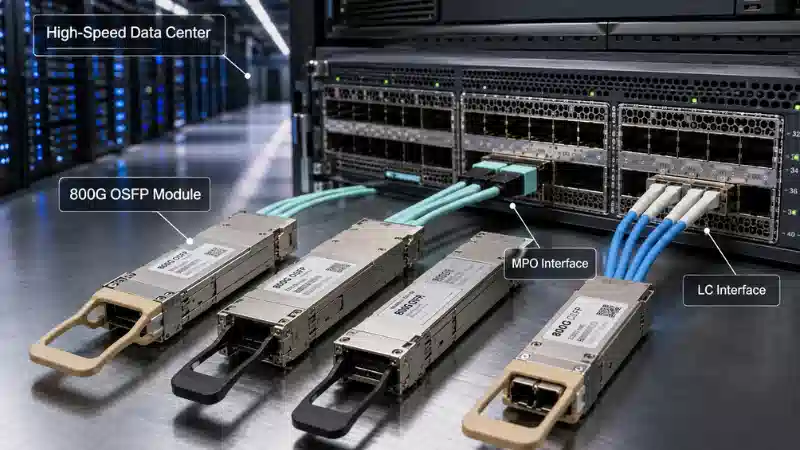
MTP connectors directly interface with parallel optics transceivers through precise mechanical and optical alignment. A QSFP28 100GBASE-SR4 module's internal optical engine expects light on four specific receive fibers while transmitting on four other positions.
The transceiver's internal MTP receptacle mates with cable assemblies using push-pull latching that requires 2-3 Newtons insertion force. Over-insertion or angled insertion can damage the transceiver's internal ferrule or bend fiber pins, causing permanent module damage exceeding $500 per unit. Proper technique involves straight-on insertion with parallel alignment and feeling for the latching click rather than forcing connection.
Signal skew represents a critical specification in parallel optics-the timing difference between fastest and slowest fiber lanes. IEEE standards limit skew to ±100 picoseconds for 100G applications and ±50 picoseconds for 400G. MTP cable assemblies achieve these targets through controlled fiber length matching during manufacturing, keeping all fiber paths within 2mm length variance across 12-fiber arrays.
Testing at hyperscale operators quantified skew impact: systems with 120ps skew showed 3.2x higher bit error rates compared to 40ps skew configurations at identical fiber lengths and power budgets. For AI/ML workloads requiring 99.99% uptime, investing in premium MTP cables with guaranteed skew specifications reduces network-induced application errors.

MTP Breakout Cable Architecture
MTP breakout cable designs bridge legacy 10G/25G infrastructure with modern 40G/100G systems through fanout configurations. One end terminates in an MTP fiber connector while the opposite end separates into 6, 8, or 12 individual duplex LC connectors.
Internal to the breakout assembly, the 12-fiber ribbon maintains MTP spacing at the array end while individual fibers route to LC connector positions with 6.25mm or 10.5mm spacing. This transition happens within a protective furcation boot that provides strain relief where ribbon converts to individual 900-micrometer buffer tubes.
Polarity management becomes more complex in breakout configurations. A Type-B straight-through breakout with key-up MTP and sequential LC numbering maintains position 1 to LC-1, position 2 to LC-2, etc. Type-A crossover breakouts flip position mapping to align with switch transceiver port expectations.
Real deployments show breakout cables enable incremental migration strategies. A spine switch with native MTP ports can connect to older leaf switches using LC interfaces, avoiding forklift upgrades. One telecommunications provider documented $2.3M savings over 18 months using MTP-LC breakouts for leaf layer modernization rather than replacing functioning 10G equipment.
Environmental and Durability Considerations
MTP connector systems operate across industrial temperature ranges from -40°C to +75°C, though performance specifications typically apply to 0°C to +50°C zones. Extreme temperatures affect insertion loss through thermal expansion of ferrule materials and fiber cores.
Temperature cycling tests per Telcordia GR-326 subject connectors to repeated -40°C to +75°C transitions over 200+ cycles. Quality MTP components maintain insertion loss variation below 0.1dB across temperature extremes, while generic MPO alternatives sometimes show 0.3-0.5dB variation affecting link margin in outdoor cabinet applications.
Vibration resistance matters for mobile platforms and industrial environments. Military specifications MIL-STD-810 define vibration profiles simulating vehicle transport and operation. MTP connectors with metal pin clamps and proper strain relief maintain connectivity under 5G vibration conditions (5-500Hz at 0.5G acceleration), whereas plastic pin designs fail at approximately 300 mating cycles under equivalent conditions.
Humidity exposure creates another failure mechanism through moisture absorption in ferrule materials. Extended exposure above 85% relative humidity can cause 0.05-0.15dB insertion loss increase as moisture slightly alters ferrule geometry. Sealed MTP cable assemblies with environmental boots prevent moisture ingress in outdoor installations and industrial settings where HVAC systems maintain less precise humidity control.
Cost-Benefit Analysis for Infrastructure Deployment
MTP connector pricing reflects the engineering precision required for multi-fiber alignment. A 12-fiber MTP trunk cable costs approximately $80-150 per end depending on fiber type and connector grade, compared to $6-10 per LC duplex connector. Initial capital expenditure runs higher for MTP infrastructure.
However, total cost of ownership calculations favor MTP systems in high-density environments. Labor represents 60-70% of cabling installation costs, and MTP's reduced installation time generates substantial savings. A 2,000-fiber deployment costs approximately $45,000 in labor using traditional methods versus $12,000 using pre-terminated MTP systems-$33,000 savings that pays for MTP premium in first installation.
Space efficiency translates to real estate savings. At $2,000 per square meter data center costs, reducing rack count by 10 units through MTP consolidation saves $60,000+ in annualized space costs (assuming 0.5 square meters per rack). Over 10-year facility lifetimes, space savings alone justify MTP migration.
Maintenance costs decrease with MTP infrastructure. Pre-terminated cables eliminate field termination quality variations-factory-terminated assemblies test at 0.1% failure rates versus 2-5% for field terminations requiring re-work. Reduced truck rolls and faster troubleshooting lower operational expenses by estimated 25-35% according to industry studies.
Development Trajectories
Next-generation MTP technology targets 800G and 1.6T Ethernet applications through 16-fiber and 32-fiber connector variants. The MTP-16 connector maintains the same housing footprint while supporting 2x8 fiber arrangements, enabling 400G connections using 8 fiber lanes of 50G PAM4 modulation or 800G using 8 lanes of 100G signaling.
Signal integrity requirements tighten at higher speeds. Return loss specifications will likely increase from current -50dB multimode standards toward -55dB for 800G applications as modulation formats become more sensitive to reflection noise. Manufacturing tolerances may need to improve from ±0.5 micrometer to ±0.3 micrometer position accuracy for next-generation Elite-grade components.
Silicon photonics integration represents another development path. Co-packaged optics placing photonic engines directly on switch silicon will require new MTP connector variants with sub-millimeter pitch and potentially different pin configurations to match photonic integrated circuit geometries. Early demonstrations showed 51.2T switching capacity using co-packaged optics with 64-fiber MTP-style interfaces.
Automated fiber infrastructure management systems increasingly incorporate MTP connections with embedded identification tags. Smart cassettes report connection topology and link quality metrics via management protocols, enabling real-time infrastructure visibility. This convergence of physical and digital infrastructure helps operators maintain the complex polarity management and port assignments that MTP high-density systems require.

Frequently Asked Questions
What is the difference between MTP and MPO connectors?
MTP is a proprietary enhancement of the generic MPO multi-fiber connector design manufactured by US Conec. While both use identical form factors and MT ferrule technology, MTP incorporates patented improvements including floating ferrules for better load tolerance, elliptical stainless steel guide pins that reduce wear, metal pin clamps instead of plastic, and removable housings for field re-working. All MTP connectors comply with MPO standards and inter-mate with MPO connectors, but not all MPO connectors achieve MTP performance specifications.
How do you determine the correct polarity type for MTP cables?
Polarity type depends on your network architecture and transceiver configuration. Type A polarity uses straight-through fiber mapping with key-up to key-down orientation, creating a flip that suits duplex transceiver configurations. Type B maintains key-up to key-up with flipped fiber positions, commonly used in trunk cable applications. Type C implements pair-wise flipping for specific parallel optics requirements. Check transceiver documentation and use consistent polarity throughout the link-mixing polarity types causes signal path mismatches that prevent link operation.
Can MTP connectors work with single-mode and multimode fiber?
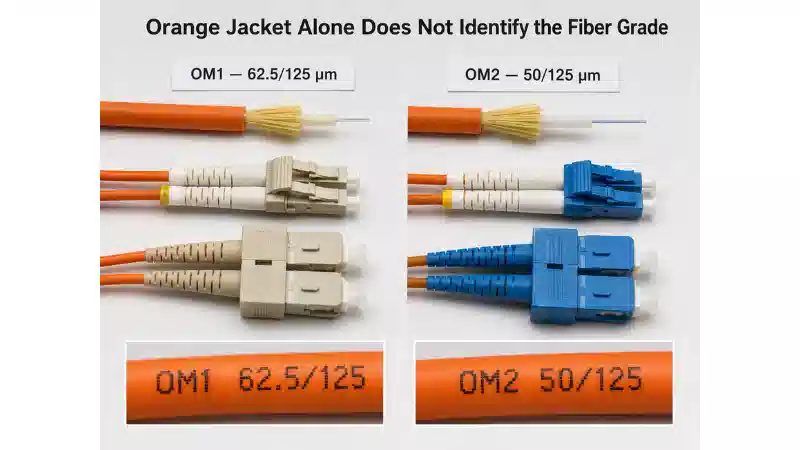
Yes, MTP connector systems support both single-mode and multimode fiber applications with appropriate end-face polishing. Multimode systems typically use UPC polishing with return loss around -50dB, suitable for 850nm and 1300nm transmission. Single-mode applications require APC polishing at 8-degree angles to achieve -60dB return loss needed for wavelengths like 1310nm and 1550nm. Cable assemblies specify fiber type-OM3/OM4 multimode or OS2 single-mode-and you cannot mix modes within a single link without mode conversion equipment.
What causes high insertion loss in MTP connections?
Common causes include end-face contamination from dust or oils, physical damage to ferrule or fiber ends from improper handling, misaligned guide pins or damaged pin holes, incorrect polarity creating no-light conditions that appear as infinite loss, and poor-quality connectors with out-of-spec ferrule geometry. Contamination accounts for approximately 80% of field insertion loss problems. Always clean both connectors and adapters before mating, inspect with a fiber microscope to verify cleanliness, and handle connectors by the housing rather than touching ferrule end-faces.
MTP connector technology continues adapting to data center evolution while maintaining backward compatibility with existing infrastructure. The combination of mechanical precision, field serviceability, and density advantages positions these systems as fundamental building blocks for networks scaling beyond 400G speeds. Understanding the relationship between ferrule geometry, pin mechanics, polarity management, and proper maintenance practices helps network teams extract maximum value from their MTP infrastructure investments. Whether you're designing greenfield data centers or incrementally upgrading existing facilities, MTP systems offer proven approaches for managing the fiber density challenges that higher bandwidth demands inevitably create.