1.What Are Fiber Connectors?
Fiber connectors are specialized devices used to connect and align fiber optic cables, ensuring accurate data transmission. They play a critical role in fiber optic networks, providing a stable connection point for light signals to transfer between cables. Fiber connectors must maintain precise alignment to avoid data loss or signal degradation. Designed to ensure minimal connection loss and maintain high signal quality, these connectors are vital in building robust, high-speed networks.
2.Simplex and Duplex, Multimode and Singlemode Applications
Simplex and Duplex Connectors
Simplex: Supports one-way signal transmission, suitable for applications requiring unidirectional data transfer, such as monitoring systems, oil pipelines, or sensor networks.
Duplex: Contains two fibers, allowing simultaneous bidirectional communication. Commonly used for workstations, fiber switches, servers, and other devices requiring two-way data transfer.
Multimode Fiber
Multimode fiber features a larger core that supports multiple light paths and wavelengths. It is ideal for office cabling, short-distance network extensions, and smaller systems such as alarm networks and building automation.
Common multimode core sizes:
50 µm: Smaller core with higher bandwidth, recommended for new constructions, backbone, horizontal cabling, and indoor applications. Supports LED or laser light sources.
62.5 µm: Traditional multimode fiber suitable for general office cabling or extending existing networks.
Performance Comparison:
| Fiber Type | Bandwidth (MHz·km) | 850 nm Distance | 1310 nm Distance |
|---|---|---|---|
| 50/125 µm | 500 | 500 m | 500 m |
| 62.5/125 µm | 160 | 220 m | 500 m |
50 µm fiber offers approximately three times the bandwidth of 62.5 µm fiber at 850 nm, enabling higher transmission speeds and longer link lengths.
Singlemode Fiber
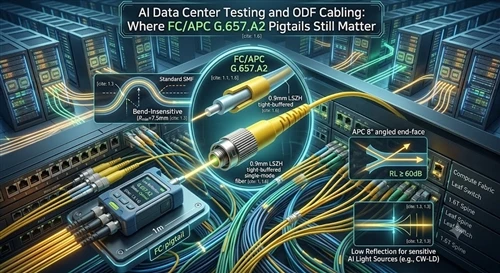
Singlemode fiber has a 9 µm core and supports only one light path. The light signal is centered in the core to minimize scattering and reflection, making it suitable for long-distance, high-bandwidth applications, such as metropolitan networks and telecom backbones. Singlemode fibers are often paired with FC/APC connectors to reduce return loss.
3.When to Choose Simplex or Duplex Fiber Cables
The choice between simplex and duplex fiber optic cables depends primarily on the direction of data transmission, device requirements, and network architecture.
Simplex Fiber Cables feature a single fiber strand, supporting unidirectional (one-way) communication. They are ideal for applications where data flows in only one direction, such as CCTV systems, sensor data collection, and broadcast or monitoring equipment. Simplex cables typically use single-mode (9/125 µm) fiber, require one connector per end, and are a cost-effective solution for simple network layouts.
Duplex Fiber Cables, on the other hand, include two fiber strands to enable bi-directional (two-way) communication. This configuration is suitable for high-performance applications such as workstations, servers, network switches, and enterprise backbones. Duplex cables may use single-mode (9/125 µm) or multimode (50/125 µm) fiber, require two connectors per end, and provide higher reliability and throughput, though at a slightly higher cost.
Comparison at a glance:
| Parameter | Simplex Cable | Duplex Cable |
|---|---|---|
| Communication Mode | Unidirectional (One-way) | Bi-directional (Two-way) |
| Typical Application | CCTV, sensor data, broadcast | Workstations, servers, switches |
| Fiber Strands | One | Two |
| Connector Count | One per end | Two per end |
| Cost | Lower | Higher |
| Common Fiber Type | Single-mode (9/125 µm) | Multimode (50/125 µm) or Single-mode (9/125 µm) |
Summary:
Choose simplex cables when only one-way data transfer is needed or for cost-sensitive installations.
Choose duplex cables when devices require simultaneous two-way communication or high reliability, such as in enterprise networks or data centers.
4.Looking for a suitable FC fiber optic connector manufacturer?
When it comes to building a reliable and high-performance fiber optic network, choosing the right FC connector supplier is crucial. FOCC Fiber Co. LTDhas over 25 years of experience in designing and manufacturing premium FC fiber optic connectors, compatible with both simplex and duplex, singlemode and multimode fibers.
Our solutions are trusted across industries-from office cabling and industrial automation to data centers-delivering low insertion loss, high return loss, and stable signal transmission. We also provide customized products and technical support tailored to your project requirements.
Partner with FOCC Fiber Co. LTD today to secure high-quality connectors, optimize your network performance, and ensure your fiber optic installations operate flawlessly. Contact us now to discuss your procurement needs and get a tailored solution.
5.Frequently Asked Questions (FAQ) – FC Fiber Optic Connectors
1.What is the difference between FC/UPC and FC/APC connectors?
FC/UPC (Ultra Physical Contact): Flat polished endface, low insertion loss, suitable for general network applications.
FC/APC (Angled Physical Contact): 8° angled endface, reduces back reflection, ideal for high-precision measurements, CATV, and fiber sensing systems.
2. Can I mix 50 µm and 62.5 µm multimode fibers in the same network?
Yes, both types have the same 125 µm cladding diameter and can be used in the same network. However, 50 µm fiber provides higher bandwidth and longer link distances, making it preferable for new installations.
3. What fiber jacket sizes are compatible with FC connectors?
FC connectors are compatible with standard 2.0 mm and 3.0 mm fiber jackets, as well as 900 µm tight-buffered fibers used for high-density patch panels and precision equipment cabling.
4. In what applications is a simplex single-mode fiber cable typically used?
A simplex single-mode fiber cable is often used in long-haul monitoring systems, oil pipeline sensors, and broadcast video feeds where the data flow is strictly unidirectional over great distances.
5. Can two simplex cables be used to create a duplex connection?
Yes, you can use two separate simplex fiber optic cables to create a functional duplex connection. However, using a single duplex cable with paired connectors is more organized and recommended for professional network setups.