As data centers grow in size and complexity, the need for reliable and scalable fiber optic solutions becomes even more critical. Below is a list of key fiber optic products involved in data centers:
1. Fiber Optic Cables
Fiber optic cables are the backbone of data center networks. They transmit data as light signals, offering much higher bandwidth and longer-distance capabilities than copper cables. There are various types of fiber optic cables used in data centers:
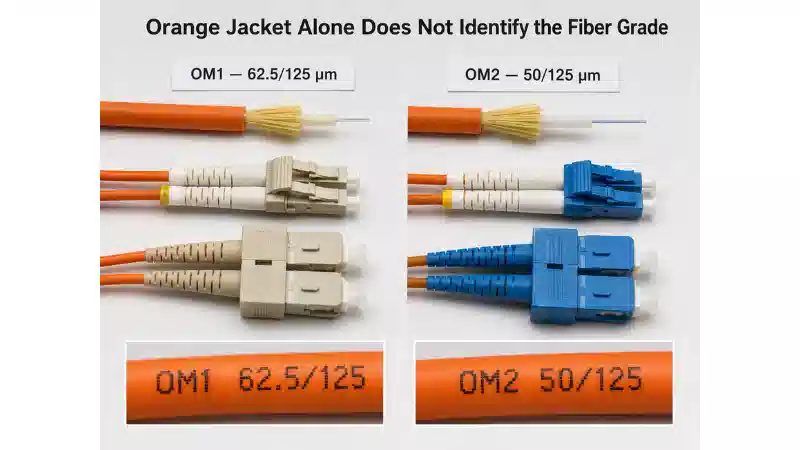
Single-Mode Fiber (SMF): Ideal for long-distance transmission (up to hundreds of kilometers) with minimal signal loss. It is used for connecting different data centers or for large-scale deployments within data centers.
Multi-Mode Fiber (MMF): Suitable for shorter distances (up to 500 meters) within data centers, MMF is more cost-effective for intra-data center connections like between servers and switches.
2. Fiber Optic Transceivers
Fiber optic transceivers are devices that convert electrical signals into optical signals (and vice versa) for transmission over fiber optic cables. In data centers, these transceivers are typically plugged into network switches, routers, and servers. Common types of transceivers include:
SFP+ (Small Form-Factor Pluggable Plus): Supports up to 10 Gbps data transmission and is widely used for 10G Ethernet networks.
QSFP (Quad Small Form-Factor Pluggable): Supports higher data rates, such as 40 Gbps (QSFP+) and 100 Gbps (QSFP28), making it ideal for high-speed connections between data center devices.
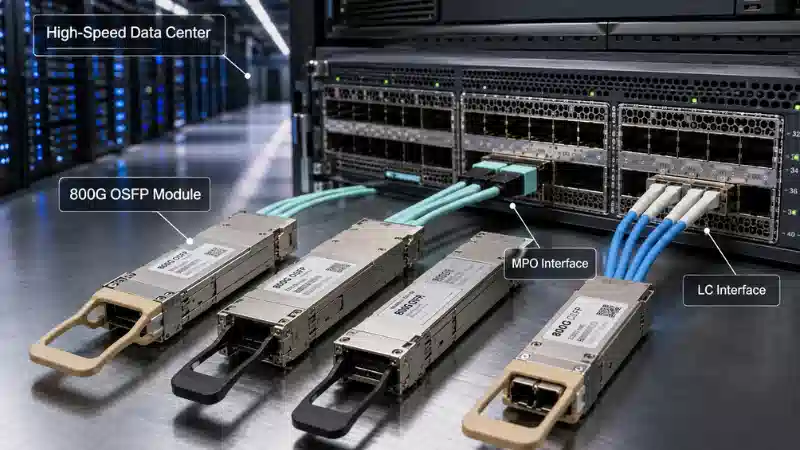
OSFP and QSFP-DD: Designed for 400G Ethernet networks, these are emerging transceiver types that support high-capacity networks in hyperscale data centers.
3. Fiber Optic Patch Cords and Jumpers
Fiber optic patch cords (or patch cables) are used to connect network devices such as switches, servers, and routers to fiber optic transceivers or fiber patch panels. These cables come in single-mode or multi-mode varieties and can have different connector types (e.g., LC, SC, MTP/MPO). Fiber optic jumpers are similar to patch cords but are often used for more specific internal connections within racks.
4. MTP/MPO Connectors and Cables
MTP (Multi-Fiber Termination Push-On) or MPO (Multi-Fiber Push-On) connectors are used to terminate multiple fibers (usually 8, 12, or 24 fibers) in a single connector. These high-density connectors are commonly used in high-speed networks such as 40G and 100G Ethernet.
MTP/MPO cables are pre-terminated fiber cables that enable fast and easy deployments in data centers, reducing installation time. They are ideal for applications like high-density interconnects between switches, servers, and storage systems.
5. Fiber Optic Patch Panels and Enclosures
Fiber optic patch panels are used to organize and manage fiber connections in data centers. They provide a central point for connecting fiber optic cables, making it easier to maintain, troubleshoot, and scale the network. Patch panels can accommodate various types of connectors (e.g., LC, SC, MTP/MPO) and provide easy access to fiber cables.
Fiber enclosures house patch panels and protect fiber connections from damage. They are available in rack-mounted or wall-mounted designs, depending on the data center setup.
6. Fiber Optic Splice Closures
Fiber optic splice closures are protective devices used to safeguard fiber splices from environmental factors like moisture and dust. In data centers, these closures are commonly used in backbone fiber networks or external links between data centers.
7. WDM (Wavelength Division Multiplexing) Systems
Wavelength Division Multiplexing (WDM) technology allows multiple data signals to be transmitted over a single optical fiber by using different wavelengths (colors) of light. WDM systems increase bandwidth without the need for additional fiber infrastructure.
CWDM (Coarse WDM): Uses fewer channels (wavelengths) and is often used for shorter distances.
DWDM (Dense WDM): Supports up to 80 or more channels, making it ideal for long-distance, high-capacity data transmission between data centers.
8. Optical Amplifiers
Optical amplifiers boost the strength of optical signals over long distances, reducing the need for electronic regeneration of signals. In data centers, EDFA (Erbium-Doped Fiber Amplifiers) are often used in long-haul connections between geographically dispersed data centers.
9. Fiber Optic Attenuators
Fiber optic attenuators are devices used to reduce the strength of optical signals in cases where the signal is too strong and might cause damage to network equipment or result in signal distortion. They are typically used in short-distance, high-speed links within data centers.
10. Fiber Optic Splitters
Fiber optic splitters are passive devices that divide a single optical signal into multiple outputs, allowing a single fiber to connect to multiple devices. They are commonly used in PON (Passive Optical Network) architectures within data centers.
11. AOC (Active Optical Cables)
Active Optical Cables (AOC) integrate fiber optic transceivers and cables into a single solution, providing high-speed, plug-and-play connections. AOCs are often used for short-range data center connections, like between switches and servers, where high data rates (up to 100 Gbps or more) are needed without the complexity of managing separate transceivers and cables.
12. Fiber Management Solutions
Effective fiber management is crucial in large-scale data centers to prevent cable clutter, ensure optimal airflow, and minimize the risk of cable damage. Fiber management products include:
Cable trays and ducts for organizing fiber cables.
Fiber raceways for guiding fiber optic cables through racks and data center floors.
Fiber cable labels and tags for easy identification and management of fiber optic connections.
Fiber optic products are indispensable in modern data centers, offering the speed, bandwidth, and scalability needed to meet the increasing demands of cloud computing, AI, and big data. From high-speed transceivers and multi-fiber connectors to WDM systems and fiber patch panels, these products ensure that data centers can transmit massive amounts of information efficiently and reliably. As data centers continue to evolve, the role of fiber optics will only become more critical, enabling the next generation of digital services and innovations.