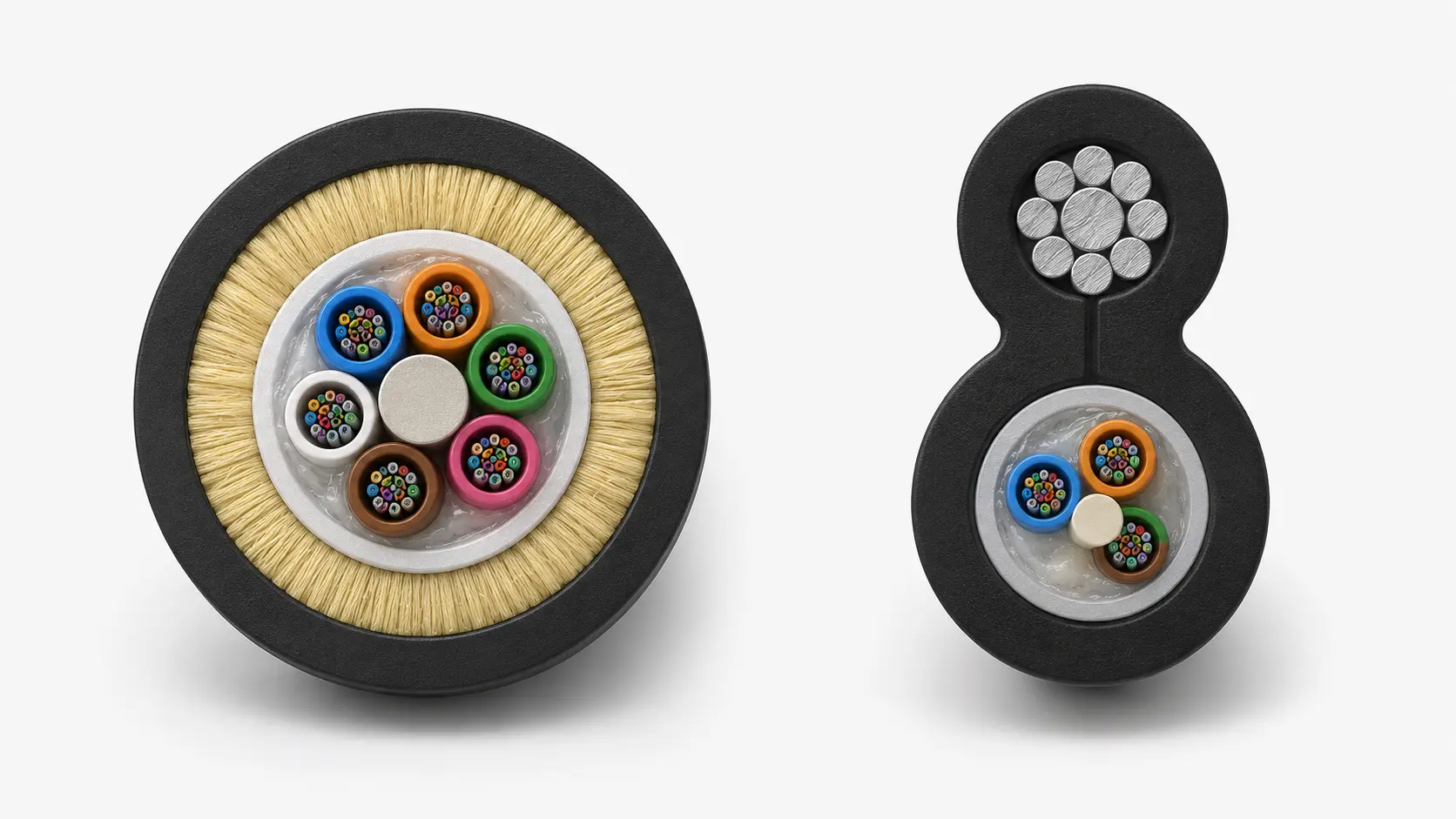
1. Plastic Optical Fiber (POF)
Overview:
Plastic Optical Fiber (POF) is made from polymer materials, primarily polymethylmethacrylate (PMMA), and is designed to transmit light signals over relatively short distances. The cladding surrounding the core of POF is typically made from a fluorinated polymer.
Structure:
Core diameter: Typically larger than glass fibers, around 0.5 mm to 1 mm, which makes it easier to handle.
Material: Made of plastic, often cheaper to produce and more flexible.
Advantages of POF:
Ease of Installation:
POF fibers are more flexible and less fragile than glass, making them easy to install, even in tight spaces. Their large core diameter simplifies alignment and connection.
Lower Cost:
The materials (plastic) and production process for POF are cheaper, reducing overall costs for short-distance applications.
High Flexibility and Durability:
POF is more resistant to bending, twisting, and physical damage compared to glass fibers, making it ideal for environments where the fiber might be subjected to movement or stress.
Lightweight:
POF cables are lightweight and easy to handle, transport, and install, which is advantageous in residential and consumer applications.
Disadvantages of POF:
Limited Transmission Distance and Bandwidth:
POF has higher attenuation, which limits its use to shorter distances, typically less than 100 meters. The maximum data rate over POF is generally limited to 100 Mbps to 1 Gbps.
Susceptibility to Environmental Conditions:
POF is more sensitive to temperature changes and environmental conditions, which can degrade its performance and longevity.
Higher Attenuation:
POF has higher signal loss per meter compared to glass fiber, making it unsuitable for long-range communication.
Fields Where POF is Suitable:
Home Networking:
POF is often used in home networks for transmitting data over short distances, such as connecting devices within a room or building.
Automotive Industry:
POF is widely used in the automotive sector for in-vehicle communication systems, such as media and entertainment systems or communication between sensors and controllers.
Consumer Electronics:
Devices such as audio-visual equipment, gaming consoles, and home theaters use POF for short-distance digital signal transmission.
Industrial Automation:
POF can be used for communication between devices and sensors in factory automation systems due to its flexibility and resistance to mechanical stress.
2. Glass Optical Fiber (GOF)
Overview:
Glass Optical Fiber (GOF) is made from ultra-pure silica (glass) and is known for its ability to transmit data over long distances with minimal signal loss. GOF is the preferred medium for high-speed and long-distance telecommunications.
Structure:
Core diameter: GOF typically has a smaller core diameter, ranging from 8 µm (single-mode) to 50 µm (multi-mode).
Material: High-purity silica glass with a protective cladding also made from glass or polymer.
Advantages of GOF:
Long-Distance Transmission:
GOF is ideal for transmitting data over very long distances, from kilometers to hundreds of kilometers, due to its low attenuation (signal loss).
High Bandwidth and Data Rates:
GOF supports high data transmission rates, making it ideal for applications that require large bandwidth, such as internet backbone infrastructure. Speeds can reach Tbps (terabits per second).
Low Signal Loss:
GOF has very low attenuation, usually around 0.2 dB/km, allowing signals to travel longer without degradation or the need for signal repeaters.
Immunity to Electromagnetic Interference (EMI):
GOF is immune to EMI and radio-frequency interference, which makes it reliable in environments with heavy electrical noise, such as industrial plants or power lines.
Disadvantages of GOF:
Higher Cost:
GOF is more expensive due to the materials and precision required in manufacturing, installation, and maintenance. The cost of glass fiber connectors, splicing, and maintenance is higher compared to POF.
Fragility:
GOF is more fragile and prone to damage from bending, pulling, or sharp impacts. Special care is required during installation to avoid fiber breakage.
Complex Installation:
Handling GOF requires precise equipment and skills, such as laser-based splicing and connectorization. Installation and repairs are more time-consuming and require expert technicians.
Fields Where GOF is Suitable:
Telecommunications:
GOF is the backbone of the telecommunications industry. It is used in fiber-to-the-home (FTTH) networks, long-distance telephone lines, and internet data transfer. GOF supports high-speed, long-distance data transmission in 5G networks and beyond.
Internet and Data Centers:
GOF is essential for high-speed internet infrastructure and data center interconnects, where large amounts of data need to be transmitted between servers and storage devices at high speeds and over long distances.
Medical Imaging and Laser Surgery:
GOF is used in endoscopy, laser surgeries, and other medical procedures that require precise light transmission inside the body. Its clarity and low attenuation make it suitable for transmitting light over extended distances.
Military and Aerospace Applications:
GOF is used in military communications, radar systems, and aerospace technology due to its resistance to electromagnetic interference and ability to transmit data over long distances without signal degradation.
Research and Scientific Applications:
GOF is critical in scientific instrumentation, such as high-precision optical measurements, spectroscopy, and other fields that require reliable, high-speed data transmission.
Comparison: Plastic Optical Fiber vs. Glass Optical Fiber
| Feature | Plastic Optical Fiber (POF) | Glass Optical Fiber (GOF) |
|---|---|---|
| Core Material | Polymer (PMMA) | Silica Glass |
| Typical Core Size | 0.5 mm - 1 mm | 8 µm (single-mode), 50 µm (multi-mode) |
| Transmission Distance | Short distance (up to 100 meters) | Long distance (kilometers) |
| Bandwidth | Low to moderate | High (Gbps to Tbps) |
| Attenuation | Higher (0.1 - 1 dB/m) | Lower (0.2 - 0.5 dB/km) |
| Cost | Lower | Higher |
| Durability | More flexible, less prone to breakage | Fragile, requires careful handling |
| Application Examples | Home networks, automotive, consumer electronics | Telecom, data centers, medical, scientific |
| Installation Complexity | Easy | Requires specialized skills and tools |
So:
Plastic Optical Fiber (POF) is ideal for short-range, cost-effective applications that require flexibility and ease of installation, such as home networking, automotive systems, and consumer electronics. It is affordable, durable, and easier to handle, but it is limited by short transmission distances and lower data rates.
Glass Optical Fiber (GOF) is better suited for long-distance, high-speed, high-bandwidth applications like telecommunications, internet infrastructure, data centers, and medical imaging. While GOF offers superior performance, it is more expensive and fragile, requiring more specialized skills for installation and maintenance.