1. Structure of Optical Fibers
An optical fiber (OF) is a transparent dielectric fiber used for guiding light. A practical optical fiber consists of multiple layers of transparent media, generally divided into three layers:
Core: Located at the center of the fiber (diameter 5~80μm), composed of high-purity silica, doped with a small amount of dopants (e.g., germanium dioxide, phosphorus pentoxide) to increase its refractive index (n1). For communication fibers, the core diameter is 5~10μm (single-mode fiber) or 50~80μm (multi-mode fiber).
Cladding: Surrounding the core (diameter ~125μm), composed of high-purity silica with a small amount of dopants (e.g., boron trioxide), intended to reduce its refractive index (n2), slightly lower than the core). The cladding can be single-layer or multi-layer.
Coating: The outermost layer (made of acrylate, silicone rubber, or nylon), serving a protective function. It includes a primary coating and a secondary coating (jacket). After coating, the outer diameter of the fiber is approximately 1.5cm.
2. Classification of Optical Fibers
There are 4 main classification methods for optical fibers; they can also be classified by composition (e.g., silica fibers, fluoride-containing fibers, plastic fibers, etc.).

(1) Classification by Refractive Index Profile of the Fiber Cross-Section

Divided into Step Index Fiber (SIF) and Graded Index Fiber (GIF).
Step Index Fiber: The refractive indices of the core and cladding are uniform (denoted \(n_1\) and \(n_2\) respectively), with a step change at the interface between the core and cladding.The refractive index profile is expressed as:

This was an early fiber structure, gradually replaced by graded index fibers in multi-mode fibers, but has regained attention as a mainstream structure in single-mode fibers.

Graded Index Fiber: The refractive index at the core axis (n1) is the largest, gradually decreasing along the radial direction (following a parabolic law), and drops to the cladding refractive index (n2) at the core-cladding interface; the refractive index of the cladding is uniform(n2)
The refractive index profile is expressed as:

Where: g is the refractive index profile exponent; (a1) is the core radius; (Delta) is the relative refractive index difference 
Feature: Reduces modal dispersion in multi-mode fibers and increases transmission capacity.

(2) Classification by Number of Propagation Modes
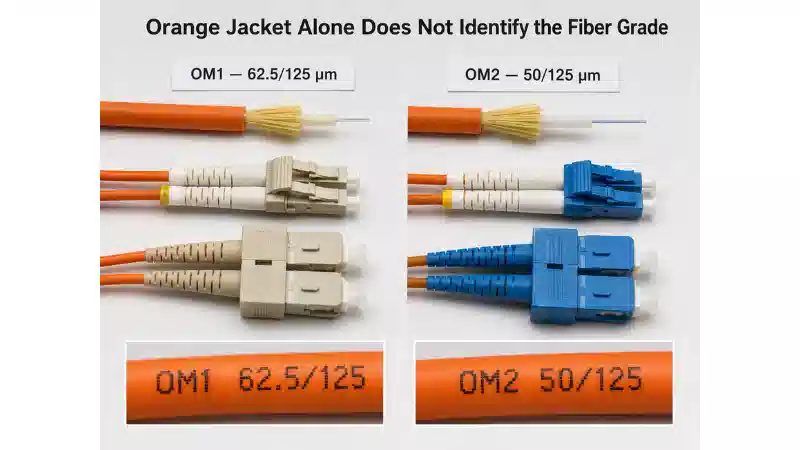
Divided into Multi-Mode Fiber (MMF) and Single Mode Fiber (SMF).
Multi-Mode Fiber: For a given operating wavelength, multiple transmission modes exist in the fiber. The refractive index profile of the cross-section can be uniform (step-index multi-mode) or non-uniform (graded-index multi-mode).Features: Poor transmission characteristics, narrow bandwidth, small transmission capacity.

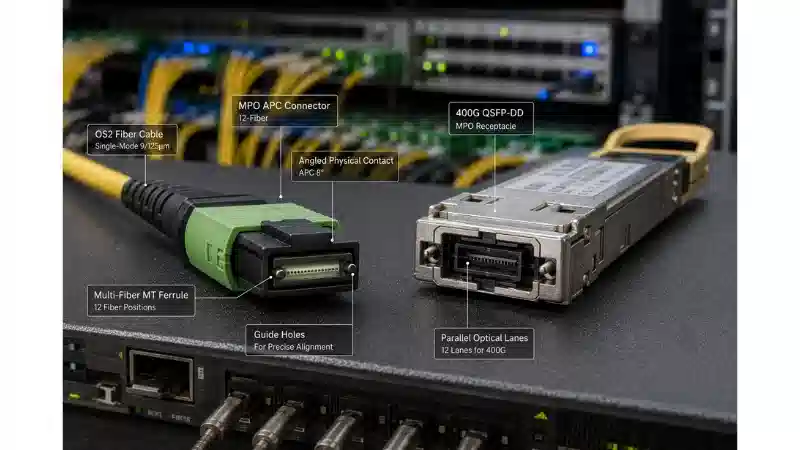
Single Mode Fiber: For a given operating wavelength, only one transmission mode (the fundamental mode) exists in the fiber, with no intermodal delay difference.Features: Bandwidth much larger than that of multi-mode fibers, suitable for high-speed transmission.
(3) Classification by Operating Wavelength
Divided into Short-Wavelength Fibers and Long-Wavelength Fibers.
Short-Wavelength Fibers: Wavelength 0.6~0.9μm (typical value 0.85μm), an early product, rarely used now.
Long-Wavelength Fibers: Wavelength 1.0~2.0μm (typical values 1.31μm, 1.55μm). In this band, silica fibers have low attenuation and small material dispersion.Features: Low attenuation, wide bandwidth, suitable for long-distance, large-capacity communications.

(4) Classification by Jacketing Type
Divided into Tight-Buffered Fibers and Loose-Tube Fibers.
Tight-Buffered Fibers: The secondary and tertiary coatings are tightly bonded to the primary coating, core, and cladding.Disadvantage: Temperature characteristics degrade after jacketing (the jacketing material has a high expansion coefficient; low-temperature shrinkage causes microbending of the fiber, increasing attenuation).
Loose-Tube Fibers: The pre-coated fiber is loosely placed in a plastic tube, with no secondary or tertiary coating.Advantages: Simple manufacturing process; better attenuation-temperature characteristics and mechanical properties than tight-buffered fibers, increasingly widely used.