What is OM5 fiber optic?
OM5 fiber optic is an innovative multi-mode fiber optic cable designed for high bandwidth over short to medium distances. It is the first approved wideband multimode fiber (WBMMF) compliant with the ISO 11801 third edition and TIA-568.0-D standards published in 2017. OM5 fiber typically operates in the wavelength range of 850 to 953 nanometers and supports at least four different wavelengths. This extended wavelength range allows multiple channels to be transmitted simultaneously on the same fiber using shortwave wavelength division multiplexing (SWDM) technology. As the number of fibers decreases, so does crosstalk and overall loss. The color of OM5 is lime green outer sheath, and the geometry (50μm core, 125μm cladding) is the same as OM3 and OM4, making the OM5 optical cable backward compatible with OM3 and OM4 optical fibers. Supporting 100Gb/s, 200Gb/s, and 400Gb/s network transmission over 150 meters, it is the first choice for scenarios that require high-performance output transmission.

What is SWDM?
Shortwave data center connections are typically powered by VCSELs operating at wavelengths close to 850 nm. Shortwave wavelength division multiplexing (SWDM) is a technology that uses four wavelengths in the range 850 to 950 nm. The SWDM transceiver is designed to use 2 fiber connections to a transceiver with OM5 multimode fiber.
What is the difference between OM5 optical fiber and OM3 and OM4 optical fiber?
When evaluating short-distance communications fiber, OM5, OM3, and OM4 are important choices with unique characteristics. Here's how these multimode fibers compare:
Bandwidth and transmission distance
OM5 Fiber offers higher bandwidth compared to OM3 and OM4, thereby supporting higher data rates. This is particularly beneficial in scenarios where enhanced throughput is required, making it a first choice for applications requiring higher data rates. OM5 has the same maximum allowed distance as OM4 for all current and future multimode IEEE applications (including 40GBase-SR4 and 100GBase-SR4). OM5 is paired with 40G-SWDM4 or 100G-SWDM4 optical modules. Compared with OM4 and OM3, the transmission distance is more advantageous.
Channel loss and crosstalk
OM5 optical cable operates in the wavelength range of 850 to 950nm and can provide 100GB of data flow using only one pair of parallel optical fibers. Fewer fibers means less crosstalk and lower overall loss. The attenuation of OM5 broadband multimode fiber has been reduced to 3.0 dB/km from the 3.5 dB/km of previous OM3 and OM4 cables.
cost considerations
In fact, OM5 cabling costs about 50% more than OM4. In addition, with the large-scale procurement of silicon photonics technology and large-scale ultra-large-scale data centers, the cost of single-mode optical modules has dropped significantly, and more and more users will tend to choose single-mode optical modules. For example, 100GBase-PSM4 costs just $750 using single-mode MTP backbone cable that can support 500 meters of transmission distance.


Is OM5 fiber compatible with existing OM3 and OM4 fiber?
certainly. OM5 fiber is designed with a 50 micron core size, making it compatible with OM4 and OM3 fiber optic cables. This compatibility results from their shared core dimensions, enabling seamless integration and flexibility in network designs. This means that if you have an existing infrastructure using OM4 or OM3, you can introduce OM5 jumpers to enhance performance without having to replace the entire cabling system. This backward compatibility enables a phased and cost-effective approach to network upgrades. However, maintaining compliance of all components, including connectors and adapters, with multimode fiber standards is critical to ensuring optimal performance and reliability of the network.
What types of connectors are available for OM5 fiber optics?
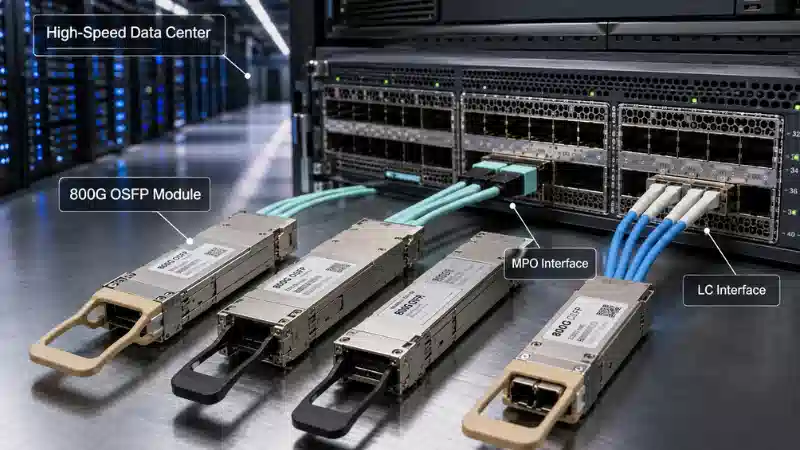
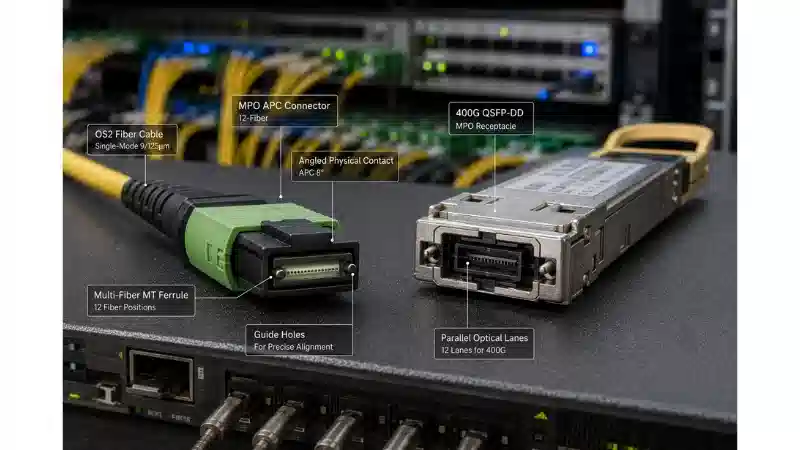
OM5 cables come with a variety of connectors including LC, SC, ST and MTP/MPO. The choice of connector depends on the specific requirements of the network and the equipment used. FS's OM5 optical fiber supports a variety of connectors and can be customized according to different scenarios to meet various needs.
What optical modules are compatible with OM5 fiber?
OM5 Fiber is compatible with a variety of optical transceivers or modules that support multimode fiber connections. Module selection depends on the specific requirements of the network equipment and application. Some common optical modules compatible with OM5 cables include:
1. SR4 (Short Reach 4) Modules: These modules are designed for higher data rates and are typically used in 40/100 Gigabit Ethernet (40/100GbE) applications.
2. SR8 (Short Range 8) module: The SR8 module is used for high-density connections and supports 400 Gigabit Ethernet (400GbE). It is suitable for scenarios that require fast and high bandwidth in data centers and enterprise networks.
3. SWDM4 (Short Wavelength Division Multiplexing 4-channel) module: Ideal for scenarios requiring high-density and high-performance connections, it can be used to support 40/100 Gigabit Ethernet (40/100GbE) applications.
When selecting an OM5 cable module, you must ensure compatibility with the specific connectors on the patch cord (e.g. LC, SC, MTP/MPO) and the network equipment used. Always refer to specifications provided by module and cable manufacturers to ensure proper compatibility and optimal performance.
Do optical transmission standards such as Ethernet and Fiber Channel specify OM5?
There is no transmission standard specified for OM5 or SWDM. Transmission standards usually include only one variant of multimode fiber selected based on economic, commercial and technical criteria. Parallel transmission is the default multimode fiber variant for data rates ≥ 40G.
OM5 Multimode Fiber vs. OM5 Multimode Fiber Single Mode Fiber: Which One to Choose?
Although the price of single-mode fiber (SMF) is declining recently due to the application of new technologies, the cost of pluggable fiber still limits the implementation of SMF in data centers. In contrast, OM5 can multiplex four wavelengths in the 850nm to 953nm range, increasing data capacity fourfold and reducing fiber costs. Additionally, MMF has advantages in installation, troubleshooting, cleaning, and overall maintenance, making it a better choice for data centers. The problem with MMF, however, is distance. And the maximum distance decreases as data speed increases. Multimode fiber therefore has higher value to network owners over 500m distances, while OM5 allows migration to 400Gbps over 150m distances. For applications over 500m, single-mode fiber should be selected.