FTTH - Optical Distribution Network
In this chapter, let us understand what Split Ratios, Maximum Reach and Traffic Management are in the Optical Distribution Network (ODN).
The maximum permissible optical power attenuation between OLT optical ports to ONT input is 28dB, which is by utilizing the so-called Class B optical network elements. ODN Class A, B, and C are differentiated mainly on the ‘optical transmitter power output’ and ‘bit-rate optical receiver sensitivity.’ Class A gives the least optical-budget and Class C gives the highest, while cost wise they are in the same order. For maximum 1:64 split ratio, Class B optics is commonly deployed on commercial basis.
The comparison of class A, B, and C ODN optics is shown in the table given below −
Comparison of ODN Class A, B, and C Optics
| S.No. | Parameter | Unit | Class A | Class B | Class C | Remarks |
|---|---|---|---|---|---|---|
| 1 | Attenuation range (ITU-T Rec. G.982) | dB | 5 – 20 | 10 - 25 | 15 - 30 | |
| 2 | 2488 Mbps downstream direction | |||||
| 2.1 | OLT Transmitter | |||||
| 2.1.1 | Mean launched power MIN | dBm | 0 | +5 | +3 | Single fiber |
| 2.1.2 | Mean launched power MAX | dBm | +4 | +9 | +7 | Single fiber |
| 2.1.3 | Mean launched power MIN | dBm | 0 | +5 | +3 | Dual fiber |
| 2.1.4 | 2.1.4 Mean launched power MAX | dBm | +4 | +9 | +7 | Dual fiber |
| 2.2 | ONU Receiver | |||||
| 2.2.1 | Minimum sensitivity | dBm | -21 | -21 | -28 | Single fiber |
| 2.2.2 | Minimum overload | dBm | -1 | -1 | -8 | Single fiber |
| 2.2.3 | Minimum sensitivity | dBm | -21 | -21 | -28 | Dual fiber |
| 2.2.4 | Minimum overload | dBm | -1 | -1 | -8 | Dual fiber |
| 3 | 1244 Mbps upstream direction | |||||
| 3.1 | ONU Transmitter | |||||
| 3.1.1 | Mean launched power MIN | dBm | -3 | -2 | +2 | Single fiber |
| 3.1.2 | Mean launched power MAX | dBm | +2 | +3 | +7 | Single fiber |
| 3.1.3 | Mean launched power MIN | dBm | -3 | -2 | +2 | Dual fiber |
| 3.1.4 | Mean launched power MAX | dBm | +2 | +3 | +7 | Dual fiber |
| 3.2 | OLT Receiver | |||||
| 3.2.1 | Minimum sensitivity | dBm | -24 | -28 | -29 | Single fiber |
| 3.2.2 | Minimum overload | dBm | -3 | -7 | -8 | Single fiber |
| 3.2.3 | Minimum sensitivity | dBm | -24 | -28 | -29 | Dual fiber |
| 3.2.4 | Minimum overload | dBm | -3 | -7 | -8 | Dual fiber |
Optical Signal Splitting
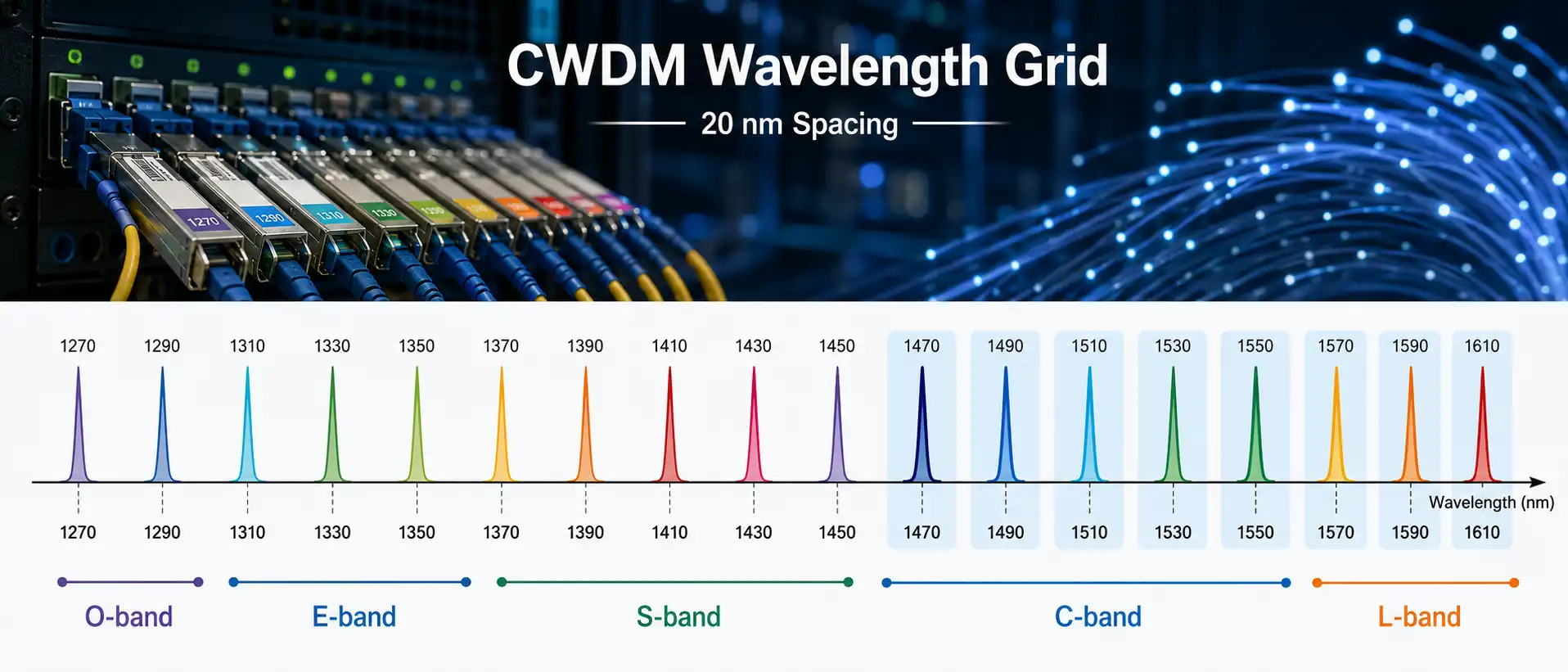
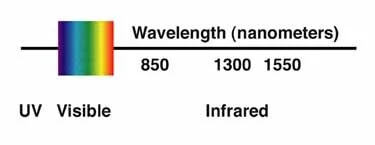
A single fiber starting from the OLT is split through passive optical splitters to serve 64 customer-premise ONTs. The same fiber carries both down-stream (OLT towards ONT) and up-stream (ONT towards OLT) bit streams viz., 2.488 Mbps/1490 nm (1480 - 1500nm window) and 1.244 Mbps/1310 nm (1260-1360nm window).
RF Overlay for TV Services
The TV signals (derived from a satellite Head End) are optionally broadcast on a third optical wavelength of 1550nm on same (or additional) fiber introduced into the FTTx system through an RF Overlay sub-system. CATV Signal can be coupled with GPON signal after amplification by EDFA. The RF CATV signals modulated onto the 1550 nm wavelength. It is extracted through a De-mux function, built inside the ONT, and routed to back plane service connection for the STB/TV.