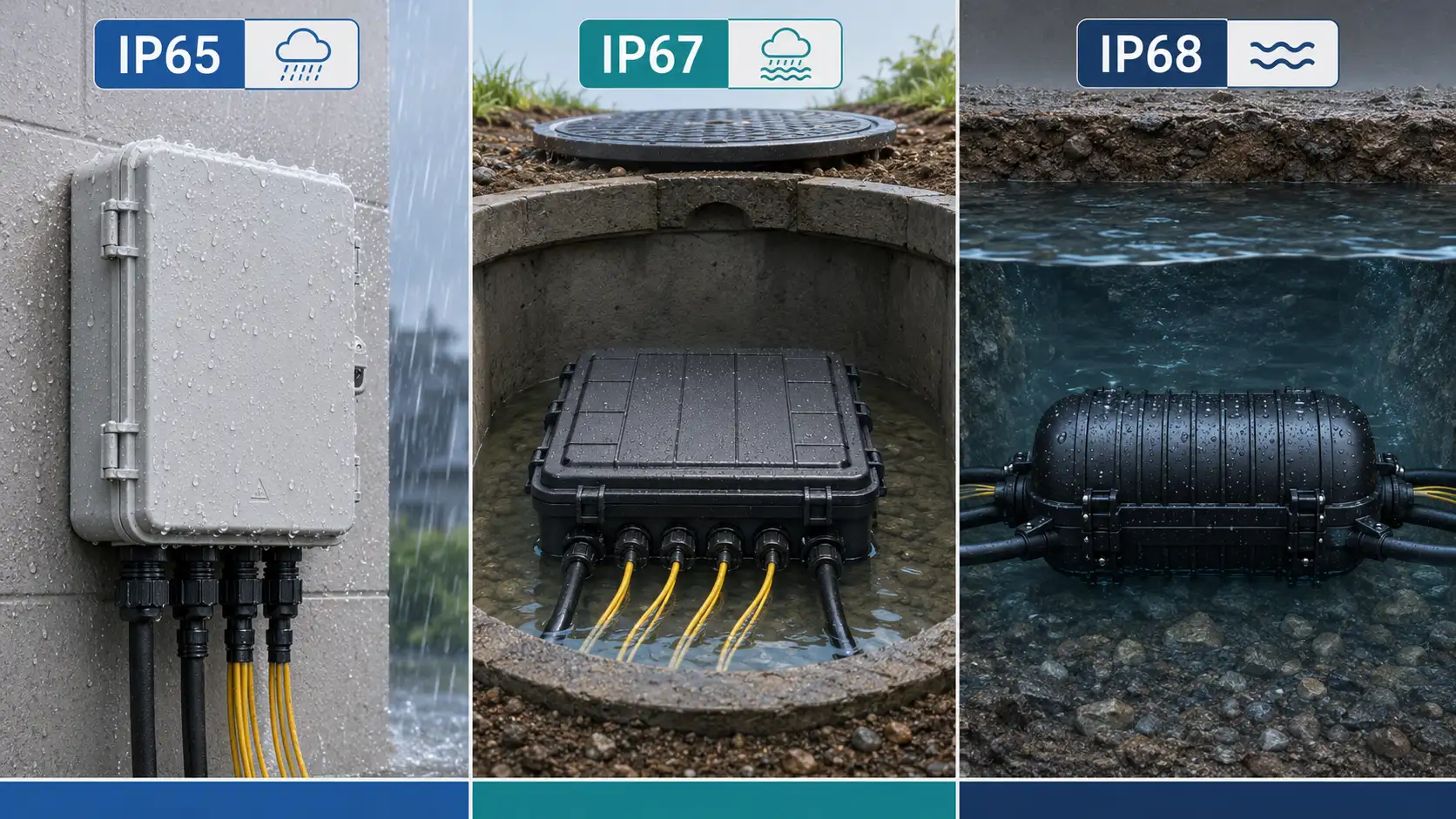

The IP rating for fiber optic enclosures is usually the first specification an engineer or buyer checks, because it summarizes how well a box resists dust and water. A quick answer first: IP65 suits wall- and pole-mounted enclosures exposed to rain and water jets; IP67 is the safer choice where temporary immersion is possible, such as underground handholes or sites with poor drainage; and IP68 belongs in flood-prone or continuously wet locations, but only when the enclosure design, cable sealing and installation quality actually support that level.
A higher number helps, yet it never guarantees long-term waterproofing on its own. In the field, the real protection comes from the enclosure structure, the cable entry seals, gasket quality, material durability, and how carefully the unit is installed. Most water-ingress failures we see are not caused by the rating being too low. They are caused by a sealing or routing detail that went wrong during installation.
What an IP Rating Actually Means for a Fiber Enclosure
IP stands for Ingress Protection. The two digits after the letters are defined by IEC 60529, the international standard that classifies the IP code. The first digit (0 to 6) rates protection against solid objects and dust; the second digit (0 to 9) rates protection against water. So an IP65 enclosure is dust-tight and protected against water jets, while an IP67 enclosure is dust-tight and protected against temporary immersion under defined test conditions.
Two points matter for specifying outdoor fiber boxes and are easy to miss:
- The water digits are not cumulative above level 6. An IP67 box passed an immersion test, but that does not automatically mean it passed a water-jet test. If a site needs both jet resistance and immersion resistance, look for a dual rating such as IP66/IP68 rather than assuming one covers the other.
- IP tests use fresh water. The rating says nothing about salt spray, solvents, oils, or steam. A box that keeps fresh water out can still corrode or degrade in a coastal or chemical environment, because the rating covers ingress, not material compatibility.
Equally important is what the IP code does not describe. It is a tested ingress figure, not a full durability spec. It does not cover UV resistance, corrosion resistance, impact strength, temperature-cycling performance, or long-term gasket aging. This is why two enclosures with the same IP rating can perform very differently after a few years outdoors.
Common IP Ratings for Outdoor Fiber Optic Enclosures
IP54: Sheltered Indoor or Semi-Outdoor Areas
IP54 offers limited dust protection and resistance to splashing water. It fits indoor technical rooms, covered corridors, cabinets, or sheltered areas where direct rain and water jets are unlikely. For an exterior wall, a utility pole, a rooftop, or a roadside cabinet exposed to weather, a higher rating is normally preferred.
IP65: Outdoor Wall- and Pole-Mounted Fiber Distribution Boxes
IP65 is the most common rating for outdoor fiber terminal boxes. Dust-tight and protected against water jets, it is a practical baseline for:
- Wall-mounted fiber distribution boxes
- Pole-mounted FTTH terminal boxes
- Building entrance fiber access points
- Sites exposed to rain, wind and dust but not standing water
For most standard outdoor FTTH and FTTx work, IP65 balances protection, cost, structure and ease of maintenance well.
IP67: Underground Handholes and Temporary Immersion
IP67 is the right choice when the enclosure may face temporary immersion, which is common in underground handholes, drainage-prone pits, or roadside sites that pool water after heavy rain. Under IEC 60529, IP67 is verified by immersion in roughly one meter of fresh water for about 30 minutes. It does not mean the box can stay underwater indefinitely. Outdoor field hardware such as IP67-rated connector systems like ODVA, OptiTap and FullAXS is built for exactly this temporary-water exposure. If a site floods repeatedly or stays wet for long periods, IP67 may not be enough.
IP68: Flood-Prone or Continuously Wet Environments
IP68 covers continuous immersion under conditions specified by the manufacturer, which means depth and duration are not fixed by the standard and must be stated by the supplier. It can suit flood-prone access points, buried closures in high-groundwater areas, and harsh networks with unpredictable water exposure. For deep or saturated underground points, a sealed fiber optic splice closure rated to IP68 is the usual answer, and for vertical buried or dome-style routing, mechanically sealed dome closures are designed to hold a seal under sustained pressure. The label still needs correct installation and a matching cable seal to perform in the field.
IP65 vs IP67 vs IP68
| IP Rating | Main Protection | Best Used For | Main Limitation |
|---|---|---|---|
| IP65 | Dust-tight, protected against water jets | Outdoor wall or pole mounting | Not intended for immersion |
| IP67 | Dust-tight, protected against temporary immersion (about 1 m, 30 min) | Underground handholes, temporary flooding risk | Not permanent waterproofing |
| IP68 | Dust-tight, continuous immersion under manufacturer-defined conditions | Flood-prone or continuously wet sites | Depth and duration must be defined; install must be precise |
If the enclosure sees rain but never standing water, IP65 is usually enough. If it can be temporarily covered by water, step up to IP67. If it may sit underwater or in saturated ground, specify IP68 with a stated immersion depth and duration. The best choice is the lowest rating that matches the real environment, not the highest number on the data sheet, because over-specifying adds cost without fixing the failure points that actually cause leaks.

Quick Selection Guide by Installation Scenario
| Installation scenario | Recommended baseline | What to verify |
|---|---|---|
| Outdoor wall-mounted FTTH box | IP65 | UV-resistant housing, sealed ports, drip loop |
| Pole-mounted terminal box | IP65 to IP67 | Cable entry orientation, wind-driven rain |
| Underground handhole | IP67 to IP68 | Immersion risk, full cable sealing system |
| Flood-prone or high-groundwater area | IP68 | Defined depth and duration, closure design |
| Coastal or industrial site | IP65+ / IP67+ with corrosion-resistant build | Salt, UV and chemical resistance, not IP alone |
Why a High IP Rating Does Not Always Stop Water
The weakest points in an outdoor fiber enclosure are usually created during installation, not in the factory test lab.

Cable Entry Is the Weakest Point
Cable ports, glands, rubber seals and unused entry holes are the most common leakage paths. If the cable diameter falls outside the gland's sealing range, the gland never compresses correctly, and a seal that works for a 5 mm drop cable can fail on a thicker feeder. Unused ports left open let water in even when the body is well designed. Because drop, feeder and branch cables have different diameters and jacket shapes, the cable entry and the cable itself have to be specified together. Matching the box to compatible outdoor cable assemblies and sealed, factory-terminated waterproof connectors removes a lot of this risk before it reaches the field.
Gaskets Shift, Age and Lose Compression
A gasket only protects the box when it is seated evenly. Uneven cover pressure, a twisted seal, or screws tightened in the wrong order can break the seal on day one. Over months, heat, cold, sunlight and mechanical stress slowly reduce compression, which is why long-term reliability depends on gasket material (silicone and EPDM age differently) far more than on the initial pass mark.
Condensation Is Often Mistaken for Leakage
Water inside a box does not always come from outside. Temperature swings cause warm, humid air trapped in the enclosure to condense on the inner wall or cover, and it can look exactly like a leak. Good internal design, sensible cable routing, and breathable venting where it is compatible with the enclosure design and the required IP level can reduce this. Venting is not appropriate for every sealed closure, so confirm it does not conflict with the rating.
Poor Cable Routing Creates Water Paths
If a cable enters from above with no drip loop, water runs down the jacket straight to the entry point and is eventually forced inside. A simple drip loop, so cables approach the gland from below or to the side, makes a measurable difference in real installations.
Field case: an IP65 wall box reused in an underground handhole flooded within two wet seasons. The housing and gasket were intact. The leak came from a cable gland sized for the original drop cable but reused on a thicker feeder, so the gland never sealed, and the handhole filled with water after rain. The fix was not a higher-rated box. It was the correct gland, a closure rated for immersion, and sealing the unused ports.
How We Evaluate a Waterproof Fiber Enclosure
An IP number is one input, not the whole decision. Before signing off an outdoor enclosure, we check it against the conditions an IP rating leaves out:
- IP rating matched to the actual site, including immersion risk
- Cable sealing range versus the real installed cable diameters
- Gasket material and expected aging under local temperature cycling
- UV resistance and corrosion resistance of housing and hardware
- Mounting orientation and how water reaches the entry point
- Field maintenance access and inspection after heavy rain
The same discipline applies to high-density parallel links. If you are sealing trunk infrastructure, our guide to outdoor MPO/MTP waterproofing walks through the same sealing logic for multi-fiber connectors.
IP Ratings vs NEMA Types for North American Projects
In North America, enclosures are often specified with NEMA types rather than IP codes. The two are not directly interchangeable. IP ratings under IEC 60529 focus narrowly on dust and water ingress, while NEMA enclosure types under ANSI/NEMA 250 also cover corrosion, icing, oil and certain hazardous-location conditions, plus construction and marking requirements. A NEMA type may meet or exceed a given IP digit, but you cannot reliably convert an IP rating into a NEMA type. If a project calls for NEMA compliance, specify the NEMA type explicitly and ask for a dual-rated product (for example "NEMA 4X / IP66") with test reports, rather than assuming an IP-rated box satisfies the full NEMA requirement.

Common Mistakes When Selecting Fiber Enclosure IP Ratings
- Specifying IP68 for every outdoor project. This raises cost without solving the real risk when the failure point is cable sealing or routing.
- Using IP65 underground. IP65 handles water jets, not the immersion that handholes can see after rain.
- Ignoring cable compatibility. Even a premium enclosure leaks if the gland does not match the installed cable.
- Treating IP as a full durability spec. For real outdoor performance, weigh IP alongside material quality, sealing design, corrosion resistance and installation practice.
FAQ
Q: What IP rating is required for outdoor FTTH terminal boxes?
A: For wall- or pole-mounted FTTH terminal boxes exposed to rain and dust but not immersion, IP65 is the common baseline. Underground or flood-prone points generally need IP67 or IP68.
Q: Is IP65 enough for pole-mounted fiber distribution boxes?
A: In most cases yes, as long as the box will not be submerged. On exposed sites with storms, heavy washdown or poor drainage, IP67 is worth considering.
Q: Is IP67 better than IP65?
A: They protect against different things. IP65 resists water jets; IP67 resists temporary immersion. IP67 is better where water can pool around the enclosure, while IP65 is often sufficient for normal outdoor rain.
Q: Does IP68 mean permanently waterproof?
A: No. IP68 means continuous immersion under conditions the manufacturer specifies. The depth, duration and sealing method must be defined; it is not unlimited waterproofing in every environment.
Q: What should I check besides the IP rating?
A: Cable sealing range versus your actual cable diameters, gasket material and aging, UV and corrosion resistance, mounting orientation, and maintenance access. These determine real-world reliability as much as the IP number does.
Q: How do cable glands affect enclosure waterproofing?
A: The gland is often the first thing to leak. If the cable falls outside the gland's clamping range, it cannot compress and seal, so confirm the gland or rubber port matches every cable that enters the box, and seal any unused ports.
Q: What is the best IP rating for underground fiber closures?
A: For handholes with temporary water accumulation, IP67 is the practical minimum. For continuously wet ground or flood-prone sites, IP68 with a defined immersion depth and duration is appropriate.
Q: Should I always choose the highest IP rating?
A: No. Match the rating, sealing design and installation method to the real site. Over-specifying adds cost; under-specifying causes failures.
Conclusion
Pick the IP rating from the environment, not the data sheet. IP65 covers most wall- and pole-mounted outdoor fiber boxes, IP67 handles temporary immersion in handholes, and IP68 is for continuously wet or flood-prone closures with a stated immersion spec. Then make the rating count by getting the cable seal, gasket seating and routing right on site, because that is where outdoor fiber networks actually keep water out.