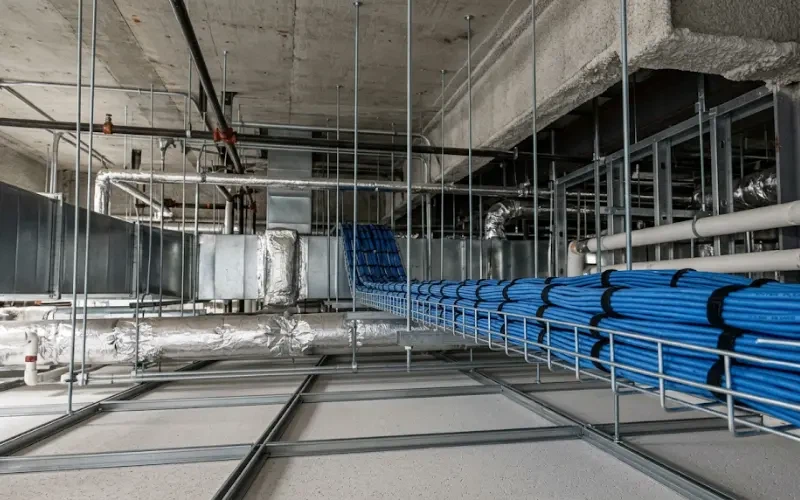
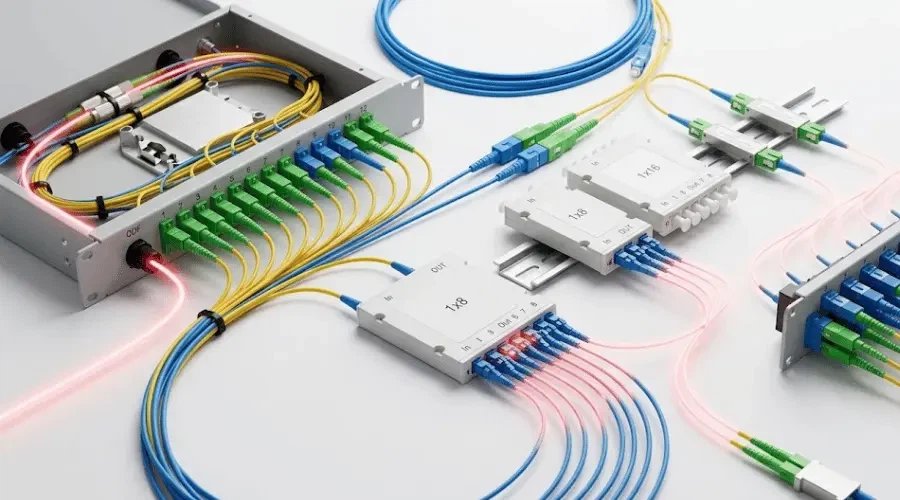
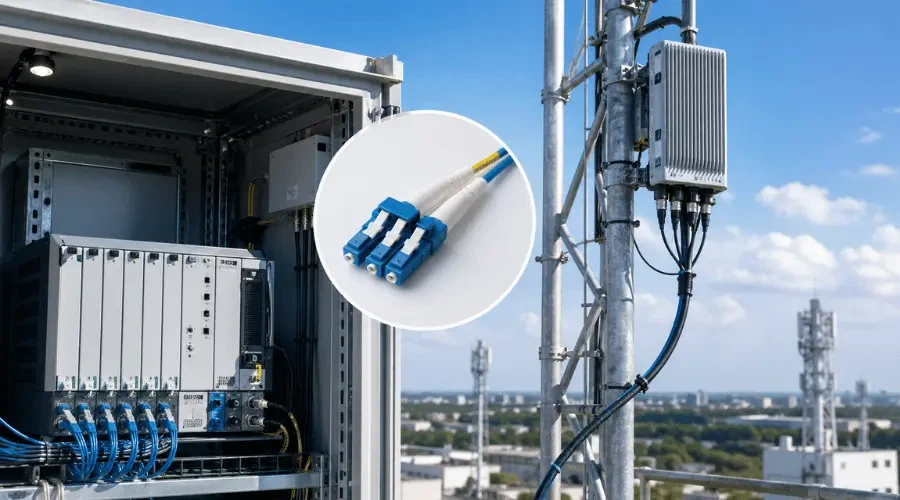
MTP patch cables for datacenters are selected based on three primary factors: transmission distance requirements, network speed demands, and infrastructure budget. Multimode OM4 cables handle most modern datacenter needs for distances under 150 meters at 100G speeds, while OM5 supports emerging 400G deployments with short-wavelength division multiplexing technology.
The choice depends on your specific deployment scenario. For typical top-of-rack to distribution layer connections spanning 30-100 meters, OM4 provides reliable 40G/100G performance at competitive pricing. Hyperscale facilities planning 400G migration should evaluate OM5 for its SWDM capabilities that reduce fiber count requirements.

Understanding MTP Patch Cable Components in Datacenter Context
MTP patch cables consist of multi-fiber connectors housing 8, 12, or 24 individual fibers within a single compact interface. The MTP connector-a trademarked version by US Conec with enhanced mechanical performance-improves upon the generic MPO standard through metal pin clamps, floating ferrule designs, and oval springs that protect fiber ribbons during insertion.
These cables enable parallel optics transmission where multiple fiber pairs simultaneously transmit and receive data. A 12-fiber MTP patch cable operating at 25G per fiber lane delivers aggregate 100G throughput, while the same cable configuration at 50G per lane scales to 400G capacity.
Modern datacenters rely on MTP patch cables for three distinct applications: jumper cables connecting equipment within racks, trunk cables linking distribution frames between cabinets, and breakout cables transitioning from MTP to LC duplex connectors. Each serves specific roles in the structured cabling hierarchy.
Fiber Type Selection: OM3, OM4, and OM5 Comparison
The fiber mode classification directly impacts transmission distance capabilities and cost structure. OM3 multimode fiber, introduced in 2003, uses laser-optimized 50-micron core with 2000 MHz·km effective modal bandwidth at 850nm. It supports 10G Ethernet to 300 meters and 40G/100G applications to 100 meters-adequate for small datacenter deployments but increasingly superseded.
OM4 fiber emerged in 2009 with 4700 MHz·km bandwidth at 850nm, extending 10G distances to 550 meters and supporting 100G connections up to 150 meters when paired with appropriate QSFP28 transceivers. The aqua jacket color identifies OM4 cables universally. This specification became the datacenter standard from 2015-2023, balancing performance with mature supply chain pricing.
OM5 specification arrived in 2016 to address bandwidth density challenges through wideband multimode fiber design. Operating across 850-953nm spectrum with 4700 MHz·km at 850nm and 2470 MHz·km at 953nm enables short-wavelength division multiplexing. With SWDM4 transceivers, OM5 achieves 400G over 150 meters using only two fibers versus eight fibers required by traditional OM4 implementations.
Distance and speed parameters follow these tested benchmarks: OM3 reaches 300m at 10G, 100m at 40G/100G. OM4 extends to 550m at 10G, 150m at 40G/100G, 100m at 200G/400G with BiDi transceivers. OM5 matches OM4 baseline distances while adding 150m capability for 400G-SR4.2 and supporting 800G roadmaps through multiple wavelength operation.
Cost differentials between fiber types narrowed significantly since 2020. OM4 cable assemblies typically price 5-15% above OM3 equivalents, reflecting enhanced manufacturing tolerances. OM5 commands 15-25% premium over OM4 primarily due to lower production volumes and specialized testing requirements. Installation labor costs remain identical across all multimode types.
For datacenter planning, OM4 represents the pragmatic choice for current 25G/100G networks with proven interoperability across transceiver vendors. OM5 investment makes sense when 400G deployment roadmaps exist within 2-3 years or when fiber pathway constraints justify the density advantages of SWDM technology.
MTP Cable Polarity Management in Production Environments
Polarity defines fiber position mapping between transmit and receive ports across MTP connections. The TIA-568 standard codifies three methods-A, B, and C-each solving polarity through different component configurations. Method selection impacts patch cable inventory requirements, installation complexity, and operational flexibility.
Method B dominates modern datacenter deployments for several practical reasons. Type B trunk cables flip fiber positions (position 1 connects to position 12, position 2 to 11, continuing the reversal pattern) while using key-up orientation on both connector ends. This configuration allows identical duplex patch cords at both link ends, eliminating the need to track distinct A-to-A and A-to-B patch cable types.
The operational advantage becomes clear during moves-adds-changes. Technicians stock one patch cable type rather than managing separate inventories. Error rates during patching operations decrease substantially when all jumpers follow consistent polarity. Major hyperscale operators including those deploying 100G/400G networks standardized on Method B for these reliability benefits.
Method A uses straight-through trunk cables (position 1 to position 1) with key-up to key-down orientation. It requires A-to-B patch cords on one link end and A-to-A crossover cords on the opposite end. While conceptually simpler, the dual patch cord inventory creates operational overhead. Method A remains appropriate for smaller facilities with limited patching frequency.
Method C implements pair-wise flipping in trunk cables where adjacent pairs swap positions. Though supported in standards, the complexity of managing crossover components makes Method C uncommon in production datacenters. Most equipment manufacturers optimize MTP transceiver pinouts for Method B compatibility.
Gender management-the presence or absence of guide pins-follows straightforward rules. Active equipment ports always use pinned (male) connectors. Patch cables connecting to equipment must use unpinned (female) connectors. Adapter panels typically mount as key-up to key-up for Method B systems, accepting female connectors from both patch cable directions.
Distance and Density Considerations
Datacenter architecture patterns directly influence MTP cable selection. Spine-and-leaf topologies concentrate 40G/100G/400G interconnects within the fabric layer, typically spanning 10-50 meters between top-of-rack switches and spine aggregation points. These short distances allow aggressive port density optimization with OM4 or OM5 multimode fiber.
Three-tier hierarchical designs stretch core-to-distribution connections to 100-150 meters. The extended reach pushes toward OM4 minimum specifications or necessitates singlemode fiber evaluation for critical uplinks. Many operators deploy OM4 for horizontal connections while reserving OS2 singlemode for vertical campus backbone links exceeding 300 meters.
Port density calculations favor MTP over duplex LC in constrained rack spaces. A single 1U MTP cassette panel accommodates 96 LC ports (48 duplex connections) compared to 48 LC ports possible with traditional duplex panels. The 2x density improvement matters critically in high-performance computing clusters and AI training environments where GPU interconnect requirements consume substantial front panel real estate.
Cable pathway congestion affects airflow dynamics and cooling efficiency. Twelve 12-fiber MTP trunks occupy similar volume to 144 individual duplex LC cables while supporting equivalent connectivity. The reduced cable mass improves hot aisle/cold aisle airflow separation, measurably decreasing power consumption. Studies document 8-12% cooling efficiency gains in retrofitted facilities replacing duplex with MTP infrastructure.
Bend radius specifications become restrictive in dense routing scenarios. OM4 and OM5 cables require minimum 7.5mm bend radius during installation, 30mm minimum static radius post-installation. Tight 90-degree transitions into overhead cable trays or through zero-U vertical managers demand careful planning. Pre-terminated MTP trunk cables with proper length specification prevent stress on ferrules that degrades insertion loss over time.

MTP Patch Cable Connector Quality and Performance Specifications
MTP Elite connectors represent the premium tier with maximum 0.35dB insertion loss for mated pairs versus 0.60dB for standard MTP multimode connections. The floating ferrule design maintains physical contact under applied load, critical for parallel optic applications where cable plugs directly into active transceivers. Elite ferrules use tighter manufacturing tolerances-sub-micron concentricity requirements-that justify the 15-20% cost premium.
Standard MTP connectors adequately serve most datacenter applications where cassette-based architecture positions the connector interface at distribution points rather than equipment ports. The 0.60dB insertion loss specification leaves sufficient link budget for 100G connections within OM4 distance limits. Cost-sensitive deployments standardizing on cassette modules typically specify standard MTP for trunk cables.
Connector endface geometry impacts return loss and power coupling efficiency. Physical contact (PC) polish produces 8mm radius curvature suitable for multimode applications. The industry standard for datacenter MTP cables uses PC endface with UPC (ultra-physical contact) designation, ensuring less than -50dB return loss. Angled physical contact (APC) polish remains exclusive to singlemode OS2 applications where back-reflection sensitivity demands below -65dB performance.
Factory termination quality exceeds field termination reliability by measurable margins. Pre-terminated MTP assemblies undergo automated polishing and interferometric inspection, achieving consistent sub-0.5dB loss and minimal variability across fiber positions. Field termination, while viable for specialized circumstances, introduces human error risk and typically requires skilled technicians with specialized epoxy-cure equipment.
Jacket Rating Requirements
Building code compliance mandates specific cable jacket ratings based on installation pathways. Plenum-rated OFNP cables contain materials tested under UL 910 flame spread requirements, suitable for air-handling spaces above drop ceilings. The stringent smoke and toxicity limits ensure life safety during fire events. Plenum jackets typically use fluoropolymer compounds, increasing cable cost 25-40% over riser alternatives.
Riser-rated OFNR cables meet UL 1666 vertical flame spread testing, appropriate for shaft installations connecting multiple floors. The lower smoke generation requirements compared to plenum reflect reduced air distribution concerns in enclosed vertical pathways. OFNR represents the cost-optimized choice for most datacenter vertical cable trays and conduit runs.
Low-smoke zero-halogen (LSZH) jacketing addresses international market requirements and increasingly appears in North American facilities despite lacking specific NEC rating. LSZH compounds produce minimal halogen acid gases during combustion, protecting sensitive electronic equipment from corrosive damage. European datacenters almost universally specify LSZH for environmental and equipment protection rationale.
Jacket color coding assists operational cable management though no universal standard exists. Common conventions use aqua for OM3/OM4 multimode, lime green for OM5, yellow for singlemode OS2. Some operators implement custom color schemes denoting network layers-distinct colors for spine, leaf, and management networks simplify visual tracing during troubleshooting.
Transceiver Compatibility Considerations
MTP cables interface with parallel optic transceivers using 4-lane, 8-lane, or 12-lane configurations. QSFP+ 40G-SR4 transceivers consume 8 fibers (4 transmit, 4 receive) from 12-fiber MTP cables, utilizing the central 8 positions while edge fibers remain unused. QSFP28 100G-SR4 follows identical pinout mapping at 25G per lane instead of 10G.
QSFP-DD and OSFP 400G transceivers leverage 8 fibers operating at 50G per lane (PAM4 modulation) to achieve aggregate 400G throughput. The 8-fiber MTP connector format becoming prevalent for 400G deployment reduces overall cabling density compared to 12-fiber alternatives. Base-8 architecture alignment simplifies breakout cable configurations and improves cassette port utilization.
BiDi (bidirectional) transceivers reduce fiber requirements by transmitting and receiving on the same fiber using different wavelengths. 100G-BiDi transceivers operate over two-fiber duplex connections, eliminating MTP requirements entirely for certain deployment scenarios. The technology trades transceiver cost increase (typically 2-3x standard optics pricing) against simplified cabling infrastructure.
Transceiver compatibility extends beyond mechanical interface to include reach specifications and wavelength windows. SR (short-reach) optics operate at 850nm optimized for multimode fiber. LR (long-reach) variants use 1310nm suitable only for singlemode infrastructure. Ensuring transceiver reach classification matches fiber type prevents connection failures-40G-LR4 transceivers require OS2 singlemode rather than OM4 multimode fiber.
Pre-Termination vs Field Termination Trade-offs
Factory pre-terminated MTP trunk assemblies accelerate installation schedules and deliver superior optical performance. Manufacturing facilities employ automated equipment for fiber cleaving, epoxy curing, and connector polishing that achieve consistent quality impossible with field methods. Pre-terminated cables arrive with test reports documenting insertion loss across all fiber positions, simplifying acceptance testing.
Lead times for pre-terminated assemblies typically span 2-4 weeks for standard configurations, extending to 6-8 weeks for complex builds with specialized lengths or custom fiber counts. Organizations with defined cabling pathways and accurate length measurements benefit from ordering bulk pre-terminated inventory matched to their architectural standards.
Field termination provides flexibility for unpredictable pathway lengths or retrofit installations where existing infrastructure prohibits pulling continuous assemblies. MTP field termination kits include pre-loaded ferrules requiring fiber insertion, epoxy injection, curing, and polishing. Skilled technicians achieve 0.75-1.0dB insertion loss on field-terminated connections-acceptable for many applications though inferior to factory 0.35-0.50dB benchmarks.
The economic crossover between approaches depends on labor costs and project scale. Small deployments requiring fewer than 20 trunk assemblies with variable lengths favor field termination flexibility. Large builds exceeding 100 trunks with standardized lengths benefit from factory pre-termination cost efficiencies and compressed installation timelines.
Testing and Certification Standards
Tier 1 testing verifies basic continuity and polarity using visible light sources or optical time-domain reflectometers. This fundamental validation confirms fiber pairs map correctly between connectors without breaks. While sufficient for initial troubleshooting, Tier 1 testing lacks quantitative loss measurement required for performance certification.
Tier 2 testing measures insertion loss and return loss using calibrated light sources and power meters. Industry standards mandate maximum 0.75dB insertion loss per mated MTP connector pair for multimode fiber. End-to-end channel loss budgets account for connector pairs, splice points, and fiber attenuation. For 100m OM4 channel with two connector pairs: 0.75dB × 2 + (100m × 0.003dB/m) = 1.8dB total loss.
OTDR testing provides fiber-by-fiber characterization across MTP arrays, identifying individual problem fibers within the multi-fiber connector. Bi-directional OTDR analysis captures asymmetric loss events and precisely locates defects or stress points. This diagnostic level becomes essential for troubleshooting intermittent errors or optimizing links approaching maximum distance specifications.
Certification requirements vary by customer standards. Financial services and government facilities often mandate full bi-directional OTDR testing with archived results. Commercial datacenters typically accept Tier 2 testing for initial acceptance, reserving OTDR analysis for problem resolution. Cloud service providers increasingly require factory test reports documented in audit databases tracking every fiber position performance across their fleet.

Frequently Asked Questions
Can I mix OM3 and OM4 cables in the same link?
Mixing fiber types within a single link degrades performance to the lowest specification. An OM3 patch cable connected to OM4 trunk limits the entire channel to OM3 distance specifications. For optimal results, maintain consistent fiber grade throughout each link from transmitter to receiver.
Does MTP work with older LC-based equipment?
MTP-LC breakout cables bridge between MTP trunk infrastructure and legacy LC duplex equipment. A 12-fiber MTP connector fans out to six LC duplex connections, enabling gradual migration from traditional to high-density cabling without forklift upgrades.
How do I prevent polarity errors during installation?
Standardize on Method B polarity across the facility and procure only Type B trunk cables with female connectors. Use identical duplex patch cords at both link ends. Label all cassettes and panels clearly with polarity method designation to prevent mixing architectures.
What causes high insertion loss in MTP connections?
Contamination represents the primary cause-microscopic debris on ferrule endfaces degrades physical contact between fiber cores. Always inspect and clean MTP connectors using approved methods before mating. Mechanical stress from excessive bend radius or improper cable routing also increases loss.
Practical Selection Framework
Choose OM4 12-fiber MTP patch cables for existing 25G/40G/100G datacenter deployments spanning 30-150 meters. The mature supply chain, broad transceiver compatibility, and cost efficiency make OM4 the default specification. Specify Method B polarity to simplify operations and request Elite connectors only for direct-attach applications where cables plug into active equipment.
Consider OM5 12-fiber MTP patch cables when planning 400G migration within 24 months or facing fiber pathway constraints where SWDM technology justifies the cost premium. The reduced fiber count requirements deliver value in conduit-limited campus environments or retrofit projects where pulling additional cables proves prohibitively expensive.
Evaluate 8-fiber MTP configurations for Base-8 architectures deploying QSFP-DD 400G transceivers. The fiber count alignment improves cassette utilization and reduces waste compared to 12-fiber systems where edge fibers remain unused. This becomes particularly relevant in large-scale deployments where per-port fiber efficiency impacts total infrastructure cost.
For spine-and-leaf fabrics concentrated within 50 meters, prioritize high port density through pre-terminated trunk assemblies with MTP cassettes. The installation speed advantage and proven reliability outweigh minor per-port cost differences. Reserve field termination for specialized retrofit scenarios or unpredictable pathways where pre-cut lengths create installation challenges.
Budget approximately $85-125 per 12-fiber OM4 MTP trunk cable in 15-meter lengths, $95-140 for equivalent OM5 specifications. Volume pricing for deployments exceeding 500 cables reduces unit costs 20-30%. Factor installation labor at 15-20 minutes per trunk termination versus 60-90 minutes for equivalent LC duplex cable count.
The selection ultimately balances current requirements against migration roadmaps. An OM4 infrastructure adequately supports planned 100G deployment while preserving capital for equipment upgrades. Organizations with confirmed 400G timelines justify OM5 investment to avoid premature infrastructure replacement. Match cable specifications to your specific distance profiles, speed requirements, and operational practices rather than pursuing maximum specification regardless of actual need.