Physically resilient routing based on deterministic Shuffle
As AI clusters continue to scale and data centers expand at an accelerated pace, network architecture has naturally moved beyond traditional designs. Leaf-Spine and Dragonfly topologies are becoming the norm. On paper, they look efficient and modern. In practice, however, operations teams often face a different reality-what really causes trouble is not the topology itself, but the sheer volume of patch cords. Once you are dealing with thousands of connections, management quickly becomes unwieldy. And when a single point fails, it can bring down an entire link. That kind of risk is hard to ignore.
This is where the idea behind Infinity Shuffle OXC starts to make sense. Instead of following the conventional point-to-point model-where a single path carries everything-it breaks high-speed channels apart and distributes them across multiple Spine paths at the physical layer. In simple terms, it avoids putting all the eggs in one basket. When a failure occurs, the system does not collapse entirely; it simply operates at a slightly reduced capacity, and services continue running.
Take a 1.6T connection as an example. It is divided into eight independent 200G channels, each routed through a different path. If one module or fiber fails, only a fraction of the bandwidth-about 12.5%-is affected. For AI training workloads, this kind of degradation is usually manageable. A slight slowdown is far preferable to a complete interruption.
From an operations perspective, this also changes the rhythm of maintenance. Faulty components no longer require urgent overnight intervention. They can be handled during scheduled maintenance windows, which is far more sustainable in large-scale environments. At the same time, the reduction in optical modules simplifies the overall system, improving stability rather than complicating it. In many ways, this distributed approach feels closer to real-world engineering logic than to theoretical perfection.
On the physical layer, the solution uses a pre-terminated, high-density fiber shuffle design, keeping insertion loss as low as approximately 0.05 dB. It is engineered to support 400G, 800G, and 1.6T networks with sufficient optical budget, while maintaining channel skew and isolation in line with IEEE 802.3 standards. There is nothing overly flashy about it-but it is practical, consistent, and built to hold up under scale.
Four Core Dimensions Designed for Hyperscale AI Requirements
1. Seamless Ecosystem Integration and Flexible Deployment Topologies
 |
 |
The Infinity Shuffle OXC integrates directly with GPX series distribution frames (GPX51, GPX58, GPX59, GPX61, GPX62, GPX70) without requiring third-party adapter boxes. It natively supports MPO/MTP®, MMC, SN-MT connectors, as well as direct bare fiber connectivity.
Two deployment topologies are available:
Inline Shuffle: Spine connections enter from the rear (typically aligned with top-of-rack spine switches), while Leaf connections exit from the front. This configuration supports both modular cassette-based designs and full 1RU/2RU panel formats. It enables clear hot/cold aisle separation and ensures deterministic rear-to-front cable routing.
Side-by-Side Shuffle: All Spine switch connections are consolidated on the left side of the chassis or panel, while Leaf switch connections exit from the right. This layout is particularly suited for centralized Fiber Distribution Frames (FDFs), where horizontal cable management between Spine and Leaf zones must be minimized.
Both topologies support rear-access serial connections and front-access parallel interconnections, significantly improving rack space utilization and adapting to diverse data center cabling architectures.
2. Cost Optimization and Risk Mitigation
From an economic perspective, integration at 400G, 800G, and 1.6T levels reduces the number of required switches from 24 to 8, and optical modules from 1280 to 320. This directly lowers power consumption and capital expenditure, with total cost savings reaching up to 40%.
From a risk standpoint, traditional bundled fiber systems introduce single points of failure-for example, damage to a single MPO-16 trunk can immediately result in the loss of a full 1.6T link. In contrast, the Shuffle architecture distributes the same 1.6T capacity across eight independent physical paths. Statistically, failures are isolated to individual channels, limiting impact to 1/8 of total bandwidth. AI training clusters can continue operating at approximately 87.5% capacity while maintaining RDMA connectivity, avoiding large-scale network reconvergence events.
3. Industrial-Grade Precision Manufacturing
Each OXC unit is produced on automated manufacturing lines, incorporating substrate cutting (±0.5 mm), bionic fiber routing (±0.1 mm), and precision dispensing (±0.5 mm).
The bionic routing design ensures strict physical channel isolation-preventing crosstalk among the eight 200G channels within a 1.6T link-while maintaining equal fiber lengths to eliminate signal skew. All units undergo comprehensive optical validation prior to delivery, removing the risk of field termination errors and avoiding channel imbalance issues associated with high-speed PAM4 signaling.
4. Compliance with International Standards
The Infinity Shuffle OXC complies with major international standards, including Telcordia GR-63, GR-1435 (MPO), IEC 61300, IEC 61753-1, and IEC 61754-7 / TIA-604-5.
The flexible optical circuit utilizes a polyimide film substrate with conformal protective coating, supporting maximum dimensions up to 1000 mm × 800 mm. A single-layer design can accommodate more than 1200 fiber cores, meeting the density requirements of hyperscale deployments.
5. Multi-Channel Signal Integrity
The substrate supports 250 μm ribbon fiber, 200 μm single-mode fiber (G657.A1/A2), and next-generation 180 μm fiber.
Optical performance is tightly controlled, with typical insertion loss ≤ 0.12 dB (high-quality UPC/APC), 97% random matching ≤ 0.25 dB, and return loss of ≥ 65 dB (APC) and ≥ 60 dB (UPC). This ensures uniform loss distribution across all eight channels in a 1.6T link, meeting KP4 FEC calibration requirements and maintaining power efficiency at scale.
You have not enough Humanizer words left. Upgrade your Surfer plan.
Precisely Aligned with Three Core Application Scenarios
1. Optimizing Leaf-Spine with Enhanced Spine Reliability
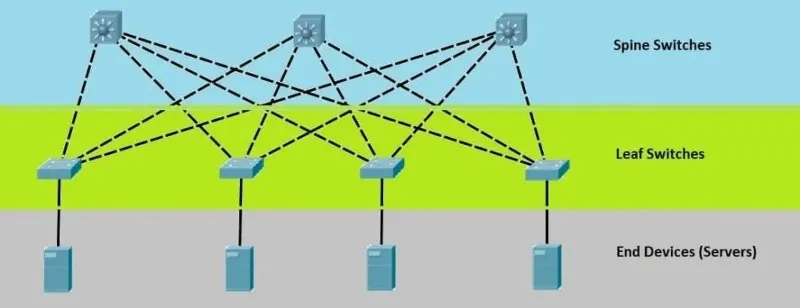
In AI training clusters, the Infinity Shuffle OXC enables deterministic cross-routing between Spine and Leaf layers. When deployed in a serial Inline Shuffle configuration-Spine connections entering from the rear and Leaf connections exiting from the front-it creates a clean hot/cold aisle structure and a predictable cabling layout.
This design aligns naturally with lean Spine architectures. A 1.6T link is physically distributed across eight Spine switches. If one Spine switch-for example, Spine #3-requires maintenance, only a single 200G channel (12.5% of total bandwidth) is redirected via ECMP to an equivalent path. The remaining capacity continues to operate, allowing training workloads to sustain approximately 1.4T throughput without disruption. Maintenance can proceed without impacting core services.
2. Simplifying Dragonfly Topologies through Physical-Layer Distribution
In high-performance computing (HPC) environments with tens of thousands of nodes, traditional Dragonfly full-mesh topologies require complex intra-group cabling. With the Infinity Shuffle OXC, inter-group optical shuffling is completed at the factory level, significantly reducing on-site complexity.
When deployed in a centralized fiber distribution frame using a parallel Shuffle topology, Spine connections are consolidated on the left side while Leaf connections are routed from the right. This creates clear physical separation between network layers. Deterministic routing ensures that within a single 1.6T link, all eight 200G channels follow independent physical paths-across different switches, fibers, and connectors-effectively eliminating the correlated failure risks associated with bundled trunk links.
3. Future-Ready for 800G and Beyond
As network bandwidth evolves toward 1.6T and 3.2T (8 × 200G or 8 × 400G), the resilience value of Shuffle architectures becomes even more pronounced. In a 3.2T deployment distributed across Spine switches (16 × 200G), a single channel failure results in only a 6.25% bandwidth reduction.
Once the Shuffle optical infrastructure is deployed, future upgrades require only optical module replacement, without changes to the physical layer. The substrate natively supports next-generation 180 μm ultra-fine fibers, ensuring compatibility with future all-optical technologies. As per-channel data rates increase-along with power consumption and failure probability-this architecture provides a stable foundation, effectively absorbing the higher risk associated with 800G and beyond, while maintaining uninterrupted service.
From Manual Complexity to Deterministic Reliability
The concept of "Shuffle" is not about randomness. It is a deterministic distribution of high-speed channels across physically independent Spine connections. Traditional operations rely on manually managing thousands of fiber links-an approach that is both inefficient and error-prone. In contrast, this architecture restructures connectivity at the physical layer, improving both operational clarity and system reliability.
By evenly distributing eight 200G channels across eight Spine switches, the system ensures that failures-whether in optical modules, fibers, or switches-remain isolated events rather than systemic outages. This fundamentally prevents large-scale disruptions in AI-driven optical networks.
Whether optimizing Leaf-Spine architectures with a leaner Spine layer, simplifying Dragonfly deployments through structured cabling, or preparing for 1.6T/3.2T future scaling with built-in fault tolerance, the Infinity Shuffle OXC provides a high-efficiency, high-reliability, and cost-effective cabling foundation for hyperscale data centers-ensuring that compute workloads remain uninterrupted by optical infrastructure constraints.