For field technicians, the choice of tools is not about quantity, but about whether the toolkit can support a complete and repeatable workflow under real-world conditions. A practical fiber optic toolkit should enable technicians to complete the entire process from cable preparation to final verification without interruption, minimizing rework and ensuring consistent link performance in fiber-to-the-home (FTTH) installations, outdoor fiber patch cord deployments, and routine maintenance tasks.
What Tools Do Fiber Technicians Really Need?
In practical field operations, fiber technicians do not simply need "more tools" - they need a structured tool system that supports the entire deployment workflow. The real requirement is the ability to move seamlessly from fiber preparation to final link validation without relying on additional equipment or external support.
At the most fundamental level, technicians need reliable fiber preparation tools that can handle different cable structures, ensuring clean stripping without damaging the core. This is followed by a high-precision cleaving tool, which is critical for achieving low insertion loss and stable connections. Without consistent cleaving quality, even the best connectors cannot deliver optimal performance.
Beyond installation, professional technicians must be equipped with termination and connection support tools that ensure accurate alignment and repeatable results, especially in FTTH and outdoor fiber patch cable deployments. However, what truly separates basic tool kits from professional ones is the inclusion of testing instruments. Tools such as a Visual Fault Locator (VFL) and an Optical Power Meter (OPM) allow technicians to verify continuity, detect faults, and measure signal loss directly on-site, eliminating guesswork and reducing rework.
Equally important, though often underestimated, are cleaning and maintenance tools. Contaminated fiber end faces are a leading cause of signal degradation, and without proper cleaning, even a perfectly installed connection can fail performance standards.
In real-world scenarios, the tools fiber technicians need are not isolated items, but a cohesive system designed to support preparation, execution, validation, and maintenance. Only with this integrated approach can technicians ensure efficient deployment, consistent quality, and long-term network reliability.
Complete Workflow-Based Tool System
A professional fiber optic tool kit should be structured around the actual deployment workflow rather than a simple list of tools. Each module below corresponds to a critical stage in the process, ensuring consistency, low loss, and verifiable results across FTTH installation, outdoor fiber patch cable deployment, and maintenance tasks.
Fiber Preparation Module
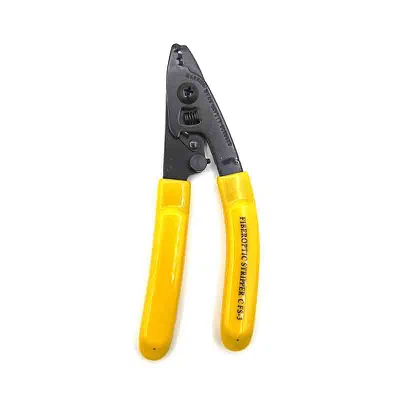
This module focuses on controlled removal of cable layers without damaging the fiber core. Tools such as Cable Stripper, Three-port Miller Pliers, Utility Knife, and Needle-nose Pliers enable technicians to handle different cable structures (250μm, 900μm, 3.0mm). Consistent preparation directly reduces the risk of micro-damage that can lead to hidden signal loss.
Precision Cleaving Module
The Fiber Optic Cleaver ensures a clean, perpendicular end face with high repeatability. A stable cleaving process (≤0.5° angle deviation) is essential for minimizing insertion loss and improving connection reliability. This module is the foundation of high-quality fiber termination.

Termination & Handling Module
This module supports connector installation and physical connection stability. With auxiliary tools such as screwdrivers and pliers, technicians can ensure proper alignment and secure connections in both indoor and outdoor environments, reducing the risk of intermittent faults caused by poor handling.
Testing & Verification Module
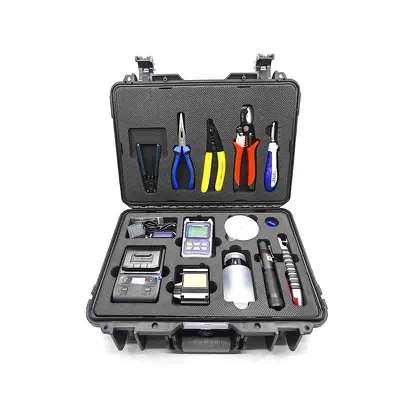
A key differentiator of a professional tool kit is the integration of testing capability. The Visual Fault Locator (VFL) enables quick identification of breaks or bends, while the Optical Power Meter (OPM) provides quantitative loss measurement. Together, they transform the workflow from installation-only to installation with real-time validation.

Cleaning & Maintenance Module
Cleaning tools such as alcohol bottles and lint-free wipes are essential for maintaining signal integrity. Removing dust and contaminants before connection prevents unexpected insertion loss and ensures long-term network stability, especially in outdoor or high-dust environments.
 |
 |
Management & Efficiency Module
This module enhances operational efficiency and traceability. A specialized tool case ensures organized storage and quick access, while a thermal label printer enables standardized cable identification, simplifying maintenance and future troubleshooting.
Why Most Tool Kits Fail in Real Projects
In field deployments, failure rarely comes from a lack of tools-it comes from gaps between tools and workflow. Many kits are assembled around basic installation tasks, but stop short of enabling verification and control. The result is a process that looks complete on paper yet remains unstable in practice.
A common issue is inconsistent end-face quality. Entry-level cleavers and imprecise preparation tools introduce micro-defects that are not immediately visible but translate into higher insertion loss and intermittent performance. Without a repeatable cleaving standard, connection quality varies from technician to technician.
Another critical gap is the absence of on-site testing. Tool kits that exclude a Visual Fault Locator or Optical Power Meter force teams to rely on assumptions. Installations are completed without real-time validation, pushing fault discovery to the acceptance stage. This not only delays delivery but also increases troubleshooting time and labor costs.
Cleaning is frequently overlooked, yet contamination remains one of the leading causes of signal degradation. Kits without a defined cleaning process allow dust and residues to persist on connector end faces, undermining otherwise correct installations and leading to unpredictable losses.
In outdoor and high-density environments, tool durability and organization also become limiting factors. Basic kits are not designed for repeated field use, leading to inefficiencies, misplaced tools, and inconsistent handling under pressure.
Ultimately, most tool kits fail because they are built as collections of items rather than integrated systems. They enable technicians to make connections, but not to verify, standardize, or sustain performance. In real projects-where acceptance criteria, timelines, and reliability targets are non-negotiable-this gap becomes the primary source of failure.
Final Summary & Contact
A reliable fiber network is not built on individual tools, but on a controlled, end-to-end workflow. From preparation and precision cleaving to connection, validation, and maintenance, each step must be executed with consistency and verified with data. This is where a complete fiber optic tool kit delivers measurable value-reducing rework, accelerating acceptance, and ensuring long-term link stability across FTTH and outdoor deployments.
If your current setup still separates installation from testing, or relies on fragmented tools, it is likely introducing hidden risks into your projects. Upgrading to a workflow-based tool system is not just an equipment decision-it is an operational upgrade.
Looking for a professional fiber optic tool kit tailored to your projects?
Contact us for customized configurations, technical support, and bulk pricing solutions aligned with your deployment requirements.