Scenario and Tool Framework
In real fiber optic engineering workflows, the starting point is not simply "which fusion splicer should we buy?" Instead, technicians first need to determine the nature of the fault: is it a splicing issue, contamination, a fiber break, reflection-related loss, or excessive total link loss?
Based on this logic, fiber optic tools can be divided into four functional layers: the construction layer, including fiber stripping, cleaving, and heat shrinking; the splicing layer, mainly represented by the fusion splicer; the basic testing layer, including VFL, light source, and optical power meter; and the diagnostic layer, such as mini fault locators or OTDRs. In data center environments, end-face inspection and cleaning are often raised to a separate priority level because connector cleanliness directly affects link stability and insertion loss.
Fluke's technical materials emphasize that OLTS and OTDR are complementary tools rather than substitutes for each other. Meanwhile, information from EXFO and VIAVI shows that in PON, metro network, and field diagnostic applications, OTDR requirements become more demanding, especially in terms of dynamic range, post-splitter testing capability, and in-service fiber testing.
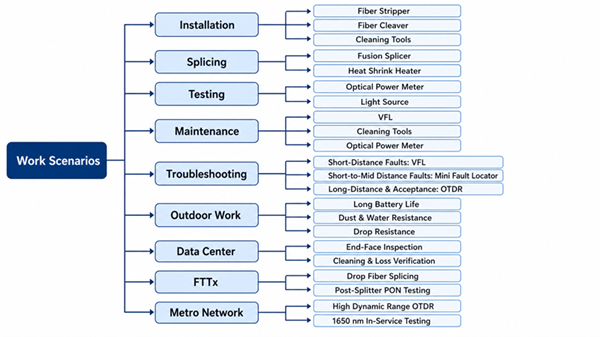
Applying this flowchart to real procurement decisions leads to several practical conclusions:
- For installation and pre-terminated cable work, there is no need to start with a high-end OTDR. However, fiber cleaving, connector cleaning, and basic insertion loss testing must be properly covered.
- For independent fusion splicing work, the quality of the fiber cleaver should not fall far behind the fusion splicer. Otherwise, a "high-end fusion splicer + low-end cleaver" setup can quickly weaken the return on your equipment investment.
- For troubleshooting, not every issue requires an OTDR. For short-distance patch cord and cabling problems, start with a VFL and end-face cleaning. For fault location in 0–60 km maintenance scenarios, a mini fault locator can be considered. Acceptance testing and more advanced long-distance diagnostics should then move up to a standard or higher-grade OTDR.
- For data center environments, the primary risks are often connector end-face contamination and reflection-related issues, rather than the long-distance routing path itself.
Common Tool Comparison
The table below uses representative models to support practical procurement decisions, rather than discussing tool categories in general terms. The "learning curve" in this report is an assessment based on automation level, UI complexity, whether trace interpretation is required, and the discipline needed in field workflows. It is not an original manufacturer parameter. Prices are estimated ranges. For imported equipment in particular, pricing can vary significantly depending on version, taxes, shipping, authorized sales channels, and whether cleavers, batteries, software options, or accessories are included.
| Tool Category | Representative Brand / Model | Key Parameters | Price Range (RMB) | Portability / Durability / After-Sales | Typical Faults & Suitable Scenarios | Learning Curve | Source |
|---|---|---|---|---|---|---|---|
| Fusion Splicer | Fujikura 90S+ | Active core alignment; 7–9s splicing; 9–15s heating; 2.8kg; approx. 300 splice + heat cycles; electrode life approx. 5,000 cycles; supports operation up to 5,000m altitude | Approx. 40,000 | Medium portability; suitable as a main field unit; clear official annual service system | Backbone networks, metro networks, high-quality splicing, batch deployment | Medium | |
| Fusion Splicer | Sumitomo T-57C+ | Adaptive core alignment; 6s splicing; 15s heating; 2.0kg including battery; approx. 300 cycles; IP52; 6,000m altitude; electrode life approx. 6,000 cycles | Approx. 29,000–31,000 | Good portability; strong outdoor adaptability; demo/retail units commonly offer 12-month warranty | Outdoor construction, FTTx, access network splicing, beginner-friendly high-quality solution | Low–Medium | |
| Fusion Splicer | Fujikura 41S+ | Cladding alignment; 6–7s splicing; 25–27s heating; 1.3kg; approx. 200 cycles; 5,000m altitude; electrode life approx. 5,000 cycles | Approx. 23,000–25,000 | Excellent portability; suitable for backpack field work; clear annual service logic | Maintenance repair, access network splicing, lightweight deployment | Medium | |
| Fusion Splicer | INNO View 7 | Core alignment; 520x magnification; 13s heating; approx. 355 cycles; 5-inch touchscreen | Approx. 31,000–39,000 | Strong visual interface; training-friendly; price depends on new unit or sales channel | High-visibility splicing, training, campus/backbone splicing | Medium | |
| Fusion Splicer | Signal Fire AI-10A | 6 motors; approx. 6s splicing; 15s heating; 7800mAh battery; approx. 240 cycles; emphasizes integrated and compact design | Approx. 4,100–4,900 | High portability; after-sales support depends heavily on channel and authorization | FTTx, home installation, economical field splicing, cost-sensitive projects | Low | |
| Optical Power Meter | Joinwit JW3208A / JW3208C | JW3208A: -70 to +6 dBm; JW3208C: -50 to +26 dBm; uncertainty ±0.25; battery life approx. 130h; 160g | Approx. 200–220 | Extremely portable; domestic documentation and service channels are clear | Total loss verification, transmit/receive power troubleshooting, maintenance inspection | Low | |
| Stabilized Light Source | Joinwit JW3111 | 1–4 wavelength options; common wavelengths include 1310/1550nm; output approx. -6 to -7 dBm; 45h battery life; 300g | Approx. 680–700 | Good portability; high value when paired with an optical power meter | Forms an OLTS with a power meter, suitable for installation, loss verification, and maintenance | Low | |
| Mini Fault Locator | Joinwit JW3304N | 1550nm; reflective events up to 60km; non-reflective events approx. 20km; 15m dead zone; built-in VFL; approx. 450g | Approx. 3,000–5,400 | Lightweight and field-friendly; easier to learn than a full OTDR | Short- to mid-distance fiber breaks, post-repair verification, simple event location | Low–Medium | |
| OTDR | EXFO MaxTester 730D | Designed for PON/metro applications; can test through up to 1x128 splitters; 1650nm in-service fiber testing; 7-inch sunlight-readable screen; approx. 12h battery life | From approx. 35,000; higher-end authorized retail configurations may reach 77,000–130,000 | Professional-grade; focused on diagnostics and acceptance testing; supported by global calibration system | FTTH/PON, metro networks, in-service fiber, acceptance testing, deep fault location | Medium–High | |
| OTDR | VIAVI SmartOTDR | 1310/1550nm + 1625/1650nm versions; optional VFL/OPM/microscope; 5-inch touchscreen; 17h battery life; supports 1x128 PON | Approx. 25,000–61,000 | Lightweight with high integration; emphasizes automatic analysis and cloud/connectivity features | Access networks, metro networks, rapid field diagnostics, process-based testing | Medium | |
| Fiber Cleaver | Fujikura CT16 | Cuts up to 2 fibers simultaneously; cleave angle 0.3°–0.9°; blade life approx. 48,000 fibers; 190g | Approx. 2,500 | Compact and lightweight; suitable for pairing with lightweight fusion splicers | Core process affecting splice loss and rework rate | Low–Medium | |
| Fiber Cleaver | Sumitomo FC-6R+ | Supports single fiber to 12-fiber ribbon; typical cleave angle 0.5°; blade life approx. 60,000 fibers; 440g; automatic blade rotation | Approx. 3,300 | Strong stability; more suitable for bench or workstation use | High-frequency construction, both ribbon and single-fiber work, consistent cleaving quality | Medium | |
| Fiber Stripper | Ripley Miller CFS-2 | Dual-hole design; handles 1.6–3mm outer jacket, 900µm tight buffer, and 250µm coating down to 125µm bare fiber | Original approx. 190; domestic alternatives are lower | Small size and long service life; original units offer better consistency | Incorrect stripping, scratched bare fiber, and contamination before end-face preparation | Low | |
| Cleaning Tool | Fluke Quick Clean / General One-Click Cleaner | Quick Clean mechanical dry cleaning; one unit cleans 525+ end faces; crush resistance >250N; drop resistance >1.5m; domestic single units commonly reach around 800 cleaning cycles | General type approx. 15–50; imported branded multi-pack options can reach around 3,000 | Highly relevant for data centers and high-density patching; original accessories vary by packaging and channel | End-face contamination, reflection, bit errors, abnormal insertion loss | Low | |
| Heat Shrink Heater | External heat shrink oven units, such as YT-6 / YY-6 | Suitable as a backup for the built-in heater of a fusion splicer or as a dedicated workstation heater | Approx. 286–628 | Low-cost backup equipment; brand consistency varies significantly | Batch heat shrinking, backup when the built-in heater fails | Low |
One procurement conclusion that is easily underestimated is this: the fiber cleaver is not just an accessory. It is a performance amplifier that determines whether a fusion splicer can fully deliver its expected results. Machines such as the Fujikura 41S+, Sumitomo T-57C+, and Fujikura 90S+ already offer strong automation and reliable splice quality. However, if the cleave angle fluctuates, the bare fiber is damaged during stripping, or the end face is not properly cleaned, even a high-end splicer will be forced into repeated rework.
At the same time, a high-spec OTDR is not mandatory for every project. For access network maintenance, patch cord faults, or short-distance break location, a mini fault locator can already cover many high-frequency work orders. However, once the task involves post-splitter PON links, metro networks, in-service fiber testing, or acceptance scenarios that require documented trace reports, the value of a professional OTDR becomes significantly more apparent.
Tiered Recommended Tool Kits
Here is the overall judgment first: if you are a junior technician, prioritize a tool combination that is workflow-friendly, easy to learn, and able to reduce rework. If you are an intermediate technician, prioritize a main field kit that can be used reliably every day. If you are an advanced technician, it is better to split the tool system into a primary field kit and a secondary backup kit, rather than carrying the same full equipment box for every task.
One point should be emphasized: low-budget kits are not suitable as the only equipment for independent splicing and acceptance testing. They should be understood as inspection kits, pre-terminated cable kits, maintenance kits, or backup kits.
| Experience Level | Budget | Recommended Kit | Main Components | Estimated Total Price | Suitable Scenarios | Main Advantages | Main Limitations | Pricing Basis |
|---|---|---|---|---|---|---|---|---|
| Junior | Low | Entry-Level Pre-Terminated Inspection Kit | Joinwit JW3208A + Joinwit JW3111 1310/1550 + general FTTH tool kit, including stripper, cleaver, and portable case + one-click cleaner | Approx. RMB 1,100–1,500 | Data center patch cords, equipment room maintenance, home pre-terminated installation, basic inspection | Lowest learning curve; supports loss verification; low investment | Cannot perform independent splicing; cannot locate mid- to long-distance events | |
| Junior | Medium | FTTx Growth Splicing Kit | Signal Fire AI-10A + Joinwit JW3208A + cleaning pen + heat shrink sleeves, alcohol wipes, and spare electrode mini kit | Approx. RMB 4,800–6,200 | FTTH home installation, small-scale deployment, outdoor emergency repair | Reaches the threshold for independent splicing; high automation level; strong cost performance | Brand and channel after-sales support vary significantly; weak deep diagnostic capability | |
| Junior | High | Stable Construction Upgrade Kit | Sumitomo T-57C+ + FC-6R+ + Joinwit JW3208A + Joinwit JW3111 + CFS-2 | Approx. RMB 31,000–34,000 | High-quality access network construction, mixed campus/backbone work | AI and UI are user-friendly; outdoor durability is strong; cleaving and splicing quality are both more stable | High CAPEX; may be somewhat overconfigured for junior technicians | |
| Intermediate | Low | Data Center Maintenance Kit | Joinwit JW3208A + Joinwit JW3111 + Ripley CFS-2 + one-click cleaner + general tool kit | Approx. RMB 1,300–1,800 | Data centers, equipment rooms, pre-terminated cabling, maintenance duty | Complete cleaning and loss-testing workflow; well suited for standardized operations | No OTDR; no independent splicing capability | |
| Intermediate | Medium | Field Splicing Maintenance Kit | Signal Fire AI-10A + Joinwit JW3208A + Joinwit JW3111 + CFS-2 + cleaning pen + heat shrink consumables | Approx. RMB 5,600–7,500 | FTTx, video surveillance networks, campus maintenance, daily fault repair | Controlled cost; strong frontline suitability; covers both splicing and loss verification | Cannot replace an OTDR; complex faults still require borrowed or rented test equipment | |
| Intermediate | High | Lightweight High-Quality Construction Kit | Fujikura 41S+ + Fujikura CT16 + Joinwit JW3208A + Joinwit JW3111 + cleaning tools | Approx. RMB 27,000–30,000 | High-quality access network splicing, maintenance repair, backpack field work | Lightweight main unit; low rework rate; better balance between cleaving and splicing quality | Still lacks an OTDR; purchase price is significantly higher than economical options | |
| Advanced | Low | Standby Emergency Secondary Kit | COMPTYCO AUA-MC70 4-in-1, mini power meter + VFL solution + Ripley CFS-2 + one-click cleaner + general stripping/cutting tools | Approx. RMB 400–900 | Backup kit for advanced technicians, remote troubleshooting, spare field tool box | Extremely portable; very low cost; highly practical as a secondary kit | Does not provide acceptance-grade accuracy; not suitable as a primary field kit | |
| Advanced | Medium | Advanced Fault Location Kit | Joinwit JW3304N + Joinwit JW3208A + Joinwit JW3111 + cleaning pen + CFS-2 | Approx. RMB 4,000–6,500 | Operations and maintenance, break location, post-repair verification, hidden fault troubleshooting | Efficient for 0–60 km fault location; built-in VFL; quick to learn | Not a complete OTDR acceptance solution; does not solve the splicing process itself | |
| Advanced | High | Backbone and Metro Primary Field Kit | Fujikura 90S+ + EXFO MaxTester 730D + FC-6R+ + JW3208A/JW3111 + Quick Clean + spare electrodes + launch/receive fibers | Approx. RMB 80,000–160,000+ | Metro networks, PON/post-splitter testing, in-service fiber testing, acceptance testing, trace reporting, complex fault diagnosis | Covers the full workflow from splicing to diagnostics and reporting; suitable as a team's primary field kit | High initial investment; must be supported by annual calibration, launch/receive fibers, and training |
If your main work area is FTTx and access networks, the most balanced ROI is usually found in the intermediate / medium-budget tier.
If your main work area is data centers, there is no need to blindly invest in an expensive OTDR first. The budget should go first into end-face inspection, cleaning discipline, and a reliable loss-testing workflow.
If your main work area is metro networks, PON, or projects that require formal handover documentation, an OTDR should no longer be treated as optional. It should be considered part of the primary field system. At the same time, launch/receive fibers and calibration must also be included in the budget.
FOCC Supply Capability
As a fiber optic communication product manufacturer with more than 10 years of export experience, FOCC provides practical, project-oriented supply support for fiber optic installation, testing, maintenance, and network deployment scenarios.
Our supply capability is not limited to single tools or standalone components. Based on different field requirements, FOCC can help customers build complete fiber optic tool kits for FTTx installation, data center maintenance, outdoor construction, access network repair, and metro network troubleshooting. From fiber strippers, cleavers, cleaning tools, VFLs, optical power meters, light sources, mini fault locators, to OTDR-related accessories, we support flexible configuration according to budget level, technician skill level, and actual working environment.
For contractors, telecom operators, system integrators, and distributors, FOCC can provide one-stop fiber optic cabling solutions together with matching accessories. Our product range covers fiber optic patch cords, FTTA CPRI patch cords, MPO/MTP patch cords, adapters, patch panels, ODF/MDF/DDF frames, FTTx products, cabinets, and related fiber optic installation accessories. This allows customers to purchase not only the cable assemblies, but also the supporting tool and maintenance system required for deployment and long-term operation.
With a 5,000-square-meter dust-free workshop and an experienced production team, FOCC focuses on stable quality, flexible OEM support, and export-oriented service. We can support standard product supply, customized configurations, private label cooperation, bulk order packaging, and project-based procurement requirements.
Need Help Choosing the Right Fiber Optic Tool Kit?
Choosing fiber optic tools should not start with the highest-priced equipment. It should start with your real job site: FTTx installation, data center patching, outdoor repair, metro network testing, PON troubleshooting, or routine maintenance.
If you are not sure which tool combination is suitable for your team, FOCC can help you build a practical procurement plan based on:
| Your Requirement | FOCC Can Help With |
|---|---|
| FTTx / FTTH installation | Entry-level and field-ready splicing tool kits |
| Data center maintenance | Cleaning, inspection, VFL, OPM, and loss testing solutions |
| Outdoor construction | Portable, durable, and job-site-friendly tool combinations |
| Access network repair | VFL, mini fault locator, optical power meter, and splicing support |
| Metro / PON projects | OTDR-related configuration planning and supporting accessories |
| Distributor supply | OEM packaging, bulk supply, and product portfolio matching |
Before purchasing, you can send us your working scenario, target budget, preferred tool list, and project quantity. FOCC will help you compare suitable configurations and recommend a more cost-effective solution instead of simply pushing the most expensive option.
Build your fiber optic tool kit with FOCC - from installation to testing, from maintenance to troubleshooting.