Choosing an MPO cable is not only about selecting a higher fiber count. For data center engineers, system integrators and procurement teams, the real question is whether the MPO cable matches the optical transceiver, lane design, polarity plan, patch panel architecture and future upgrade path.
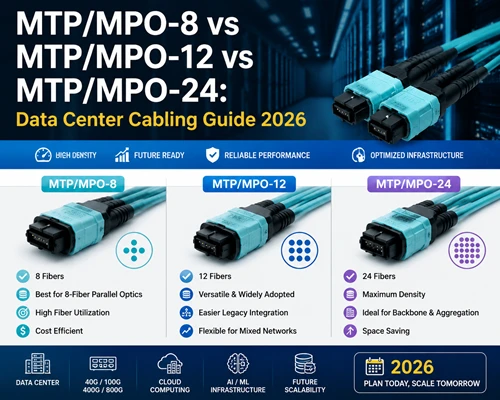
A 12 fiber MPO cable is still widely used in 40G and 100G SR4 applications because it is mature, cost-effective and easy to integrate with existing infrastructure. A 16 fiber MPO cable is increasingly used in 400G and 800G parallel optics where 8 transmit and 8 receive lanes are required. A 24 fiber MPO trunk cable is often selected for high-density backbone cabling, cassette-based distribution and structured cabling systems. A 32 fiber MPO cable is more future-facing and is usually considered for ultra-high-density or next-generation optical architectures rather than standard data center deployments.
For 400GBASE-SR8, industry materials show that both dual-row 12-fiber MPO and single-row 16-fiber MPO interface options have been discussed and used in parallel optics designs. Juniper's 400G optics documentation also notes that 400G SR8 may use MPO-16, while some 400G MPO-12 solutions use only 8 of the 12 fiber positions, leaving 4 unused. This is why fiber count selection must be based on actual module interface and network design, not only on cable availability.
Which MPO Fiber Count Should You Choose?

For 40G/100G SR4 links, choose a 12 fiber MPO cable. It is the most common and cost-effective choice for current data center networks, especially when existing MPO-12 panels, cassettes or trunks are already deployed.
For 400G/800G SR8 or other 8-lane parallel optics, choose a 16 fiber MPO cable when the transceiver interface requires MPO-16. It provides cleaner lane utilization because all 16 fibers can be used for 8 transmit and 8 receive channels.
For high-density structured backbone cabling, choose a 24 fiber MPO trunk cable. It is suitable for cassette-based distribution, high-density patching and multi-link aggregation where more fibers need to be managed through fewer cable assemblies.
For future ultra-high-density systems, consider 32 fiber MPO only when the equipment roadmap clearly supports it. It is not the default choice for most current data center projects, but it may be useful for specialized high-density optical systems.
Comparison Table: 12, 16, 24 and 32 Fiber MPO Cable
| Fiber Count | Best-Fit Application | Main Advantage | Key Limitation |
|---|---|---|---|
| 12 fiber MPO cable | 40G SR4, 100G SR4, breakout links, existing MPO-12 infrastructure | Mature, economical, easy to source, strong compatibility | Some fibers may remain unused in 8-fiber applications |
| 16 fiber MPO cable | 400G SR8, 800G SR8 and 8-lane parallel optics | Efficient 8Tx + 8Rx lane mapping, high density, suitable for next-generation optics | Not directly compatible with 12/24 fiber MPO interfaces due to offset keying |
| 24 fiber MPO trunk cable | High-density backbone, cassette systems, multi-link aggregation | More fibers per trunk, cleaner cable pathway, good for structured cabling | Requires correct cassette, polarity and channel planning |
| 32 fiber MPO cable | Future-ready, ultra-high-density or special optical systems | Highest density among the four options | Less common, higher cost, limited equipment compatibility today |

12 Fiber MPO Cable: Mature Choice for 40G and 100G Networks
A 12 fiber MPO cable is one of the most common solutions in data center cabling. It is widely used in 40GBASE-SR4 and 100GBASE-SR4 applications, where 4 transmit fibers and 4 receive fibers are used. In this type of architecture, 8 fibers are active and 4 fibers may remain unused.
The advantage of MPO-12 is its mature ecosystem. Many existing patch panels, cassettes, fanout cables and transceiver connections are designed around MPO-12. For enterprises upgrading from 10G to 40G or 100G, a 12 fiber MPO cable provides a practical balance between performance, compatibility and cost.
It is also suitable for breakout applications, such as MPO to LC harness cables. For example, one 12 fiber MPO connector can be converted into multiple duplex LC channels, helping simplify cabinet cabling and reduce cable congestion.
Choose 12 fiber MPO cable when your network is mainly based on 40G/100G links, when your panels are already MPO-12 based, or when budget control is more important than long-term 800G scalability.
16 Fiber MPO Cable: Designed for 400G and 800G Parallel Optics
A 16 fiber MPO cable is becoming more important in high-speed data center networks. It is especially relevant for 400G and 800G parallel optics that use 8 transmit lanes and 8 receive lanes.
Compared with MPO-12, MPO-16 can use all 16 fibers in an 8Tx + 8Rx architecture. This avoids the unused fiber positions that often appear in MPO-12-based parallel solutions. For high-density AI clusters, cloud data centers and switch-to-switch interconnects, this cleaner lane mapping can improve fiber utilization and make cabling more organized.
MPO-16 has a different keying design from MPO-12 and MPO-24. Fluke Networks notes that 8-, 12- and 24-fiber MPO connectors use a center key, while 16- and 32-fiber MPO connectors use an offset key to the left. This prevents accidental mating between incompatible MPO formats, but it also means buyers must confirm connector type, adapter type and transceiver interface before ordering.
Choose 16 fiber MPO cable when your project is moving toward 400G/800G parallel optics, when the equipment port is specified as MPO-16, or when you want better lane efficiency for 8-channel optical transmission.
24 Fiber MPO Trunk Cable: High-Density Backbone for Structured Cabling
A 24 fiber MPO trunk cable is not simply "two 12 fiber MPO cables combined." It is a high-density cabling option often used in backbone links, cross-connect areas, cassette systems and high-density data center distribution frames.
The main value of a 24 fiber MPO trunk cable is pathway efficiency. Instead of pulling many small cable assemblies through trays or cabinets, one 24 fiber MPO trunk can carry more fibers in a compact structure. This helps reduce cable volume, improve airflow and simplify long-term cable management.
MPO-24 is also useful when a data center needs to support mixed applications through cassettes, such as MPO-to-LC distribution, multiple 10G/25G duplex links, or migration paths from legacy duplex connections to parallel optics.
However, 24 fiber MPO trunk cable requires careful planning. The polarity method, cassette wiring, male/female connector configuration and fiber mapping must match the network design. Otherwise, the link may be physically connected but optically incorrect.
Choose 24 fiber MPO trunk cable when you are building high-density backbone cabling, when you use modular cassettes, or when you need a more structured cabling system for future network expansion.
32 Fiber MPO Cable: Future-Ready but Not Always Necessary
A 32 fiber MPO cable is mainly positioned for ultra-high-density optical infrastructure and future network evolution. It can provide more fiber channels in a single connector format, but it is not yet the mainstream choice for most enterprise or standard cloud data center deployments.
The biggest advantage of MPO-32 is density. It may be suitable for future 1.6T or higher-speed systems, optical switching environments, or specialized equipment with very high fiber-count requirements. However, the current challenge is compatibility. Equipment ports, adapters, test tools and standard deployment experience are still more mature around MPO-12, MPO-16 and MPO-24.
The practical advice is simple: do not choose 32 fiber MPO cable only because it looks more future-proof. Choose it only when your equipment vendor, transceiver roadmap and cabling architecture clearly require it.
MPO Cable Selection by Network Speed
If your network is currently based on 40G and 100G, start with 12 fiber MPO cable. It is mature, cost-effective and compatible with many existing data center cabling systems.
If you are deploying new 400G or 800G links, especially for AI, cloud or high-density switch interconnection, check whether your transceiver requires 16 fiber MPO. If yes, MPO-16 should be treated as the preferred choice.
If you are building a structured backbone system with modular cassettes, choose 24 fiber MPO trunk cable. It provides higher fiber density and cleaner cable management, especially for larger data center projects.
If you are planning beyond 800G, evaluate 24 fiber or 32 fiber MPO carefully. Do not select 32 fiber MPO only for marketing reasons. Use it when the equipment, optical module and infrastructure roadmap clearly support that architecture.
Why Work with FOCC for MPO Cable Solutions?
FOCC provides customized MPO/MTP cable assemblies for data center, telecom, FTTX and high-density optical cabling applications. As a fiber optic OEM manufacturer, FOCC can support different MPO cable configurations, including 12 fiber MPO cable, 16 fiber MPO cable, 24 fiber MPO trunk cable, MPO to LC breakout cable, MPO patch cable and customized high-density trunk assemblies.
FOCC can help buyers define the right cable structure based on fiber count, polarity, connector gender, fiber type, jacket material, length, insertion loss requirement and packaging standard. For project-based procurement, this is more reliable than simply selecting a cable by fiber count alone.
FAQ
What is the difference between 12 fiber and 16 fiber MPO cable?
A 12 fiber MPO cable usually has a center-key connector and is widely used in 40G/100G SR4 networks. A 16 fiber MPO cable uses a different offset-key design and is commonly associated with 400G/800G parallel optics that require 8 transmit and 8 receive lanes.
Is 16 fiber MPO required for 800G?
Not always. Some 800G optical modules may use MPO-16, while others may use dual MPO-12, LC, CS or other connector interfaces. The correct cable must be selected according to the actual transceiver datasheet.
When should I choose a 24 fiber MPO trunk cable?
Choose a 24 fiber MPO trunk cable when you need high-density backbone cabling, modular cassette distribution, cleaner cable pathways or multi-link aggregation in a structured data center environment.
Can 12 fiber MPO and 24 fiber MPO be used together?
They may both use center-key connector designs, but they are not the same optical channel structure. MPO-24 uses a dual-row fiber arrangement, while MPO-12 uses a single-row structure. Direct use without correct cassette or conversion design can cause incorrect channel mapping.
What is the main risk of choosing the wrong MPO cable?
The main risks include polarity mismatch, unused fibers, incompatible keying, wrong connector gender, excessive insertion loss and future upgrade limitations.
Should I use multimode or single-mode MPO cable?
For short-reach data center links, OM3/OM4 multimode MPO cable is common. For longer distances or single-mode optical modules, OS2 single-mode MPO cable should be selected. The fiber type must match the optical transceiver.