The MPO fiber connector is one of the most important products in this trend. Unlike LC, SC, or FC connectors, an MPO connector can integrate multiple fibers into one compact interface and support multi-channel parallel transmission. For data centers that require a large number of high-speed ports, MPO connectors help save rack space, reduce cable volume, simplify cable management, and provide a clearer physical-layer path for future upgrades from 400G to 800G and 1.6T.
For buyers, system integrators, and data center engineering teams, choosing an MPO connector is not only about fiber count or price. The factors that truly affect long-term project stability include insertion loss, return loss, end-face quality, polarity, male/female configuration, fiber type, polishing method, and factory testing capability. This article explains the value of MPO fiber connectors from three angles: technical structure, application scenarios, and practical selection logic.
What Is a Fiber Optic Connector?
A fiber optic connector is a core passive component in optical communication systems. It provides a detachable connection between fiber and fiber, or between fiber and equipment. Its basic function is to hold the fiber end face in place and ensure accurate core alignment, allowing optical signals to pass through with minimal loss.
Based on the number of fibers being connected, fiber optic connectors can generally be divided into two categories: single-fiber connectors and multi-fiber connectors.
Single-fiber connectors mainly include LC, SC, FC, and ST types. They usually use ceramic ferrules, and each connector is designed for one fiber. These connectors are widely used in traditional telecom networks, FTTH systems, ODF frames, optical module interfaces, and equipment patching.
Multi-fiber connectors are represented by MPO/MTP connectors. They use MT multi-fiber ferrules and can align multiple fibers in a single connector. Compared with single-fiber connectors, multi-fiber connectors are better suited for high-density, high-bandwidth, parallel transmission, and large-scale port deployment scenarios, such as data center backbone cabling, MPO pre-terminated systems, 400G/800G optical module connections, and AI cluster interconnects.
What Is an MPO Connector?
MPO stands for Multi-Fiber Push-On. It is a high-density multi-fiber connector that uses an MT ferrule, guide pins, guide pin holes, spring mechanism, housing, and latch structure to align multiple fibers precisely within one interface.
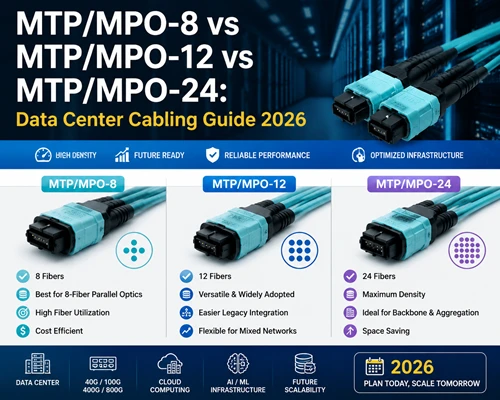
Compared with LC or SC connectors, the key advantage of MPO is high density. One MPO interface can support different fiber counts, such as 8 fibers, 12 fibers, 16 fibers, 24 fibers, and 32 fibers. This makes it suitable for parallel optical transmission and high-density fiber cabling systems.
In real projects, MPO connectors are commonly used in the following product forms:
| Product Type | Main Application |
|---|---|
| MPO trunk cable | High-density backbone connection between data center cabinets and distribution areas |
| MPO-LC breakout cable | Converts an MPO multi-fiber interface into multiple LC interfaces for optical modules or patching equipment |
| MPO patch cable | Direct connection between high-speed optical modules or network devices |
| MPO adapter | Mating interface for MPO connectors and panel installation |
| MPO pre-terminated cable assembly | Fast deployment, reduced field splicing, and lower installation error rate |
The value of an MPO connector is not simply that it places multiple fibers inside one connector. Its real value is that it combines pre-termination, standardized polarity, and factory testing to turn complex multi-fiber links into manageable, deployable, and verifiable cabling systems.
MPO vs MTP: What Is the Difference?
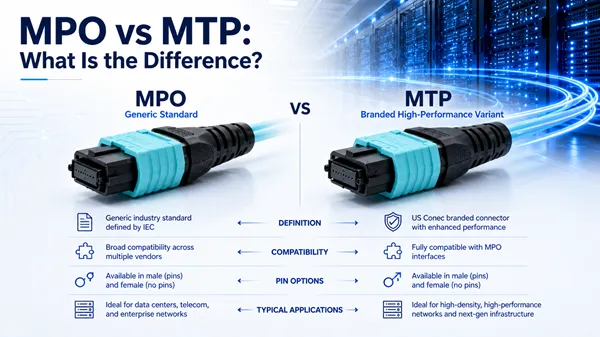
In the market, MPO and MTP are often mentioned together, but they are not exactly the same.
MPO is the generic type of multi-fiber push-on connector. MTP® is a branded MPO connector developed by US Conec. In simple terms, MTP is a high-performance branded connector within the MPO connector family. It usually has more advanced design features in mechanical structure, guide pin design, spring design, and ferrule floating performance.
For buyers, MTP should not be understood as a completely different connector type. A more accurate comparison is as follows:
| Item | MPO | MTP® |
|---|---|---|
| Type | Generic multi-fiber push-on connector | Branded connector within the MPO connector family |
| Application | Data centers, backbone cabling, optical module connection | High-performance and high-reliability MPO applications |
| Compatibility | Matches MPO adapters and cable systems | Usually compatible with MPO systems, depending on project requirements |
| Purchasing Focus | Insertion loss, return loss, polarity, fiber count, end-face quality | In addition to basic performance, brand specification and project approval may be required |
If the customer drawing or project specification clearly requires MTP®, quotation and production should follow the specified brand requirement. If the project only requires MPO multi-fiber connectors, standard-loss or low-loss MPO solutions can be selected based on budget, performance level, and delivery schedule.
Why Are MPO Connectors Becoming More Important in 400G/800G Data Centers?
The development of high-speed optical networks is driving changes in connection methods. In the 40G/100G era, MPO-12 and MPO-24 connectors were already widely used for parallel optical links and high-density backbone cabling. In the 400G and 800G era, optical module channel counts, port density, and cabling complexity have increased further, making MPO connectors even more important.
Take 800G DR8 as an example. This type of parallel single-mode application typically requires 8 transmit lanes and 8 receive lanes, meaning 16 fiber channels. As a result, the MPO-16/APC interface has become one of the common interface choices for 800G DR8 optical modules. Compared with using multiple single-fiber connectors, MPO-16 can complete multi-channel transmission and reception within one interface, significantly reducing front-panel space usage and cable management complexity.
In AI training clusters and large-scale data centers, network architectures often use high-density leaf-spine or similar topologies. A large number of high-speed optical links are required between switches. If every link depends on single-fiber connectors, cable volume inside the cabinet will quickly increase, and later maintenance and troubleshooting will become more complicated. MPO connectors enable multi-fiber parallel transmission and pre-terminated deployment, shifting cabling from "field-by-field connection" to "modular fast deployment." This is more efficient for installation and more manageable for long-term operation.
Key Technical Advantages of MPO Connectors
The first advantage of MPO connectors is high density. A single MPO interface can carry multiple fibers, enabling higher port capacity within the same panel space. For data centers, cloud computing facilities, and high-density distribution areas, this means better space utilization and cleaner cable management.
The second advantage is deployment efficiency. MPO cables are usually factory pre-terminated. Before delivery, they can be tested for end-face quality, insertion loss, return loss, and polarity. During installation, large amounts of field splicing and field termination are not required. This shortens deployment time and reduces human error.
The third advantage is support for high-speed parallel transmission. Applications such as 400G DR4 and 800G DR8 require multi-channel parallel optical connections. MPO connectors can directly match the interface requirements of these optical modules, making them suitable for short-distance data center interconnects and high-bandwidth equipment connections.
The fourth advantage is system scalability. By combining MPO trunk cables, MPO-LC breakout cables, cassette modules, and fiber patch panels, data centers can gradually upgrade from 10G/25G to 100G/400G/800G without rebuilding the entire cabling infrastructure.
How to Choose the Right MPO Fiber Count

MPO connectors are not a case of "more fibers are always better." Different fiber counts match different optical module architectures, cabling densities, and upgrade strategies. Selection should be based on current equipment interfaces, future upgrade paths, and link budget requirements.
| MPO Fiber Count | Common Applications | Selection Notes |
|---|---|---|
| 8-fiber MPO | 40G/100G SR4 and some 400G parallel optical applications | Suitable for 4 transmit and 4 receive parallel transmission; reduces unused fibers compared with 12-fiber systems |
| 12-fiber MPO | 40G/100G, data center backbone, MPO-LC breakout | The most widely used option with strong compatibility for general backbone cabling |
| 16-fiber MPO | 800G DR8 and some high-speed single-mode parallel applications | Suitable for 8 transmit and 8 receive architectures; important for 800G applications |
| 24-fiber MPO | High-density backbone, 100G SR10, aggregated cabling | Suitable for high-density pre-terminated systems, but polarity management must be carefully handled |
| 32-fiber MPO | Ultra-high-density interconnects and future high-speed link reserve | More suitable for high-end and customized applications; equipment compatibility must be confirmed before purchase |
For general data center backbone cabling, 12-fiber and 24-fiber MPO solutions remain mainstream. For 800G DR8 or future AI cluster high-speed interconnects, 16-fiber MPO should be carefully evaluated. For projects with extremely high port density requirements, 24-fiber, 32-fiber, or higher-density customized cable assemblies may be considered. However, optical module interface, polarity, and test standards must be confirmed at the same time.
Key Performance Parameters of MPO Connectors
The performance of an MPO connector should not be judged only by appearance or fiber count. The real factors that determine link stability are insertion loss, return loss, end-face geometry, polarity accuracy, and end-face cleanliness.
Insertion loss is one of the most important parameters in MPO connector selection. Lower insertion loss means more link budget margin and better stability for high-speed transmission. In data center links with multiple connection points, if the insertion loss at each point is not well controlled, the total link budget may become insufficient and affect optical module operation.
Return loss is also important, especially in single-mode APC connector and high-speed optical module applications. APC end-face polishing uses an angled surface to reduce the chance of reflected light returning into the fiber core. It is more suitable for high-speed single-mode systems that are sensitive to reflection. Multimode MPO connectors usually use PC end faces, while single-mode MPO connectors in high-speed applications commonly use APC end faces.
End-face geometry is another important indicator of high-quality MPO products. Multi-fiber connectors must maintain consistent fiber height, angle, and array alignment across multiple fibers. If one fiber protrudes or is recessed too much, it may cause poor contact, higher insertion loss, or even end-face damage. Professional MPO production usually requires multi-fiber interferometer testing for 3D end-face inspection.
End-face cleanliness should not be ignored. MPO connectors have multiple fibers and a larger end-face area, so dust, oil, and scratches can have a more obvious effect on link performance. In real deployment, MPO end faces should be cleaned and inspected before mating to avoid unnecessary link failures caused by contamination.
Main Application Scenarios of MPO Connectors

Data Center Backbone Cabling
MPO trunk cables are widely used for high-density connections between MDA, HDA, EDA, and other distribution areas in data centers. Compared with field splicing or large quantities of LC patch cords, MPO pre-terminated trunk cables improve deployment efficiency and make future expansion more modular.
In large data centers, MPO trunks are often used together with patch panels, cassette modules, and MPO-LC breakout cables. This keeps the backbone area high-density while converting to LC interfaces on the equipment side to meet the requirements of different optical modules and switch ports.
400G/800G High-Speed Optical Module Interfaces
MPO connectors are important interfaces for many parallel optical modules. Applications such as 40G SR4, 100G SR4, 400G DR4, and 800G DR8 are closely related to MPO multi-fiber connections. Different speeds and transmission standards require different MPO fiber counts. During procurement, the correct MPO structure must be selected according to the optical module specification.
For example, 800G DR8 usually involves 16-fiber single-mode parallel connection. Therefore, MPO-16, APC polishing, single-mode fiber type, and low-loss performance level should be carefully confirmed.
MPO-LC Breakout Connection
MPO-LC breakout cables are used to convert one MPO multi-fiber interface into multiple LC duplex interfaces. This structure is very common in data center patching, switch port connection, and optical module adaptation.
When purchasing MPO-LC breakout cables, buyers should confirm not only the MPO-end fiber count, but also LC breakout length, breakout structure, cable diameter, jacket material, polarity, and labeling rules. For large projects, clear numbering and packaging directly affect on-site deployment efficiency.
CPO Optical Interconnects and High-Density Switches
CPO, or Co-Packaged Optics, places optical engines closer to the switch ASIC to shorten high-speed electrical paths, reduce power consumption, and improve system integration. Although CPO changes the connection method between traditional optical modules and switch chips, it does not reduce the demand for fiber connections. Instead, CPO systems place higher requirements on high-density fiber interfaces, internal fiber management, and front-panel breakout solutions.
In some CPO and silicon photonics-related solutions, fiber connections may involve more complex multi-fiber connectivity, low-loss control, polarization management, and highly consistent end-face quality. These applications require stronger manufacturing and testing capabilities from MPO connector suppliers.
FOCC MPO/MTP Fiber Connector and Cable Assembly Supply Capability
As a fiber optic communication product manufacturer, FOCC provides various MPO/MTP fiber connectors and pre-terminated cable assemblies for data centers, high-density cabling, FTTx, telecom networks, and system integration projects.
FOCC can support MPO trunk cables, MPO patch cables, MPO-LC breakout cables, MPO adapters, MPO pre-terminated cable assemblies, low-loss MPO connectors, and customized multi-fiber cable assemblies based on project requirements. Products can be configured with single-mode or multimode fiber, including OS2, OM3, and OM4 fiber types, and can be supplied with PC or APC polishing according to project specifications.
For bulk delivery, FOCC can customize production according to customer drawings, equipment interfaces, and cabling designs. Custom options include fiber count, cable length, jacket material, polarity type, male/female configuration, labeling rules, packaging method, and OEM branding. For data center projects, FOCC can also support end-face inspection, insertion loss testing, return loss testing, and polarity testing to help customers reduce field deployment risks.
If your project involves 400G/800G optical module connection, MPO backbone cabling, MPO-LC breakout cables, 16-fiber MPO connectors, or CPO high-density optical interconnects, we recommend providing the following information during inquiry: application scenario, transmission rate, optical module type, MPO fiber count, single-mode or multimode fiber type, cable length, polarity, end-face type, insertion loss requirement, and packaging or labeling requirements. This allows FOCC to provide a more accurate quotation and a practical product solution.
FAQ
1. What is an MPO connector mainly used for?
An MPO connector is mainly used in high-density fiber connection scenarios, including data center backbone cabling, 400G/800G high-speed optical module interfaces, MPO-LC breakout connections, AI cluster interconnects, CPO optical interconnects, and pre-terminated cabling systems.
2. Are MPO and MTP the same connector?
MPO is the generic type of multi-fiber push-on connector. MTP® is a branded connector within the MPO connector family. They can be compatible in many applications, but if a customer project specifically requires MTP®, procurement and production should follow that requirement.
3. Why does 800G DR8 commonly use 16-fiber MPO?
800G DR8 is typically based on 8 transmit lanes and 8 receive lanes in a parallel single-mode architecture, requiring 16 fiber channels. Therefore, MPO-16/APC is a common interface option for many 800G DR8 applications.
4. How should I choose between 12-fiber MPO and 16-fiber MPO?
12-fiber MPO is suitable for general data center backbone cabling, 40G/100G parallel optical links, and MPO-LC breakout systems. It offers strong compatibility. 16-fiber MPO is more suitable for high-speed applications such as 800G DR8 that require 16-fiber parallel single-mode connection. The final choice should be based on the optical module interface and system architecture.
5. Why is polarity important for MPO connectors?
An MPO connector connects multiple fibers at once. If the polarity is incorrect, the transmit and receive channels may not match correctly, causing link failure. Type A, Type B, Type C, or customized polarity must match the cabling system and equipment interface.
6. Should single-mode MPO connectors use PC or APC?
High-speed single-mode applications are usually more sensitive to return loss. APC polishing can reduce reflection and is more suitable for reflection-sensitive links. Multimode MPO connectors commonly use PC polishing, while APC is more common in high-speed single-mode MPO applications. The final choice should follow the optical module interface requirement.
7. What is often overlooked when purchasing MPO cables?
The most commonly overlooked factors are polarity, male/female configuration, end-face type, and test reports. Many project problems are not caused by cable length or fiber count, but by polarity mismatch, incorrect pin configuration, end-face contamination, or insertion loss exceeding the link budget.