Fiber optic adapters have undergone significant transformation over the past few years, driven primarily by the explosive growth of data centers and the relentless push toward 800G and beyond. These small coupling devices-often overlooked in discussions about network infrastructure-sit at the intersection of every major advancement in optical connectivity, from hyperscale AI clusters to the 5G backbone rolling out across metropolitan areas.
The Basics Nobody Talks About Anymore
A fiber optic adapter, sometimes called a coupler or mating sleeve, does exactly what you'd expect: it aligns two fiber optic connectors so light can pass from one cable to another. Inside sits a precision-machined sleeve, usually zirconia ceramic, that holds the ferrules in perfect alignment. The tolerances involved are genuinely absurd when you think about it-we're talking about aligning glass cores that measure 9 micrometers for single-mode fiber, roughly one-tenth the diameter of a human hair.
What makes this interesting is that the adapter itself doesn't transmit light. It's purely a mechanical alignment device. But get that alignment wrong by even a few micrometers, and your insertion loss jumps dramatically. The whole system falls apart.
Where Things Stand Today
The adapter market has settled into a handful of dominant types, though the landscape is shifting faster than most engineers anticipated.
LC adapters dominate data center deployments. The 1.25mm ferrule size allows twice the port density of older SC connectors, which matters enormously when you're cramming thousands of connections into a single rack. Most 100G and 400G transceivers ship with LC interfaces by default-it's become the de facto standard for anything involving SFP or QSFP modules.

SC adapters haven't disappeared entirely. They still show up in telecom applications and older enterprise networks, particularly in FTTH deployments where technicians appreciate the larger push-pull mechanism. The 2.5mm ferrule is easier to handle in field conditions where technicians aren't working in climate-controlled environments.
MTP/MPO adapters represent the high-density frontier. These multi-fiber connectors pack 12, 16, or 24 fibers into a single rectangular ferrule-essential for parallel optics in 400G and 800G deployments. The polarity configurations can get confusing (key-up versus key-down, male versus female), but once you understand the system, it's remarkably elegant.
The VSFF Revolution
Here's where things get genuinely exciting. Very Small Form Factor connectors-MDC and MMC specifically-are reshaping what's possible in high-density environments.
The MDC connector achieves triple the fiber cabling density of LC connectors. That's not marketing hyperbole. You can fit 432 fibers in a single rack unit using MDC compared to 144 with LC. For hyperscale data centers where real estate costs are astronomical, that density improvement translates directly to cost savings.
MMC takes the concept further by combining multi-fiber capability with the VSFF footprint. The TMT ferrule technology, harmonized with traditional MT alignment structures, enables 1,728 fibers in a single rack unit using 24-fiber configurations. US Conec and partners like SANWA Technologies, Sumitomo Electric, and Fujikura have been aggressively expanding the ecosystem throughout 2024 and into 2025.
The March 2025 licensing agreement between US Conec and SANWA Technologies signals that the industry expects VSFF adoption to accelerate. When major manufacturers start licensing connector technologies to diversify supply chains, it usually means demand is outstripping current production capacity.
Polishing Types: APC, UPC, and the Forgotten PC
This might seem like a minor detail, but connector polish significantly impacts network performance.
- APC (Angled Physical Contact) polishing grinds the ferrule end face at an 8-degree angle. Light reflecting off the interface bounces into the cladding rather than back down the fiber core. Return loss typically hits -60dB or better-crucial for analog video systems and passive optical networks where back-reflection causes signal degradation.
- UPC (Ultra Physical Contact) uses a dome-shaped polish at 0 degrees. Return loss sits around -50dB. Good enough for most digital systems, and the connectors are slightly easier to manufacture.
- PC (Physical Contact) is essentially obsolete. The -40dB return loss doesn't meet modern requirements, though you'll occasionally encounter it in legacy telecom equipment.
The critical rule: never mate APC to UPC. The angled versus flat interface creates an air gap that destroys insertion loss performance and can physically damage both connectors. The industry standardized color coding specifically to prevent this-green for APC, blue for UPC. If you remember nothing else, remember the colors.
Data Center Applications: 400G to 800G
The migration from 400G to 800G is driving adapter innovation in unexpected ways.
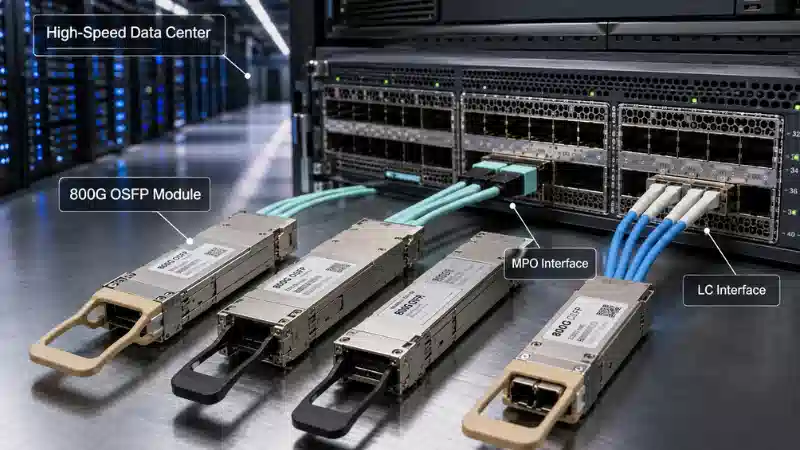
Most 800G deployments use OSFP form factor transceivers with 8×100G electrical lanes. The optical interfaces typically require MPO-16 or MPO-12 connectors for parallel single-mode configurations. Adapters must handle these multi-fiber connections while maintaining insertion loss below 0.35dB-tighter than what many 100G installations required.
Breakout applications add another layer of complexity. An 800G port often needs to connect to four 200G ports or eight 100G ports downstream. Adapter panels that convert between MPO and LC interfaces become critical infrastructure, and the adapter quality directly impacts whether those breakout connections perform within specification.
The power equation matters too. A 400G parallel optical transceiver in breakout mode consumes roughly 3 watts per 100G port, compared to 4.5 watts for dedicated 100G duplex transceivers. That 30% power saving scales dramatically across a data center with tens of thousands of ports. Better adapters with lower insertion loss contribute to these efficiency gains by reducing the optical power budget required for reliable transmission.

AI Infrastructure Requirements
AI training clusters have specific requirements that differ from general-purpose data centers.
East-west traffic dominates. Unlike traditional web applications where data flows primarily north-south (user to server), AI workloads shuffle massive datasets between GPU nodes during training runs. The fabric connecting those nodes needs consistent low-latency performance across thousands of simultaneous connections.
This drives demand for MPO trunk cabling with adapter panels that can handle rapid provisioning changes. When a training job shifts between clusters, technicians may need to repatch dozens of connections quickly. Adapter designs that support ganged insertion-plugging multiple connectors simultaneously-reduce reconfiguration time from hours to minutes.
What to Look For in 2025 and Beyond
Several trends will shape adapter selection over the next few years
Insertion loss requirements are tightening.
Premium adapters now specify maximum insertion loss of 0.15dB, down from 0.3dB that was acceptable five years ago. As optical power budgets shrink with higher-speed transceivers, every tenth of a dB matters.
01
Shuttered adapters are becoming standard.
The dust protection isn't just about cleanliness-laser safety regulations increasingly require shuttered designs in accessible areas. Some insurance carriers have started requiring them for Class 1M and above laser installations.
02
Hybrid adapter panels
Hybrid adapter panels that mix LC, MPO, and VSFF connectors in a single chassis are emerging. The flexibility to support multiple generations of equipment in the same rack simplifies migrations but requires careful attention to port mapping and polarity management.
03
Field-installable VSFF connectors
Field-installable VSFF connectors remain challenging. Unlike LC or SC connectors that technicians can terminate on-site with reasonable success rates, MDC and MMC connectors still require factory termination for consistent performance.
04
This limits their applicability in outside plant applications, though R&M and US Conec's collaboration on hardened environment connectors may eventually change that.

Cleaning and Maintenance
I've seen more network problems caused by dirty connectors than by actual equipment failures. It's not glamorous, but proper cleaning matters.
Every mating cycle should be preceded by inspection. A fiber scope that magnifies the end face 200× or higher will reveal contamination invisible to the naked eye. The ceramic ferrule looks pristine to your eyes but may have particles that create 1dB or more of additional loss.
One-click cleaners work well for most adapter types. The spring-loaded ferrule tip contacts the cleaning surface and removes contamination through mechanical wiping. Wet-dry cleaning protocols-alcohol wipe followed by dry wipe-handle stubborn residue.
MPO connectors require specialized cleaning tools that address all 12 or 24 fibers simultaneously. The multi-fiber end face makes contamination more likely and harder to eliminate. Some data centers have implemented policies requiring inspection and cleaning before every connection, which sounds excessive until you calculate the cost of troubleshooting intermittent link failures across a 10,000-port fabric.
Making the Right Choice
Selecting adapters for a new installation involves balancing current requirements against future flexibility.
For enterprise data centers running 100G today with 400G on the roadmap, LC adapters with UPC polish cover most applications. Budget for high-quality units from established manufacturers-Corning, Fujikura, US Conec, and similar companies-rather than commodity alternatives. The price difference is negligible compared to troubleshooting costs.
For hyperscale or AI-focused deployments already at 400G or planning for 800G, invest in MTP/MPO infrastructure with an eye toward VSFF migration. The adapter panels supporting both MPO and MMC connectors in the same chassis provide migration paths without wholesale infrastructure replacement.
For telecom and FTTH applications, APC polish remains essential. The higher return loss requirement of video overlay services and PON systems demands angled connectors throughout the distribution network.
For industrial or harsh environment deployments, look specifically at hardened fiber optic connectors (HFOC) and adapters (HFOA) rated for outdoor temperature ranges and moisture exposure. Standard adapters designed for climate-controlled data centers won't survive a Wisconsin winter in an outdoor cabinet.
The Bottom Line
Fiber optic adapters aren't sexy technology. They don't generate press releases or keynote presentations. But they're fundamental to every optical network deployment, and the latest developments-particularly VSFF connectors like MDC and MMC-are enabling the next generation of high-density connectivity that AI workloads demand.
The market is projected to reach $1.75 billion by 2032, growing at roughly 8.3% annually. That growth reflects both increasing deployment volumes and the shift toward higher-performance adapter types carrying premium pricing.
Whether you're upgrading an enterprise network or designing a greenfield hyperscale facility, the adapter choices you make today will determine your flexibility for years to come. Choose wisely.