Choosing between shielded Cat6a cable and UTP (unshielded twisted pair) Cat6a cable is one of the most common decisions in structured cabling projects. Both types support 10GBASE-T Ethernet defined by IEEE 802.3an over distances up to 100 meters when installed to specification. The real question is not which cable is faster - it is which cable matches your environment, interference profile, installation capability, and budget.
For most standard office networks with low electromagnetic interference, Cat6a UTP is the practical choice. It is lighter, easier to terminate, and less expensive across large deployments. For data centers with high-density cable bundles, factories with variable frequency drives and motor-driven equipment, mission-critical 10G copper links, or high-power PoE installations in confined pathways, shielded Cat6a cable delivers measurable protection against interference - but only when the entire channel is designed, grounded, and tested as a shielded system.
This guide explains the difference between Cat6a STP and UTP, compares specific shielding structures such as F/UTP, U/FTP, and S/FTP, and provides a practical decision framework for network designers, IT managers, and procurement teams.
Shielded vs Unshielded Cat6a
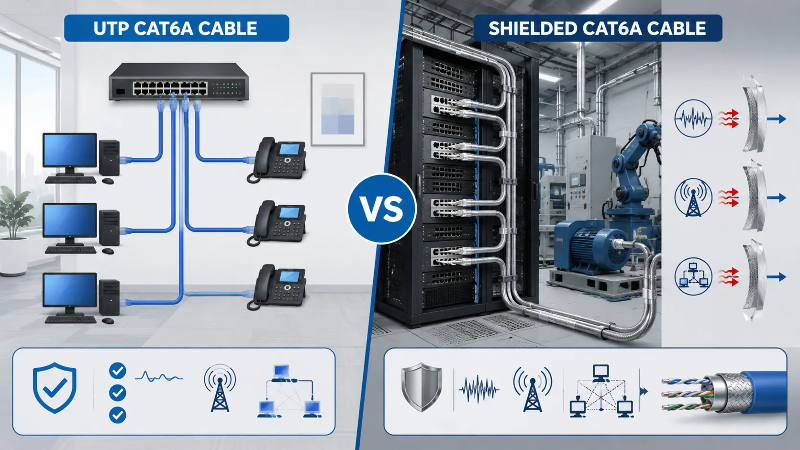
If your cable runs share pathways with motors, variable frequency drives (VFDs), generators, high-voltage power cables, fluorescent ballasts, or dense bundles of other copper data cables, shielded Cat6a is the stronger choice. The shielding layer reduces electromagnetic interference (EMI), radio frequency interference (RFI), and alien crosstalk - the unwanted signal coupling between adjacent cables that becomes a real concern at 10-Gigabit speeds.
If your installation is a typical office, classroom, retail space, or residential environment with minimal electrical noise and well-separated cable pathways, UTP Cat6a will deliver reliable performance with simpler installation and lower material cost.
One critical point that many buyers overlook: a shielded cable installed with unshielded connectors, no grounding path, or poor bonding may perform worse than a properly installed UTP system. A shielded channel is only effective when every component - cable, connectors, jacks, patch panels, couplers, and grounding - is designed as a complete shielded system.
What Is Cat6a Cable?
Cat6a stands for Category 6 Augmented. It is an Ethernet cable category specified under ANSI/TIA-568.2-D (and the newer ANSI/TIA-568.2-E), designed to support frequencies up to 500 MHz and deliver reliable 10 Gigabit Ethernet performance over a full 100-meter channel. Compared with standard Cat6, which supports 10G only over shorter distances of roughly 55 meters, Cat6a provides the headroom needed for enterprise-grade 10GBASE-T deployments.
Cat6a is widely used in enterprise offices, data centers, hospitals, universities, and smart buildings. It supports high-bandwidth applications including Wi-Fi 6/6E/7 access points, IP surveillance cameras, PoE-powered devices, VoIP systems, and network switches. Many organizations choose Cat6a as a future-ready infrastructure investment, since it can handle 1G, 2.5G, 5G, and 10G Ethernet applications on the same physical medium.
Understanding Shielding Structures: UTP vs F/UTP vs U/FTP vs S/FTP
The term "shielded Cat6a cable" covers several distinct constructions. Selecting the right one depends on the interference environment, installation constraints, and budget. Here is what each designation means in practice.

UTP (Unshielded Twisted Pair) has no metallic shield layer. Signal integrity relies entirely on the precision of the pair twisting geometry and the cable's internal separator (spline). UTP Cat6a is the lightest, most flexible option, and uses standard unshielded connectors and patch panels.
F/UTP (Foil over Unshielded Twisted Pairs) wraps all four pairs in a single overall foil shield. This is the most common type when buyers say "shielded Cat6a." It adds moderate EMI protection without dramatically increasing cable diameter. F/UTP is a practical middle ground for environments with moderate interference, such as open offices near elevator shafts or HVAC equipment.
U/FTP (Unshielded overall, Foil around each Twisted Pair) individually shields each pair with its own foil layer but has no overall cable shield. This design focuses on reducing alien crosstalk between pairs - both within the cable and from adjacent cables. U/FTP is a strong choice for high-density cable trays where alien crosstalk is the primary concern.
S/FTP (Braided Shield overall, Foil around each Twisted Pair) combines an outer braided shield with individual foil shields on every pair. This provides the highest level of protection against both EMI and alien crosstalk, but it also produces the thickest, stiffest cable. S/FTP is typically reserved for industrial plants, healthcare imaging suites, or high-security facilities where maximum noise immunity justifies the additional cost and installation complexity.
When evaluating Cat6a cable options, always confirm the actual shielding structure by its ISO/IEC designation rather than relying on generic labels like "STP." Different manufacturers use "STP" to describe different constructions.
Cat6a Shielded vs UTP: Comparison Table
| Factor | Shielded Cat6a (F/UTP, U/FTP, S/FTP) | UTP Cat6a |
|---|---|---|
| EMI / RFI protection | Metallic shield blocks external electromagnetic and radio frequency interference | Relies on pair twisting and cable geometry; no metallic barrier |
| Alien crosstalk control | Shield reduces coupling between adjacent cables, especially in dense bundles | Dependent on cable construction, separator design, and physical spacing |
| Installation complexity | Thicker, stiffer; requires shielded connectors, jacks, panels, and proper grounding | Lighter, more flexible; uses standard unshielded components |
| Grounding requirement | Shield must be bonded and grounded per TIA/BICSI guidelines to function correctly | No shield grounding needed |
| Material cost | Higher per meter for cable and all shielded accessories | Lower per meter; uses less expensive standard components |
| Cable diameter and weight | Larger outer diameter; heavier per meter | Smaller and lighter; easier to route through conduit |
| Best environments | Data centers, factories, high-density racks, PoE-heavy networks, industrial sites | Offices, schools, retail, residential, standard enterprise campuses |
| Risk of improper installation | Ungrounded or partially shielded systems may underperform or create ground loops | Fewer shielding-related failure modes |
Best Cable Choice by Environment
| Environment | Recommended Cable | Key Reason |
|---|---|---|
| Standard office | UTP Cat6a | Low interference, easier installation, lower cost |
| Data center / server room | F/UTP or U/FTP Cat6a | High cable density increases alien crosstalk risk |
| Factory / industrial plant | S/FTP or F/UTP Cat6a | VFDs, motors, and heavy machinery generate strong EMI |
| PoE camera / Wi-Fi AP deployment | UTP for standard PoE; F/UTP for high-power PoE in dense runs | High-wattage PoE in tight bundles increases heat and crosstalk |
| Home network | UTP Cat6a | Minimal interference; shielding adds unnecessary cost |
| Hospital / healthcare imaging | S/FTP Cat6a | MRI suites and diagnostic equipment produce extreme EMI |
When Shielded Cat6a Cable Is the Right Choice
Data Centers and High-Density Cable Bundles
In a data center, dozens or hundreds of copper links may run side by side through shared cable trays, ladder racks, and overhead pathways. At 10-Gigabit speeds, the 500 MHz signaling bandwidth of Cat6a makes alien crosstalk - interference coupling between adjacent cables - a measurable performance factor. A single poorly performing link in a dense bundle can degrade throughput or trigger intermittent errors that are difficult to diagnose.
Shielded Cat6a cable, particularly U/FTP or F/UTP constructions, reduces alien crosstalk by providing a conductive barrier between cables. In practice, this means tighter cable trays can be used without sacrificing performance margins. For data center operators running 10GBASE-T links across fully loaded racks, the shielding investment often pays for itself in reduced troubleshooting time and higher first-pass certification rates.
Industrial Facilities with High EMI Exposure
A factory floor with VFDs, servo motors, welding stations, high-current busbars, and overhead cranes produces electromagnetic noise that is orders of magnitude stronger than a typical office. In one common scenario, a manufacturing plant installs UTP Cat6a alongside motor control cables in the same cable tray - and discovers intermittent link errors during production shifts when the equipment is running at full load. The root cause is radiated EMI coupling into the unshielded data cable.
For these environments, shielded Cat6a - ideally S/FTP or F/UTP - provides a metallic barrier that attenuates external noise before it reaches the twisted pairs. The key requirement is that the shield must be properly bonded to a low-impedance ground at both ends of the channel, following TIA and BICSI bonding and grounding guidelines. Without correct grounding, the shield itself can become an antenna, making the problem worse.
High-Power PoE Deployments in Dense Cable Bundles
Modern IEEE 802.3bt (PoE++) devices can draw up to 90W per port. When multiple high-power PoE cables are bundled together in a ceiling plenum, cable tray, or conduit, two problems emerge. First, the DC current flowing through the conductors generates heat, and temperature rise increases insertion loss. Second, tightly bundled cables in warm environments see reduced noise margins.
Shielded Cat6a cable helps manage both issues. The shield improves crosstalk isolation, and some shielded cable constructions dissipate heat more effectively than UTP designs. For deployments with more than 24 high-power PoE drops bundled over long runs, specifying F/UTP or U/FTP Cat6a - and leaving cables loosely bundled rather than tightly cable-tied - is a practical precaution.
Mission-Critical 10G Copper Links Approaching Maximum Channel Length
The IEEE 802.3an standard specifies a maximum 100-meter channel for 10GBASE-T. As a link approaches that limit, the noise margin shrinks, and small installation imperfections - a crushed cable at a bend point, a connector with slightly opened pair twists, or alien crosstalk from an adjacent cable - can push the link from pass to marginal or fail. For mission-critical links such as connections between core switches or storage networks, shielded Cat6a provides additional margin against these cumulative noise sources.
When UTP Cat6a Is the Better Choice
Standard Office and Campus Networks
In a typical commercial office, the primary noise sources are fluorescent lighting, HVAC controls, and nearby power cables. These produce relatively low-level interference that well-constructed UTP Cat6a handles without difficulty, provided the cable is routed with adequate separation from power conductors as specified by TIA pathway standards. For a 200-drop office buildout, the material cost difference between UTP and shielded Cat6a - including shielded jacks, patch panels, and grounding infrastructure - can add 30–50% to the passive cabling budget with little measurable performance benefit.
Budget-Sensitive Large-Scale Deployments
For campus-wide or multi-building deployments with hundreds or thousands of drops, the cost advantage of UTP network cable is significant. The savings come not only from lower cable cost per meter, but also from faster termination (no shield to prepare and bond), less expensive connectors, and reduced labor time. If the environment does not present elevated EMI or high cable density, the shielding investment does not deliver a proportional return.
Tight Pathways and Retrofit Installations
Shielded Cat6a cable has a larger outer diameter - often 8–9 mm compared to 6.5–7.5 mm for UTP - and reduced flexibility due to the metallic shield layer. In retrofit projects where cables must be pulled through existing conduit, J-hooks, or narrow wall cavities, UTP is substantially easier to work with. The difference in bend radius and pull tension requirements can determine whether an existing pathway is usable or requires costly modification.
Installation Mistakes That Compromise Shielded Cat6a Performance
A shielded cable is only as good as the system around it. The following mistakes are common in projects where the cable is specified correctly but the supporting infrastructure is not.
Using Unshielded Components in a Shielded Channel
Every element in the channel - the cable, RJ45 plug, keystone jack, coupler, and patch panel - must maintain shield continuity. If a shielded Cat6a cable is terminated into an unshielded keystone jack, the shield path is broken at that point. The result is a partially shielded system that provides inconsistent protection and may not pass certification testing.
Incomplete or Incorrect Grounding
The cable shield must be bonded to a building ground system through the connector hardware and patch panel. If only one end is grounded, or if the grounding path has high impedance (corroded connections, undersized conductors, or long ground lead runs), the shield cannot effectively drain coupled noise. In the worst case, a floating or poorly grounded shield can act as a long antenna, picking up more interference than an unshielded cable would.
This is the scenario behind a widely quoted engineering principle: a poorly grounded shielded system can perform worse than a well-installed UTP system. Contractors unfamiliar with shielded cabling practices should not be assigned to shielded cable projects without proper training.
Mixing Cable and Component Categories
A Cat6a channel is only as strong as its weakest component. Installing Cat6a cable with Cat6-rated or Cat5e-rated connectors limits the entire channel to the lower category's performance. This mistake often occurs when leftover inventory from previous projects is mixed into a new Cat6a installation. Always verify that every component in the channel - including patch cords - is rated to Cat6a or higher.
Skipping Certification Testing
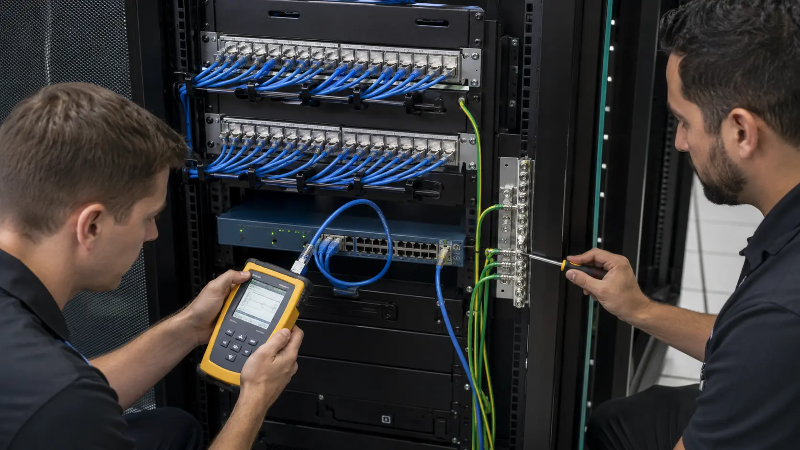
A cable that looks correctly installed may still fail performance requirements due to factors invisible to the eye: too much untwisted conductor at the termination point, a connector with poor contact resistance, or excessive alien crosstalk from an adjacent cable. Certification testing with a field tester such as the Fluke Networks DSX CableAnalyzer verifies that each link meets ANSI/TIA or ISO/IEC performance limits for insertion loss, NEXT, return loss, and - for Cat6a specifically - alien crosstalk (PSANEXT and PSAACR-F).
For any 10G copper deployment, certification testing is strongly recommended and is commonly required by project specifications, warranty programs, and structured cabling vendor guarantees. Skipping this step saves a small amount of time on installation day but creates significant risk of costly troubleshooting later.
How to Choose
Rather than a one-size-fits-all recommendation, use the following logic to match your cable choice to your actual conditions.
Choose shielded Cat6a when:
- Cables will run near VFDs, motors, generators, welding equipment, or high-voltage power distribution
- Many copper cables (more than 24) will be tightly bundled in shared pathways
- The network must support 10GBASE-T over runs approaching 90–100 meters
- High-power PoE (60W–90W per port) will be deployed over long runs in dense bundles
- Downtime is expensive or unacceptable, and maximum noise margin is needed
- Your installation team is experienced with shielded termination, bonding, and certification testing
Choose UTP Cat6a when:
- The environment is a standard office, school, retail space, or residential building with low EMI
- Cable pathways are tight and flexibility matters
- The project budget is sensitive to material cost across many drops
- The installation team is more experienced with UTP termination
- Interference levels are low and cable density is moderate
If you are unsure about interference levels: commission a site survey or consult a structured cabling specialist before specifying cable. A brief electromagnetic survey of the installation pathways - especially near electrical rooms, elevator shafts, and industrial equipment - can prevent a costly re-cabling project later.
Common Misconceptions About Shielded Cat6a Cable
Misconception: Shielded Cat6a Is Always Faster Than UTP
Both shielded and unshielded Cat6a support the same data rates - up to 10 Gbps - when installed correctly within a compliant channel. Shielding does not increase speed; it protects signal integrity in noisy environments. In a clean office with well-separated cable pathways, a properly installed UTP Cat6a link will perform identically to a shielded one on all standard certification tests.
Misconception: You Can Just Buy Shielded Cable and Use Existing Connectors
A shielded cable terminated with an unshielded RJ45 plug breaks the shield continuity. The result is a system that costs more than UTP but delivers no shielding benefit. Every component in the channel - from the cable to the wall jack to the patch panel - must be rated for shielded operation and must maintain a continuous ground path.
Misconception: UTP Is a Compromise or Low-Quality Option
UTP Cat6a is the most widely deployed copper cabling type in commercial buildings worldwide. It fully meets ANSI/TIA-568.2-D and IEEE 802.3an requirements for 10GBASE-T. In environments without elevated EMI, UTP is not a compromise - it is the appropriate specification. Overspending on shielded cable in a low-interference environment diverts budget from areas that may deliver more value, such as better cable management, proper pathway design, or certification testing.
Misconception: Shielded Cable Solves All Network Problems
Shielded cable cannot compensate for poor termination, excessive untwisting of conductor pairs, damaged cable jacket, crushed cables at bend points, incorrect patch cord category, or misconfigured network equipment. Network performance depends on the complete system - from the cable plant through the active electronics. Shielding addresses one specific risk factor (external noise), not the full range of installation and configuration issues.
FAQ
Q: Is shielded Cat6a cable worth it?
A: Shielded Cat6a is worth the added cost in environments with high electromagnetic interference, dense cable bundles, industrial equipment, or mission-critical 10G links where maximum noise margin is essential. In standard offices with low EMI, UTP Cat6a provides equivalent performance at lower cost and complexity.
Q: What is the difference between F/UTP and U/FTP Cat6a?
A: F/UTP has a single overall foil shield around all four pairs, providing general protection against external EMI. U/FTP individually wraps each pair in its own foil shield, which is more effective at reducing alien crosstalk between pairs. F/UTP is more common for general commercial use; U/FTP is preferred in high-density data center environments where inter-cable crosstalk is the primary concern.
Q: Does shielded Cat6a need grounding?
A: Yes. A shielded Cat6a system must be properly bonded and grounded to function correctly. The shield must have a continuous, low-impedance path to the building ground through shielded connectors, jacks, and patch panels. Without proper grounding, the shield may act as an antenna and actually increase noise pickup.
Q: Can Cat6a UTP support 10Gbps over 100 meters?
A: Yes. Cat6a UTP is specified under IEEE 802.3an and ANSI/TIA-568.2-D to support 10GBASE-T at up to 100 meters when properly installed and certified. The cable must meet Category 6A performance requirements, including alien crosstalk limits, across the entire channel.
Q: Do I need shielded Cat6a for PoE?
A: Standard PoE (IEEE 802.3af/at, up to 30W) does not require shielded cable. For high-power PoE (IEEE 802.3bt, up to 90W) in dense deployments with many cables bundled together over long runs, shielded Cat6a may help manage heat-related insertion loss increases and provide additional crosstalk margin. The ANSI/TIA-568.2-E standard recommends Category 6A or higher for remote powering applications.
Q: Is STP cable harder to install than UTP?
A: Yes. Shielded cables are stiffer, have larger bend radii, and require more careful termination to maintain shield continuity and grounding. Installation teams need training in shielded termination techniques. Labor time per drop is typically 15–25% higher than for UTP.
Q: Can I mix shielded and unshielded Cat6a components?
A: Within a single channel, no. Mixing shielded cable with unshielded connectors or patch panels breaks the shield path and eliminates the shielding benefit. However, it is acceptable to have some channels in a building that are shielded (e.g., data center links) while others are UTP (e.g., standard office drops), as long as each individual channel uses consistent components.
Q: Should I use shielded Cat6a at home?
A: In the vast majority of residential environments, UTP Cat6a is more than sufficient. Home networks rarely encounter the EMI levels or cable densities that justify shielded cable. Unless your cable runs pass directly alongside high-power electrical equipment, UTP will deliver full performance at lower cost and with easier installation.
Final Recommendation
The right cable is the one that matches the conditions where it will be installed - not the one with the most impressive specifications on paper.
Specify shielded Cat6a cable when your environment presents genuine interference risks: industrial equipment, dense data center cable trays, high-power PoE bundles, or mission-critical links where noise margin justifies the added cost of shielded components and proper grounding infrastructure.
Specify UTP Cat6a when the environment is a standard commercial building with moderate cable densities, low EMI exposure, and a project team experienced in conventional copper termination. UTP Cat6a is not a compromise - it is the most widely deployed and field-proven solution for enterprise Cat6a network infrastructure.
Regardless of which cable type you choose, invest in certification testing for every link. A test report from a qualified field tester confirms that the installed system meets the performance requirements of your target application - and that is worth far more than any specification printed on a cable box. For a broader perspective on how Ethernet cable categories compare, see this Cat6 vs Cat7 vs Cat8 comparison.