CWDM vs DWDM | Difference between CWDM and DWDM

CWDM-Coarse Wavelength Division Multiplexing

The figure-1 depicts CWDM based fiber system. As shown it is used to transmit 4 different applications using single optical finer instead of pair of fiber cables. Different applications are using different light wavelengths which helps in multiplexing and de-multiplexing applications at transmit and receive end.
DWDM-Dense Wavelength Division Multiplexing
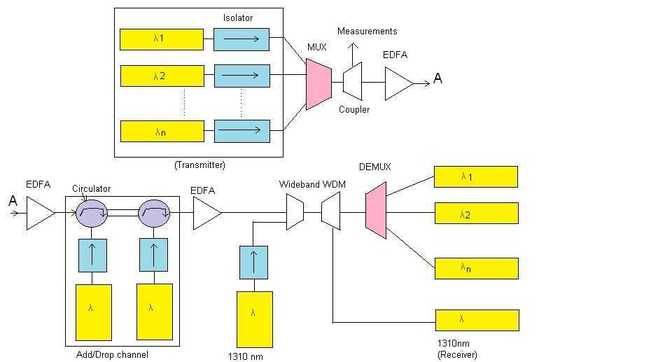
The figure-2 depicts DWDM system consisting of transmitter and receiver parts. Typically DWDM consists of MUX, DEMUX, isolators, circulators, EDFA (Erbium Doped Fiber Amplifier) etc.
DWDM system basics

| Specifications/Features | CWDM | DWDM |
|---|---|---|
| Full form | Coarse Wavelength Division Multiplexing,WDM system having less than 8 active wavelengths per optical fiber | Dense Wavelength Division Multiplexing, WDM system having more than 8 active wavelengths per optical fiber |
| characteristic | Defined by wavelengths | Defined by frequencies |
| capacity | lower | higher |
| cost | low | high |
| Distance | short range communication | long range communication |
| Frequencies | uses wide range frequencies | uses narrow range frequencies |
| Wavelength spacing | more | less, hence can pack 40+ channels compare to CWDM in the same frequency range |
| Amplification | light signal is not amplified here | light signal amplification can be used here |
| Drift | Wavelength drift is possible | Precision lasers are needed to keep channels on the target |
| Spectrum utilization | Breaks the spectrum into big chunks | dices the spectrum into small pieces |
| No. of active wavelengths per fiber | Fewer than 8 | More than 8 |
WDM (Wavelength Division Multiplexing) is a commonly used technology in optical communications. It is often deployed to join multiple wavelengths onto a single fiber. In the WDM system, there are two main types: Coarse Wavelength Division Multiplexing (CWDM) and Dense Wavelength Division Multiplexing (DWDM). Both CWDM and DWDM are available as active or passive systems. This article will focus on discussing the difference between passive CWDM vs DWDM.
What Is Passive CWDM?
CWDM is often employed in situations where only a few channels are needed and there is no need for distances longer than 70 km. The passive CWDM is an implementation of CWDM that uses no electrical power. It divides the wavelengths by passive optical components like bandpass filters and prisms. Most CWDM devices are passive. CWDM Mux Demux is the most commonly used device in passive CWDM system.
What Is Passive DWDM?
DWDW technology is used for long haul optical transmissions. It can be divided into two different versions: an active solution and a passive solution. The active solution is a good fit for applications involving more than 32 links over the same fiber. Passive DWDM solutions have fewer active elements, in other words, the solutions have higher reliability and less latency. In a passive DWDM network, the line functions only due to the use of optical transceiver. Passive DWDM systems allow to arrange a high speed system with high channel capacity, but the transmission distance and management are limited. The major applications of passive DWDM system are metro networks and high speed communication lines.
Passive CWDM vs DWDM: What’s the Difference?
Passive DWDM and CWDM are based on the same concept of using multiple wavelengths of light on a single fiber. Both of them require no power and are easy to employ. However, they still differ to each other in some aspects. The following will describe some differences between passive CWDM vs DWDM.
Passive CWDM transports up to 18 wavelengths (from 1470nm to 1610nm) with a channel spacing of 20nm. While passive DWDM can accommodate 40, 80 or up to 160 wavelengths with a narrower wavelength spacing of 0.8nm, 0.4nm or even 0.2nm. Its wavelengths are from 1525nm to 1565nm (C band) and 1570nm to 1610nm (L band).
Passive DWDM supports more channels than passive CWDM. The former can provide up to 80 channels while the latter just supports up to 18 channels.
The maximum reach of the passive CWDM is about 160 km. Although the passive DWDM system has no optical amplifiers to achieve a fairly long distance, it can reach longer than the passive CWDM.
Actually, the cost is associated with the deployment of the system. In general, the passive DWDM devices are more expensive than that of passive CWDM systems. But the passive CWDM is just cost-effective for the connection rates below 10G and for short distance.
Conclusion
After the comparison of passive CWDM vs DWDM, we can see that each one has its advantages and disadvantages. Which to deploy depends on the actual needs. Hope what we discussed in the article could help make an informed decision. If you want to know more details, welcome to visit FS.COM.
CWDM SFP vs DWDM SFP – Which One Suits You Better?
SFP (Small Form-Factor Pluggable) is designed to meet Multi-Source Agreement (MSA) standards to ensure network equipment compatibility. Recently, wavelength-division multiplexing (WDM) technology is warmly welcomed by internet users all around the world. It is a technology that multiplexes a number of optical carrier signals at different wavelengths of laser light over a single optical fiber. By using WDM technology, SFP modules will have different wavelengths assigned to them. The following passage will focus on the brief descriptions of the two types of SFP modules: DWDM vs CWDM.
Overview of CWDM SFP
CWDM SFP is a kind of optical transceiver that utilizes CWDM technology. Similar with traditional SFP module, the CWDM SFP is a hot-swappable input/output device. It plugs into an SFP port or slot of a switch or router and links the port with the fiber-optic network. CWDM SFP transceiver modules make use of the SFP interface for connecting the equipment and use dual LC/PC fiber connector interface for connecting the optical network. Colorful CWDM SFP modules are displayed below.

It is well known that CWDM SFP modules come in 8 wavelengths covering from 1470 nm to 1610 nm. Color markings on the devices identify the wavelength to which the Gigabit Ethernet channel is mapped. The following picture lists the CWDM SFPs with their wavelengths and color codes.

DWDM SFP Overview
DWDM (Dense Wavelength-Division Multiplexing) SFP transceivers are used as part of a DWDM optical network to provide high-capacity bandwidth across an optical fiber network, which is a high performance, cost-effective module for serial optical data communication applications up to 4.25Gb/s. There are 32 fixed-wavelength DWDM SFPs that support the International Telecommunications Union (ITU) 100-GHz wavelength grid. An inner structure of DWDM SFP is shown below.

Application
CWDM SFP transceiver is widely used in optical communications for both telecommunication and data communication. It is designed for operations in Metro Access Rings and Point-to-Point networks using Synchronous Optical Network (SONET), SDH (Synchronous Digital Hierarchy), Gigabit Ethernet and Fibre Channel networking equipment. The DWDM SFP can be also used in DWDM SONET/SDH (with or without FEC), but for longer transmission distance like 200km links and Ethernet/Fibre Channel protocol traffic for 80km links.
Which SFP Module Type Should You Choose: DWDM vs CWDM?
From a low-cost point of view, the CWDM SFP module is inexpensive than DWDM SFP. It provides a convenient and cost-effective solution for the adoption of Gigabit Ethernet and Fibre Channel. On the other hand, the key in selecting DWDM vs CWDM SFP modules lies in the differences between CWDM and DWDM. They refer to different methods of splitting up the light. For example, CWDM uses broader spacing between channels, allowing for inexpensive SFPs, and DWDM uses denser channel spacing, which allows for more wavelengths to be used on a single fiber. DWDM is typically used in large optical networks over the longer distance. Thus if you are looking for SFP modules over long distance and with better scalability, DWDM SFP module is the ideal choice.
Conclusion
I hope this brief introduction to DWDM vs CWDM SFP modules is helpful for you to make a choice in selecting them. Based on the Cisco CWDM SFPs, FOCC CWDM SFPs are multi-rate transceivers, supporting data rates from 100 Mbps up to 4 Gbps. Besides, they support transfer distance at 20-40km, 40-80km and 80-120km in different colors, diversely satisfy the requirements of clients. All the DWDM SFP modules meet the requirements of the IEEE802.3 Gigabit Ethernet standard. They are suitable for interconnections in Gigabit Ethernet and Fibre Channel environments.