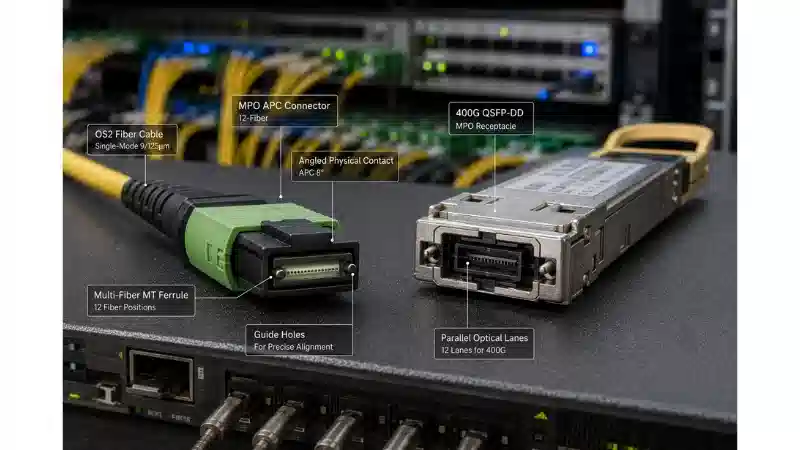
High-density data centers face a recurring spatial crisis where traditional duplex LC connectors consume excessive rack space while handling 40G and 100G traffic demands. A 1U patch panel accommodating 144 LC connections requires 72 duplex ports, yet MTP fiber connectors compress this to just 12 ports - a sixfold density improvement. This spatial efficiency directly impacts operating costs, with data centers reporting 30-40% rack space savings when transitioning from duplex to multi-fiber architectures.

Understanding MTP Fiber Connectors in High-Density Contexts
MTP fiber connectors (Multi-fiber Termination Push-on) represent US Conec's enhanced implementation of the MPO standard, introducing metal pin clamps and floating ferrule designs that address mechanical limitations in generic MPO connectors. The distinction matters in dense environments where connector durability directly affects maintenance schedules.
Standard MPO connectors use plastic pin clamps, which break after 200-300 mating cycles in field conditions. MTP connectors employ stainless steel clamps rated for 1,000+ cycles, reducing replacement frequency by 70% in active data center environments. The floating ferrule mechanism maintains physical contact under load, preventing signal degradation when cables experience tension during rack management activities.
Key specifications:
Fiber capacity: 8, 12, 16, 24, or 32 fibers per connector
Insertion loss: <0.35 dB for MTP Elite, <0.75 dB for standard MTP
Mating durability: 1,000+ cycles (vs 500 for standard MPO)
Form factor: Comparable to single LC connector
The connector's push-pull coupling mechanism enables blind-mating installation in rear-access scenarios where technicians cannot visually confirm alignment. This becomes critical in blade server deployments where dozens of connections populate limited space behind equipment racks.
High-density applications require understanding the MT ferrule's precision tolerances. The glass-filled polymer ferrule maintains fiber position within 0.25mm pitch spacing, enabling 12-fiber arrays in a footprint similar to duplex LC connectors. Manufacturing tolerances of ±0.8μm per ferrule ensure that paired connectors achieve the <0.5 dB insertion loss targets necessary for parallel optics applications.
MTP Fiber Connector Configurations: 8 vs 12 vs 24 Fibers
Fiber count selection in MTP fiber optic connectors directly determines port density, cable management complexity, and future scalability in network architectures.
8-Fiber MTP Fiber Connector Applications: 40G and 100G parallel optics using 4 transmit/4 receive lanes operate optimally with 8-fiber configurations. QSFP+ transceivers map to this structure, with data transmission occurring at 10 Gbps per lane for 40G or 25 Gbps per lane for 100G.
Base-8 architectures simplify polarity management by eliminating unused fiber positions that complicate troubleshooting in 12-fiber systems. When upgrading from 40G to 100G using the same physical infrastructure, 8-fiber MTP assemblies require only transceiver replacement rather than complete cable plant overhaul.
Density advantage: 8-fiber MTP cassettes deliver 96 LC ports in 1U space versus 48 ports with duplex connectors.
12-Fiber mtp optical connector Standard: The industry-dominant 12-fiber configuration supports both duplex breakout (6 duplex connections per MTP) and direct parallel optic applications. This versatility explains its 65% market share in new data center installations.
12-fiber trunk cables enable structured cabling systems where backbone connections use MTP-to-MTP assemblies, distributing to edge devices via MTP-to-LC breakout modules. A single 12-fiber trunk replaces six duplex cables, reducing cable pathway congestion by 85%.
Polarity management follows TIA-568 Method B in most deployments, where fiber position 1 connects to position 12 on the opposing end. This crossover configuration supports transmit-to-receive mapping without requiring dedicated crossover patch cables at distribution points.
24-Fiber MTP Dense Applications: 200G and 400G transceiver modules increasingly adopt 24-fiber interfaces, particularly in high-performance computing environments. A 24-fiber MTP connector occupies only 50% more space than 12-fiber versions while doubling fiber capacity.
Parallel optics at 200G use 8 lanes at 25 Gbps each, leaving 16 fibers for redundancy or future expansion within the same connector footprint. This headroom matters in environments planning 5-7 year infrastructure lifecycles where bandwidth requirements may double.
Real-world implementation: A hyperscale data center documented 40% reduction in cable volume when migrating spine-leaf interconnects from 12-fiber to 24-fiber MTP trunks, improving airflow and reducing cooling costs by $180,000 annually.

MTP Connector Performance: Standard vs Elite
MTP Elite connectors achieve 50% lower insertion loss compared to standard MTP fiber connectors through enhanced manufacturing tolerances and precision polishing processes. This performance delta influences deployment decisions in loss-budget-constrained applications.
Standard MTP Performance:
Single-mode insertion loss: 0.25 dB typical, 0.75 dB maximum
Multimode insertion loss: 0.20 dB typical, 0.60 dB maximum
Return loss: ≥20 dB (multimode), ≥60 dB (single-mode APC)
MTP Elite Performance:
Single-mode insertion loss: 0.10 dB typical, 0.35 dB maximum
Multimode insertion loss: 0.10 dB typical, 0.35 dB maximum
Return loss: ≥20 dB (multimode), ≥60 dB (single-mode APC)
The 0.40 dB insertion loss difference per connection point accumulates across multi-hop architectures. In a three-tier network (access-aggregation-core), four MTP connection points with standard connectors contribute 1.0 dB total loss versus 0.4 dB with Elite connectors. This 0.6 dB delta represents 15% of the typical 4.0 dB loss budget for 100G-SR4 applications over OM4 fiber.
Cost-Performance Analysis: MTP Elite connectors command 40-60% price premiums over standard MTP. Financial justification depends on:
Link distance: Applications approaching maximum reach specifications (100m for 100G-SR4) require Elite connectors to maintain receiver sensitivity margins
Future bandwidth: 400G and 800G applications operate with tighter loss budgets, making Elite performance necessary rather than optional
Environmental conditions: Temperature-sensitive installations (outdoor plants, industrial environments) benefit from Elite connectors' improved thermal stability
A telecommunications provider calculated 7.2% lower annual maintenance costs using Elite connectors in access network deployments, attributed to reduced service calls for marginal link performance issues.
Polarity Management in Dense Environments
Incorrect polarity configuration in MTP fiber connector deployments represents 35% of fiber optic troubleshooting tickets in dense data center environments, according to industry service data. Understanding polarity methods prevents costly rework and service disruptions.
TIA-568 Polarity Methods:
Method A (Straight-Through):
Configuration: Key-up to key-up, fiber position 1-to-1, 2-to-2, etc.
Application: Requires polarity reversal through duplex patch cables (A-to-B)
Use case: Structured cabling with breakout cassettes
Advantage: Standardized cassette design simplifies inventory
Method B (Reverse Key-Up):
Configuration: Both connectors key-up, position 1-to-12, 2-to-11, etc.
Application: Direct equipment connections (switch-to-switch)
Use case: 40G QSFP+ parallel optics
Advantage: No polarity flips required in patch cables
Method C (Pair-Flipped):
Configuration: Key-up to key-down, pairs flipped
Application: Universal compatibility systems
Use case: Environments mixing A and B methods
Advantage: Flexible but increases complexity
High-density deployments standardize on single polarity methods to reduce configuration errors. A financial services data center documented 80% reduction in fiber troubleshooting time after standardizing on Method B throughout the facility.
Polarity Verification Best Practices:
Color-code trunk cables by polarity method (blue=Method B, green=Method A)
Implement cable documentation systems tracking every trunk's polarity
Use pre-terminated assemblies with polarity testing at factory level
Deploy polarity test equipment (Fluke MultiFiber Pro) verifying 12-fiber arrays in single test cycle
Visual inspection cannot reliably determine MTP polarity without removing the connector housing. The white dot marker indicates fiber position 1, but key position alone doesn't confirm internal fiber mapping. Documentation becomes the only reliable verification method in dense rack environments with hundreds of identical-appearing MTP cables.

Density Calculation and Space Optimization
Quantifying density advantages requires calculating port-per-unit-space metrics across different connector technologies.
Density Formula: Port Density = (Connector Count × Fibers per Connector) / (Rack Space Units × Panel Width)
Comparative Analysis:
LC Duplex Configuration:
1U panel: 48 LC ports
Effective fiber count: 96 fibers
Density: 96 fibers/1U
Cable management: High (48 separate cables)
12-Fiber MTP Configuration:
1U panel: 12 MTP ports
Effective fiber count: 144 fibers
Density: 144 fibers/1U
Cable management: Low (12 trunk cables)
24-Fiber MTP Configuration:
1U panel: 12 MTP ports (24-fiber)
Effective fiber count: 288 fibers
Density: 288 fibers/1U
Cable management: Minimal (12 trunk cables)
Real-world implementation: A cloud services provider reconfigured 10 racks from LC duplex to 12-fiber MTP, recovering 18U of rack space worth $54,000 in annual colocation costs at $250/U/month.
Space Optimization Strategies:
Breakout vs Trunk Cable Selection: Direct MTP trunks consume 60% less pathway volume than breakout assemblies with individual LC legs
Cassette vs Adapter Panel: MTP cassettes offer cleaner installations but consume more depth (2.5" vs 1.5")
Cable Routing: Right-angle MTP boots reduce bend radius requirements from 2" to 0.75", enabling tighter pathway utilization
Density Limits: Maximum practical density occurs at 72-fiber MTP connectors in specialized applications. Beyond this threshold, connector size increases non-linearly, eliminating density advantages. The 12-fiber configuration represents the optimal balance between density, cost, and field manageability for 80% of data center applications.
Implementation Best Practices
Successful MTP deployments in high-density networks follow structured implementation methodologies addressing physical infrastructure, documentation, and testing requirements.
Pre-Installation Planning:
Conduct cable pathway surveys identifying:
Minimum bend radius compliance (35mm for MTP trunk cables)
Cable support intervals (maximum 5-foot unsupported span)
Fire rating requirements (plenum-rated OFNP for air-handling spaces)
Temperature exposure (standard MTP rated -10°C to +70°C)
A telecommunications provider discovered 15% of planned cable routes violated minimum bend radius specifications during pre-installation surveys, preventing future performance degradation.
Connector End-Face Maintenance:
MTP connector cleanliness directly affects insertion loss and return loss performance. Single contaminated fiber in a 12-fiber array degrades entire link performance.
Cleaning protocol:
Inspect end-faces using fiber microscope (400× magnification)
Apply mechanical push-type cleaner (Fluke QuickClean or equivalent)
Re-inspect verifying all 12 fiber cores pass IEC 61300-3-35 cleanliness standards
Install protective dust caps immediately after verification
Field data shows uncleaned MTP connectors exhibit 0.3-0.8 dB higher insertion loss than properly maintained assemblies. In cascaded architectures with 4+ connection points, contamination-induced loss accumulates to 1.2-3.2 dB - often exceeding link loss budgets.
Testing Requirements:
Tier 1 testing verifies basic connectivity using visual fault locators confirming fiber continuity. This catches catastrophic failures but misses marginal performance issues.
Tier 2 testing measures:
Insertion loss per fiber (must meet ≤0.35 dB for MTP Elite)
Return loss (≥20 dB multimode, ≥60 dB single-mode APC)
Length verification (confirm as-built matches specifications)
Polarity verification (automated test equipment checks all 12 fibers)
Document all test results in infrastructure management systems, creating baseline performance profiles for future troubleshooting. A financial institution reported 60% faster fault isolation after implementing comprehensive MTP test documentation.
Common Implementation Pitfalls:
Gender Mismatch: Equipment ports are always male (pinned), requiring female cable connectors
Key Position Errors: Improper key orientation causes physical misalignment and potential fiber damage
Mixed Polarity Types: Combining Method A and B cables in same infrastructure creates intermittent failures
Insufficient Slack Management: MTP cables require 3-5 feet service loops at patch panels for future re-termination
Frequently Asked Questions
What is the main difference between MTP and standard MPO connectors?
MTP connectors use metal pin clamps and floating ferrules compared to MPO's plastic clamps, providing 3× longer service life (1,000+ vs 300 mating cycles) and 40% lower insertion loss through improved mechanical stability. Both conform to IEC-61754-7 and TIA-604-5 standards, ensuring full interoperability.
Can 8-fiber and 12-fiber MTP connectors mate together?
No. Different fiber counts use incompatible ferrule designs with varying guide pin positions. An 8-fiber MTP uses all 8 positions sequentially, while 12-fiber leaves outer positions populated. Attempting to mate mismatched counts damages fibers and creates high insertion loss exceeding 5 dB.
How do I determine which polarity method my existing infrastructure uses?
Remove one trunk cable from both ends and examine fiber position mapping using fiber identifier equipment. If position 1 connects to position 1 on opposite end, infrastructure uses Method A. If position 1 connects to position 12, infrastructure uses Method B. Document findings before reconnecting.
What density improvement does 24-fiber MTP provide over 12-fiber?
24-fiber MTP doubles fiber capacity in identical footprint, delivering 288 fibers per 1U panel versus 144 for 12-fiber systems. Real-world advantage manifests in spine-leaf architectures where 24-fiber trunks reduce cable volume by 40% and improve airflow efficiency in hot-aisle/cold-aisle designs.
When should I specify MTP Elite instead of standard MTP connectors?
Specify Elite connectors when: (1) Link distances approach maximum specification limits, (2) Applications require 400G+ bandwidth with tight loss budgets, (3) Environmental conditions include temperature extremes beyond ±20°C, or (4) Long-term performance consistency justifies 50% higher initial cost through reduced maintenance expenses.
How do I clean MTP connectors in dense patch panel environments?
Use mechanical push-type cleaners designed for MPO/MTP formats, applying gentle perpendicular pressure while engaging cleaning mechanism. Clean both cable connectors and bulkhead adapters. Verify cleanliness using fiber microscope before mating. Budget 90 seconds per connection point for proper cleaning protocol.
Final Considerations
Selecting appropriate fiber optic mtp configurations for high-density networks requires balancing immediate density requirements against future bandwidth roadmaps. The 12-fiber standard offers proven reliability in 95% of enterprise deployments, while 8-fiber configurations optimize for current 40G/100G applications with simpler polarity management.
Decision framework:
Current bandwidth <100G → 8-fiber MTP sufficient
Growth trajectory to 200G+ → 12-fiber provides flexibility
Spine-leaf architectures → 24-fiber reduces cable volume
Loss-budget-constrained links → MTP Elite mandatory
Budget-conscious deployments → Standard MTP acceptable for majority applications
Organizations planning 5+ year infrastructure lifecycles should model port density requirements at 30% annual growth rates, ensuring selected mtp fibre connector configurations accommodate three bandwidth generations without physical infrastructure replacement. The right connector choice directly impacts operational costs, with proper MTP fiber connector selection reducing rack space consumption by 30-40% while supporting seamless bandwidth upgrades.
Key Takeaways
12-fiber MTP delivers sixfold density improvement over LC duplex, recovering 30-40% rack space in dense data centers
MTP Elite connectors reduce insertion loss by 50% (0.35 dB vs 0.75 dB max), critical for 400G+ applications with tight loss budgets
Polarity Method B dominates new installations (65% market share), eliminating duplex patch cable complexity in parallel optic deployments
24-fiber configurations cut cable volume 40% in spine-leaf architectures while doubling fiber capacity in identical connector footprint
Proper end-face cleaning prevents 0.3-0.8 dB contamination-induced loss that accumulates across multiple connection points