The question network engineers face isn't whether multi-fiber solutions exist-it's whether your specific infrastructure genuinely requires them. The MTP fiber optic connector market reached $1.313 billion in 2025, driven by 5G network expansion and data center proliferation, but adoption without proper evaluation leads to unnecessary complexity and cost. Understanding when fiber MTP transitions from optional to essential depends on three factors: your current cable density reaching critical thresholds, your bandwidth requirements exceeding 40 Gbps per connection, and your deployment timeline demanding rapid scalability.
What Triggers the Need for MTP Over Traditional Duplex Fiber?
MTP connectors can accommodate 864 fibers in a 1U housing compared to just 144 fibers with traditional duplex connections-six times the capacity. This density advantage becomes critical when your rack space constraints collide with expanding fiber counts. The tipping point typically occurs when you're managing 48 or more duplex connections in a single cabinet, where cable congestion starts impeding airflow and complicating troubleshooting.
Pre-terminated MTP cables save hours of labor during installation, with data centers that constantly scale transmission speeds finding them the optimal solution. The practical calculation: if terminating individual LC connectors for a 96-fiber link requires two technicians working eight hours, the same job with four 24-fiber MTP trunk cables takes under two hours with one person. For organizations deploying more than 200 fiber connections annually, the labor cost differential alone justifies the transition.
Key decision indicators:
Fiber count per cabinet exceeds 96 strands
Installation speed matters more than per-unit connector cost
Future expansion plans involve doubling current fiber capacity
Physical space constraints limit cable pathway options
Multiple high-bandwidth equipment upgrades scheduled within 18 months
Real-world deployment: A financial services firm in Chicago upgraded their trading floor network in 2024, replacing 288 individual LC connections with 24 MTP-12 trunk cables. The project reduced installation time from 11 days to 3 days, eliminated 85% of cable bulk in overhead trays, and provided sufficient capacity for their planned 400G switch migration in 2025.

How Do Bandwidth Requirements Determine MTP Necessity?
MTP connectors support parallel optics applications that transmit and receive over multiple fibers to achieve higher speeds, with 40GBASE-SR4 and 100GBASE-SR4 using 8 fibers (4 transmitting and 4 receiving). The architecture of modern high-speed transceivers fundamentally requires multi-fiber connectivity-there's no duplex alternative for native 40G and 100G parallel optic interfaces.
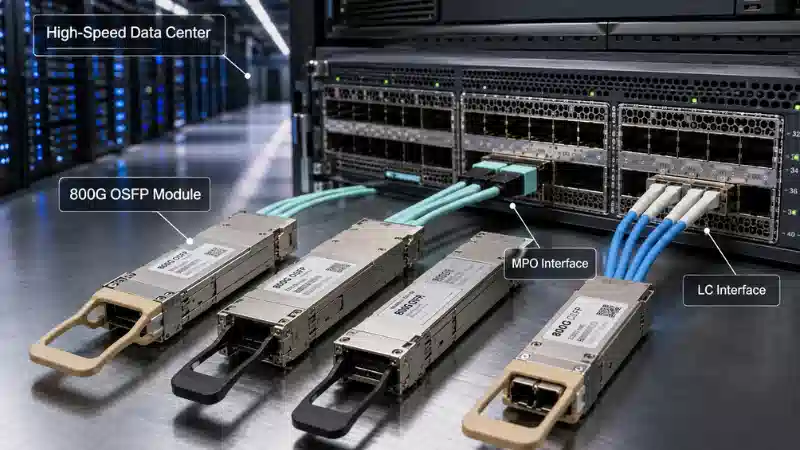
12-fiber MTP cables are the most commonly used solution for 40G–100G connections, while 16-fiber MTP cables are designed for short-reach 400G cabling in hyperscale data centers. When your equipment spec sheets show QSFP+ or QSFP28 optical modules, you're looking at devices engineered for MTP connectivity. Attempting to break these out to duplex LC connections adds unnecessary conversion points, increases insertion loss, and reduces reliability.
The bandwidth threshold breakdown:
10G and below: Duplex LC/SC remains practical and cost-effective
25G single-lane: Either duplex or MTP viable depending on density needs
40G parallel (SR4): MTP-8 or MTP-12 required for direct switch connections
100G parallel (SR4/SR10): MTP-12 or MTP-24 mandatory
200G/400G: MTP-8 or MTP-16 based on encoding (50Gbps vs 100Gbps per lane)
800G and above: MTP-16 minimum, with emerging 32-fiber solutions
MMC (Multi-fiber Miniature Connector) solutions deliver three times the port density of traditional MTP connectors, with ultra-low insertion loss at 0.25dB maximum, though this newer standard sees primary adoption in specialized government and military applications rather than commercial data centers.
Consider a cloud service provider case: Their 2024 network refresh involved deploying 100G spine switches. Using traditional duplex breakouts would have required 2,400 individual fiber connections with 800 patch cords. The MTP approach utilized 200 MTP-12 trunk cables, reduced connector mating points by 67%, and achieved 40% lower insertion loss across the fabric.
Which Data Center Scenarios Demand MTP Implementation?
Space-constrained environments reveal MTP's value most dramatically. Hyperscale, big data, and cloud data centers face the challenge of provisioning bandwidth-greedy applications that require massive space to accommodate massive cable counts. When your facility operates at 90%+ rack utilization and pathway fill ratios exceed 70%, every cubic inch of cable tray capacity becomes precious real estate.
The scenario evaluation matrix:
Greenfield data center builds: MTP becomes the default structured cabling choice. Starting with MTP-based backbone infrastructure enables graceful migration from 10G edge switching through 400G core fabric without major physical layer overhauls. MTP's modular construction allows simple upgrades and expansions without major infrastructure alterations.
Leaf-spine architecture deployments: Modern three-tier or Clos network topologies generate massive east-west traffic patterns. A typical 48-port leaf switch with 4:1 oversubscription requires 12 uplinks to the spine layer. Multiply this across 40 leaf switches, and you're managing 480 inter-switch connections-a textbook case for MTP trunk cables between distribution points.
High-frequency trading platforms: Financial applications where microseconds matter can't tolerate the additional latency from unnecessary active conversions. Direct MTP connections between switches and servers eliminate transcoding points. Firms operating algorithmic trading systems consistently choose MTP for latency-critical paths.
Colocation facilities: Multi-tenant environments benefit from MTP MTP Cable's flexibility for rapid turn-up. A colo provider can pre-install MTP backbone infrastructure, then quickly provision custom fiber counts for each customer using breakout cassettes. This approach reduced their average customer installation time from 4 hours to 45 minutes.
Edge computing deployments: Compact edge data centers serving 5G applications face unique density challenges. A telecommunications company deploying edge facilities in 2024 standardized on MTP-8 for their 8-rack edge sites, achieving 40G interconnects in spaces where traditional cabling would have failed thermal management requirements.
Practical test: If your deployment involves more than 12 fiber connections between two points, requires bandwidth above 25G, operates in constrained physical space, or anticipates growth within 24 months, MTP delivers measurable advantages over traditional alternatives.

When Does Your Current Infrastructure Signal MTP Migration?
Legacy network warning signs emerge before complete failure forces unplanned upgrades. Cable congestion creating airflow blockages, inability to trace individual connections due to bundle density, and technicians reporting difficulty accessing equipment all indicate you've reached the practical limits of duplex fiber architecture.
The quantifiable triggers:
Patch cord count: More than 200 duplex connections per cabinet
Pathway fill: Cable tray or conduit utilization above 60%
Mean time to install: Adding new connections takes more than 30 minutes
Maintenance windows: Routine changes require facility access scheduling due to complexity
Future bandwidth: Equipment roadmap shows 40G+ requirements within 18 months
Before the MTP connector came to market, it typically took two installers a full day to terminate and test 144 fibers. With MTP connectors, installers gained ability to rapidly connect 8 to 12 fibers at a time, trimming a daylong job to just a few hours. When your team reports fiber installation as a bottleneck to project timelines, that operational pain point justifies investigation.
Thermal management issues often emerge first. A university research computing facility discovered their primary issue wasn't bandwidth-it was cable-blocked airflow causing temperature alarms. Migrating 384 duplex connections to 32 MTP-12 trunk cables reduced cable volume by 78%, restored proper airflow patterns, and eliminated recurring cooling problems.
Migration assessment checklist:
Document current fiber counts per physical path
Calculate man-hours spent on fiber installations quarterly
Measure cable tray fill ratios across critical pathways
Project bandwidth growth for 24-month horizon
Evaluate technician accessibility complaints
Review thermal management incident logs
Organizations that conduct this assessment typically find the business case becomes compelling when three or more indicators show critical levels. The key isn't whether MTP offers superior technology-it demonstrably does-but whether your specific operational context makes that superiority worth the migration effort.
What Budget and Timeline Factors Determine MTP Viability?
Cost analysis requires looking beyond per-connector pricing. MTP and MPO cables both achieve 400G data transmission and use the same standards with pre-terminated cables, enabling installation in tighter spaces with more throughput and far less installation effort. While an MTP-12 assembly costs 3-4x more than equivalent duplex LC cables, that direct cost comparison misses the broader financial picture.
The total cost model includes:
Material costs: MTP connectors, trunk cables, cassettes, adapters
Installation labor: Reduced by 60-75% compared to field-terminated duplex
Testing time: One MTP connection tests 12 fibers simultaneously
Maintenance efficiency: Simplified troubleshooting and moves/adds/changes
Downtime risk: Pre-terminated quality reduces failure rates
Space efficiency: Denser cabling may delay facility expansion costs
A regional healthcare provider analyzed their 2024 data center expansion. Traditional duplex approach estimated $127,000 in materials and $89,000 in labor. MTP solution showed $164,000 in materials but only $31,000 in labor. Including the value of completing the project 8 days faster, total cost of ownership favored MTP by 18%.
Timeline considerations shape feasibility:
Immediate deployments (< 30 days): Pre-terminated MTP excels when lead time is critical
Phased rollouts (3-12 months): Hybrid approaches using MTP for backbone, duplex for edge
Future-proofing (5+ years): MTP provides bandwidth and density headroom
Budget constraints in 2025 show some organizations adopting staged approaches. Initial backbone deployment uses MTP trunk cables, while existing duplex infrastructure remains at the access layer. This lets teams gain MTP experience, prove the operational benefits, and secure additional funding for comprehensive migration.
The decision framework: If your project requires installing more than 96 fibers, targets completion in under 45 days, must support 40G+ immediately, or operates in a space where cable volume restricts options, MTP's higher material cost gets offset by labor savings and operational advantages. For smaller deployments with generous timelines and 10G-or-less requirements, traditional duplex may remain more economical.
How Do You Choose Between MTP-8, MTP-12, and MTP-24?
Fiber count selection aligns with application requirements and equipment capabilities. 8-fiber MTP systems can transmit the same data rates as 12-fiber cables with lower cost and insertion loss, making them more cost-effective for 40G and 100G applications. The choice isn't about capability-it's about optimization for your specific use case.
MTP-8 applications:
40GBASE-SR4 and 100GBASE-SR4 parallel optic transceivers
200G and 400G with 50Gbps or 100Gbps per lane encoding
Breakout scenarios splitting one 40G/100G port to multiple 10G/25G connections
Space-constrained applications where every fiber position counts
Note that while 8-fiber data center applications are best supported by 8-fiber MTP connectors, 12-fiber MTP connectors can be used with the middle 4 fiber positions unused. This creates flexibility but introduces fiber waste-12% of your installed fiber capacity remains dark in 8-fiber applications using 12-fiber hardware.
MTP-12 applications:
Most common configuration for general-purpose data center infrastructure
Dual 40G or 100G connections (using pairs of 6-fiber groups)
Standard backbone trunking between distribution frames
Cassette-based architectures for duplex LC fan-outs
Broad equipment compatibility and vendor support
The 12-fiber format represents the industry standard sweet spot, offering balanced density, flexibility, and ecosystem maturity. When in doubt, MTP-12 provides the most deployment options.
MTP-24 applications:
100GBASE-SR10 CFP transceiver connections (20 fibers active)
Very high density backbone links where space is absolute premium
Specialized enterprise or campus applications with extreme fiber counts
800 Gig applications use 16-fiber MPOs with 8 fibers transmitting and 8 receiving at 100 Gbps, while 1.6 Terabit can use 16-fiber MPOs with 8 transmitting and 8 receiving at 200 Gbps, indicating the emerging trend toward 16-fiber configurations for next-generation speeds rather than jumping to 24-fiber solutions.
Selection criteria in practice:
Match transceiver specifications first (check equipment data sheets)
Consider future bandwidth needs within 3-year equipment refresh cycle
Evaluate breakout requirements for access layer connectivity
Factor in availability and pricing from your preferred vendors
Assess your team's experience level with different formats
A manufacturing company's network refresh in 2024 illustrates practical selection. Their core required 100G connectivity (MTP-12 selected), distribution layer used 40G with plans for 100G upgrades (MTP-12 for consistency), and access layer remained 10G duplex LC. This tiered approach optimized cost while maintaining clear migration paths.

Frequently Asked Questions
When should I upgrade from LC to fiber MTP?
Evaluate the transition when managing more than 96 duplex connections in constrained space, deploying bandwidth above 25G, or facing installation backlogs. The threshold varies by organization, but most find compelling business cases emerge at 40G deployment scale or 200+ annual fiber installations.
Can I mix MTP and traditional duplex fiber in the same network?
Yes, through cassette-based or harness-based conversion architectures. MPO to LC cassettes and MPO to LC hybrid patch cords enable transition between MTP trunk cables and duplex fiber connectors at patch panels. This hybrid approach lets teams adopt MTP for high-density backbone infrastructure while maintaining duplex connections at the access layer.
Does MTP work with single-mode fiber?
Absolutely. MTP connectors come with different end-face types including APC (Angled Physical Contact) with an 8-degree angled surface that minimizes back reflection, making it ideal for single-mode applications. Single-mode MTP finds extensive use in longer-distance data center interconnects and metropolitan area networks.
How do I maintain proper polarity with MTP?
Three polarity methods exist under TIA 568 standard-Method A, B, and C-with Method B recommended as it always uses the same type of components and is least likely to cause problems. Most organizations standardize on Type B polarity across their infrastructure, using appropriate trunk cables and cassettes designed for that method. Proper documentation and labeling prevent polarity errors during maintenance.
What's the difference between MTP and MPO?
MTP caters to the strengths of MPO while providing enhancements that solve specific problems. MTP connections are more reliable, and fiber systems terminating in those connections typically last much longer. MTP represents a branded, enhanced version of the MPO standard with floating ferrule design, elliptical guide pins, and metal pin clamps improving durability and optical performance.
When does MTP become cost-effective compared to duplex fiber?
Cost crossover occurs when labor savings offset higher material costs. Projects involving 96+ fibers, compressed timelines under 60 days, or space constraints where cable volume creates operational issues typically show favorable economics. Calculate your organization's fully-loaded labor rate including overhead-the higher that number, the sooner MTP achieves cost parity.
Making the Right Decision for Your Infrastructure
Network infrastructure choices compound over years. Selecting fiber MTP becomes essential when your environment exhibits high fiber density, requires bandwidth exceeding traditional duplex capabilities, operates under space constraints, or demands rapid deployment timelines. The market continues expanding at 6.2% CAGR through 2033, driven by data center construction and high-bandwidth application demands, indicating sustained industry momentum toward multi-fiber connectivity.
The evaluation comes down to matching technology capabilities against operational requirements. Organizations deploying 40G+ fabrics, managing 200+ annual fiber installations, or operating at 80%+ rack density find MTP transitions from optional optimization to infrastructure necessity. Those with 10G requirements, generous space, and limited growth projections may justify continued duplex investment.
Your specific context determines the answer. Document current pain points, project realistic growth, calculate total cost including labor, and assess team readiness. MTP Cable technology delivers proven advantages-the question isn't whether it works, but whether it solves problems your infrastructure actually faces.
Key Takeaways
Fiber MTP becomes necessary when managing 96+ connections in constrained space, requiring 40G+ bandwidth, or facing installation bottlenecks
The technology excels in data center backbone infrastructure, leaf-spine architectures, and high-bandwidth applications where density and speed matter
Cost analysis must include labor savings, installation time reduction, and operational benefits beyond simple per-connector pricing
MTP-12 represents the most versatile configuration for general-purpose deployments, with MTP-8 optimized for specific 40G/100G applications