The basic components of an optical fiber communication system are shown in Figure 1-1. It mainly consists of three parts: transmission, reception, and the basic optical fiber transmission system that serves as a generalized channel.

(Figure 1-1 Basic components of an optical fiber communication system)
Basic Components of an Optical Fiber Communication System
△Classification of fiber optic communication systems
(1) Transmitting Section: In this section, the information source converts user information into a raw electrical signal, called a baseband signal. The optical transmitter converts the baseband signal into a signal suitable for channel transmission. If modulation is required, the output signal is called a modulated signal. To improve transmission quality, this analog baseband signal is usually converted into a frequency-modulated (FM), pulse-frequency modulated (PFM), or pulse-width modulated (PWM) signal, and finally, this modulated signal is input to the optical transmitter.
Whether it is a digital or analog system, the electrical signal carrying information input to the optical transmitter is converted into an optical signal through modulation.
(2) The optical carrier wave is transmitted to the receiving end via optical fiber lines, where the optical receiver converts the optical signal into an electrical signal. The electrical receiver functions inversely to the electrical transmitter; it converts the received electrical signal into a baseband signal, which is then used by the information sink to recover the user information.
In the entire communication system, the technology and equipment used in optical fiber communication are the same as those in cable communication for the electrical signal segments before the optical transmitter and after the optical receiver. The only difference is that the basic optical fiber transmission system, consisting of an optical transmitter, optical fiber lines, and an optical receiver, replaces cable transmission.
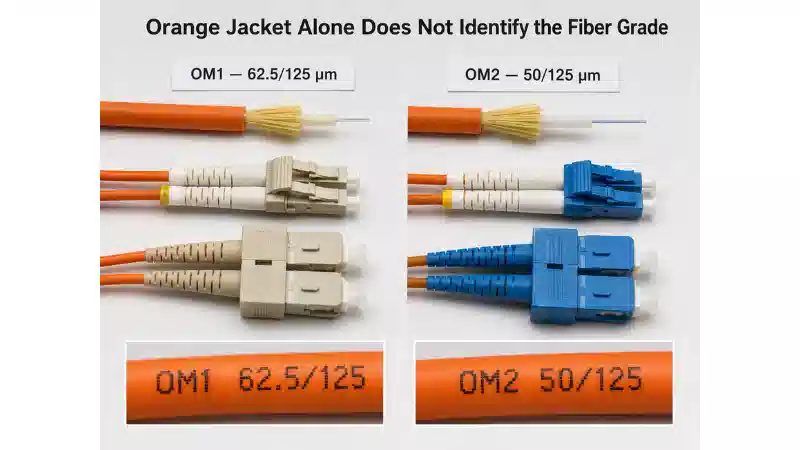
(3) Basic Fiber Optic Transmission System According to Figure 1-1, the basic fiber optic transmission system can be subdivided into three parts: the optical transmitter, the fiber optic line, and the optical receiver. The function of the optical transmitter is to convert the electrical signal input from the transmitting section into an optical signal and use combining technology to inject the optical signal into the fiber optic line to the maximum extent. The core equipment of the optical transmitter is the light source, along with the driver and modulator. The performance of the optical transmitter basically depends on the characteristics of the light source. The requirements for the light source are: sufficiently high output optical power, sufficiently high modulation frequency, as small a spectral linewidth and beam divergence angle as possible, stable output power and wavelength, and long device life. Currently, widely used light sources include semiconductor light-emitting diodes (LEDs) and semiconductor laser diodes (or lasers, LDs), as well as dynamic single-mode distributed feedback (DFB) lasers with very small spectral linewidths. Solid-state lasers are also used in some cases. The function of the fiber optic line is to transmit the optical signal from the optical transmitter to the optical receiver with the least possible distortion and attenuation. The fiber optic line consists of optical fibers, fiber optic connectors, and fiber optic plugs. The optical fiber is the main body of the fiber optic line, and the connectors and plugs are indispensable components. In practical engineering, optical cables that hold multiple optical fibers are used. Optical fiber communication systems operate at near-infrared wavelengths, and the transmission medium for optical fiber communication is quartz, which is a type of dielectric waveguide,is a cylindrical body, with core and cladding refractive indices of n₁ and cladding refractive index of n₂, and n₁ > n₂. When the full reflection condition is satisfied, light can be confined and transmitted within the core. The main characteristics of optical fiber are attenuation and color dispersion. Attenuation is expressed in the unit of dB/km, and optical fibers have three low-loss windows, with wavelengths of:
λ₀ = 0.85 μm (short wavelength band) λ₀ = 1.31 μm (long wavelength band)
λ₀ = 1.55 μm (long wavelength band)
The color dispersion of optical fiber is caused by the fact that components with different frequencies in the optical fiber do not propagate at the same speed, resulting in pulse broadening during transmission. Color dispersion is expressed in units of ps/(km · nm). The reciprocal of the signal number, i.e., the maximum bit rate-distance product that the color dispersion can tolerate.
The function of the optical receiver is to convert optical fiber signals into electrical signals with sufficiently high signal-to-noise ratio. The main component of the receiver is the photodetector, and there are also amplifiers, filters, and related circuits. The core of the photodetector is the light-receiving element. The requirement for the photodetector is a high response rate, low dark current, and high response speed. Currently, the photodetectors commonly used in optical fiber communication are semiconductor PN junction-based PIN photodiodes (PIN-PD) and avalanche photodiodes (APD).
The most important characteristic parameter of an optical receiver is its sensitivity. Sensitivity is a comprehensive indicator of the quality of an optical receiver; it reflects the receiver's ability to receive weak optical signals when adjusted to its optimal state. Sensitivity primarily depends on the noise of the photodiodes and amplifiers that make up the optical receiver, and is also affected by the transmission rate, the parameters of the optical transmitter, and the dispersion of the fiber optic line. It is also closely related to the system's required bit error rate or signal-to-noise ratio. Therefore, sensitivity is also an important indicator of the quality of an optical fiber communication system.