In 12-core MTP/MPO fiber optic cabling, polarity is not a trivial detail. Many data center links test normal and have acceptable insertion loss, yet the device ports still don't light up. The root cause is often not a problem with the fiber optic cable quality, but rather that the Tx transmitter is not correctly aligned with the Rx receiver. Fluke Networks also emphasizes in its MPO polarity specifications that the core purpose of fiber optic polarity is to ensure that the transmitted signal at one end reaches the correct receiving port at the other.
For 12-core MTP/MTP OM3 patch cords, Type A, Type B, and Type C are not simply three "wiring methods," but rather system solutions corresponding to different cabling architectures, module types, adapter orientations, and device interfaces. Choosing the wrong polarity can render the entire 40G/100G SR4 link inoperable; choosing the correct polarity can reduce on-site troubleshooting costs and improve the maintainability of high-density cabling systems.
What is MTP/MPO polarity? Why is it crucial to pay attention to it in 12-core cabling?
MTP/MPO polarity refers to the positional mapping of optical fibers within the connectors at both ends. For a two-core LC link, polarity is typically represented as A-end (Tx) connecting to B-end (Rx). However, in a 12-core MTP/MPO connector, 12 optical fibers are integrated at once. If the internal fiber core positioning is incorrect, misalignment between the transmitter and receiver will occur.
For 12-fiber MTP/MTP OM3 Patch Cables, polarity usually needs to be confirmed before ordering. This is because OM3 multimode systems are primarily used for short-distance, high-speed links, such as 40G SR4, 100G SR4, and high-density MTP patch panel connections. If the customer only confirms "12-core, OM3, MTP/MTP" but not Type A/B/C, male/female connectors, and adapter orientation, the link may still not be directly energized on-site.
Detailed Comparison of the Three MTP Polarity Types
| Polarity Type | Key Orientation | Fiber Mapping | Patch Cord Type | Typical Application | Advantages, Limitations and Compatibility |
|---|---|---|---|---|---|
| Type A - Straight-Through | Key up on one end and key down on the other end | 1→1, 2→2 … 11→11, 12→12 | A-B patch cord on one side, A-A patch cord on the other side | Method A connection: Type A MTP cassettes are used on both sides | Advantages: Simple trunk cabling with straight-through fiber alignment; suitable for traditional structured cabling. Limitations: Different patch cords are required at each end, such as A-A and A-B, which increases management complexity. It is not ideal for direct parallel-optics connections. |
| Type B - Fully Reversed | Key up on both ends | Fiber positions are fully reversed: 1↔12, 2↔11 … | Standard A-B patch cords on both ends | Method B connection: direct connection between Type A cassettes or parallel optical transceivers | Advantages: The same A-B patch cord can be used on both ends, making polarity management easier. It directly supports 40G/100G parallel optical modules. Limitations: The trunk cable must be pre-terminated with reversed fiber mapping at the factory. It is not directly interchangeable with Type A or Type C systems. |
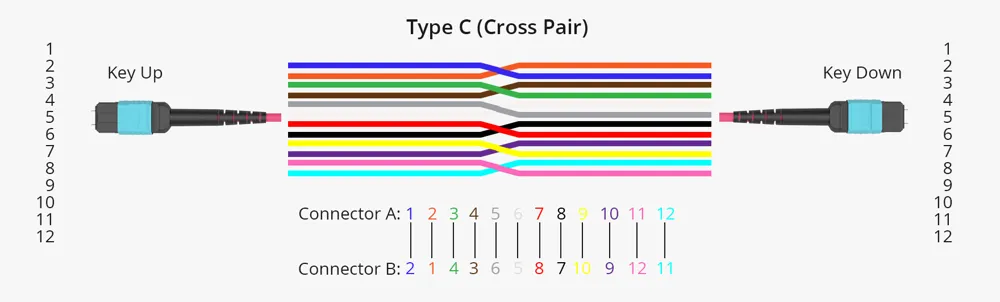
| Type C - Pair-Flipped | Key up on one end and key down on the other end | Adjacent fiber pairs are crossed: 1↔2, 3↔4 … 11↔12 | A-B patch cords on both ends | Method C connection: commonly used for MTP-to-LC breakout or duplex LC module systems | Advantages: The trunk maintains a key-up/key-down structure, and the same patch cord type can be used at both ends. It can retain Type A cassette architecture. Limitations: This configuration is less common and only flips adjacent fiber pairs. It is mainly used in specific duplex applications and can easily cause confusion if mixed with other polarity types. |
Type A - Straight-Through Polarity
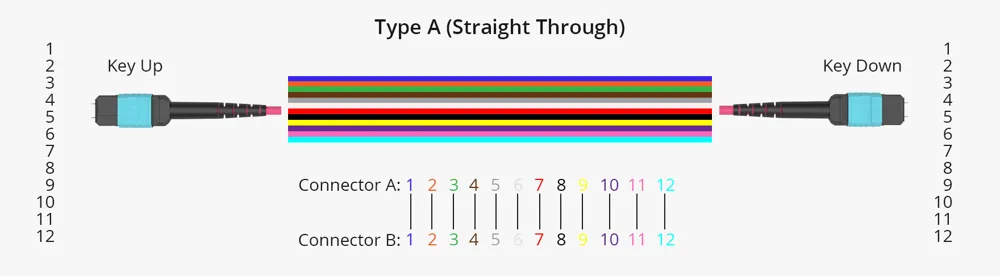
As shown in the diagram, a Type A trunk cable has one connector with the key facing up and the other connector with the key facing down. The fiber numbering remains unchanged from end to end, such as 1→1, 2→2, and so on through 12→12.
In a Method A polarity system, the same Type A modules, such as Type A cassettes, are typically used on both sides of the link. One end uses a standard A-B duplex patch cord, while the other end uses a crossed A-A patch cord.
This method provides a simple and clear trunk cabling structure, but it requires two different patch cord types. As a result, cable management becomes more complicated. It is also not suitable for direct parallel optical module connections.
Type B - Fully Reversed Polarity
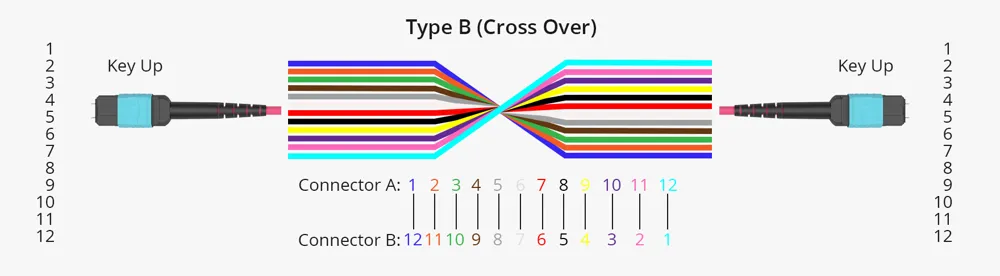
A Type B trunk cable uses key-up connectors on both ends, or key-down connectors on both ends, depending on the system design. The fiber positions are completely reversed from one end to the other: fiber 1 maps to fiber 12, fiber 2 maps to fiber 11, and so on.
In this architecture, the same type of cassette, usually Type A cassettes, can still be used on both sides, but the trunk cable itself reverses the fiber sequence. Because the fiber direction is already reversed inside the trunk, standard A-B patch cords can be used at both ends.
Type B polarity is widely used for 40G and 100G parallel optical interfaces. In this configuration, the P1-to-P12 reversal naturally corrects the TX/RX alignment required by parallel optical transceivers.
The main advantage of Type B is that both ends can use the same A-B patch cord, simplifying daily management and reducing patching errors. However, the trunk cable must be factory pre-terminated with reversed fiber mapping. When comparing products from different manufacturers, the exact polarity definition should be verified carefully.
Type C - Pair-Flipped Polarity
A Type C trunk cable may look similar to Type A from the outside because it also uses a key-up/key-down connector orientation. However, the internal fiber mapping is different. Each adjacent fiber pair is crossed: fiber 1 maps to fiber 2, fiber 2 maps to fiber 1, fiber 3 maps to fiber 4, and so on.
This means that fiber 1 on one end is connected to fiber 2 on the opposite end, fiber 3 is connected to fiber 4, and the same pair-flipped logic continues across the 12 fibers.
When used in a complete link, Type C can work with the same Type A cassettes on both ends, and A-B patch cords can be used on both sides. Type C is mainly used to maintain polarity in duplex LC systems through MTP-to-LC conversion modules, such as 4×10G breakout applications.
However, Type C is not commonly used in direct parallel optical module applications inside data centers. Its implementation is more complex, and if it is mixed incorrectly with Type A or Type B components, unpredictable fiber misalignment may occur.
Common MTP/MPO Polarity Problems and Troubleshooting Guide
In 12-fiber MTP/MPO cabling, most link failures are not caused by the cable jacket or fiber type itself, but by incorrect polarity, wrong patch cord selection, connector gender mismatch, adapter orientation errors, or contaminated end faces. For high-density OM3 MTP cabling used in 40G/100G SR4 links, these issues must be checked before installation and verified again during acceptance testing.
1. Link Failure or Signal Distortion
A failed link, unstable signal, or abnormal optical power reading is often caused by polarity mismatch. In many cases, the transmit channel is connected to another transmit channel, or the receive channel is connected to another receive channel. This creates a TX-to-TX or RX-to-RX error, and the optical link cannot work properly.
The first step is to check whether the installed trunk cable matches the original cabling design. Confirm whether the link requires MTP Type A, Type B, or Type C polarity. Then check the duplex patch cords at both ends. In many systems, a standard A-B patch cord is required, while an incorrectly used A-A patch cord may reverse the expected TX/RX mapping.
For accurate troubleshooting, use a polarity tester or MTP/MPO test set to verify each fiber position one by one. The goal is to confirm that every transmit channel is correctly mapped to the corresponding receive channel.
2. Wrong Patch Cord Type
Using the wrong duplex patch cord is one of the most common MTP polarity problems. For example, if both ends of the link use A-A patch cords when the system requires A-B patch cords, the TX/RX relationship may be reversed or shifted.
The correct solution is to compare the installed patch cords with the approved cabling diagram. In a typical Type A polarity system, one side may use an A-B patch cord while the other side uses an A-A patch cord. In many Type B systems, both ends can use standard A-B patch cords.
For SEO and procurement clarity, the specification should always state the patch cord type clearly: A-B duplex patch cord, A-A duplex patch cord, MTP Type A trunk, MTP Type B trunk, or MTP Type C trunk.
3. MTP Male/Female Connector or Key Orientation Error
MTP/MPO connector gender must be checked carefully. If two male connectors with guide pins are connected together, physical damage may occur. If two female connectors are connected together, the ferrules cannot be accurately aligned. In both cases, the link may fail or produce excessive insertion loss.
The correct rule is simple: male MTP connector should mate with female MTP connector. Before installation, confirm the gender of the trunk cable, patch cord, cassette, adapter panel, and optical module interface.
Key orientation is equally important. MTP/MPO adapters are typically designed as key-up to key-down or key-up to key-up. If the adapter orientation does not match the polarity design, the fiber sequence may be reversed unexpectedly. Always confirm whether the link uses a Type A adapter, Type B adapter, or a specific manufacturer-defined orientation.
4. Confusion Between Parallel Optical Module Channels
When using parallel optical modules such as 40G SR4 or 100G SR4 transceivers, each fiber position has a defined transmit or receive function. If the TX channels from the module are not mapped correctly to the RX channels on the opposite side, the link will fail.
This is especially important in 12-fiber MTP/MPO OM3 cabling, where only part of the 12-fiber array may be used for active transmission. In many SR4 applications, Type B polarity is commonly used because the reversed fiber mapping helps simplify TX/RX alignment between parallel optical modules.
The recommended solution is to follow the optical module manufacturer's channel mapping documentation. When there is no clear documentation, do not rely on visual inspection alone. Use a polarity tester and optical power test to confirm the final mapping.
5. Fiber Damage or Contaminated End Faces
High-density MTP/MPO connectors are more sensitive to contamination and mechanical damage than traditional duplex connectors. Dust, oil, scratches, broken guide pins, or damaged ferrule surfaces can all lead to high insertion loss or link instability.
Use a fiber optic inspection microscope or end-face inspection system to check the MTP/MPO connector surface before mating. If contamination is found, clean the connector with approved fiber cleaning tools. If scratches, cracked ferrules, damaged pins, or severe end-face defects are detected, replace the connector or cable assembly.
For broken fibers or hidden damage inside the cable, use an OTDR to locate the fault point. This is especially useful when troubleshooting long trunk cables or links installed inside high-density fiber panels
How do FOCC 12-core MTP/MTP OM3 patch cords support different polarity configurations?
FOCC can customize 12-core MTP/MTP OM3 patch cords to meet customers' needs for high-density patch panels, MTP adapter panels, 40G/100G SR4 links, and rack interconnects. The products are available in Type A, Type B, and Type C polarities, support male/female connectors, standard loss or low loss versions, and can be customized with different lengths, sheath materials, and packaging labels according to project requirements.
If you are selecting 12-core MTP/MTP OM3 patch cords for 40G/100G SR4 links, high-density MTP patch panels, or short-distance data center interconnects, please send your link diagram, module model, polarity requirements, and length list to FOCC. We can assist in confirming Type A, Type B, or Type C options and provide mass production and OEM customization support.