


Fiber optic cables are cables that contain one or more optical fibers, which are thin strands of glass or plastic that can transmit light signals over long distances. Fiber optic cables are used in telecommunications, data communications, and other applications where high-speed, high-bandwidth data transmission is required.
There are several different types of fiber optic cables, including:
1. Single-mode fiber: This type of fiber optic cable has a small core diameter (typically 9 microns) and is designed to transmit a single mode of light. Single-mode fiber is used for long-distance, high-bandwidth applications such as telecommunications and long-haul data transmission.
2. Multimode fiber: This type of fiber optic cable has a larger core diameter (typically 50 or 62.5 microns) and is designed to transmit multiple modes of light. Multimode fiber is used for shorter-distance, lower-bandwidth applications such as data center and local area network (LAN) communication.
3. Loose-tube fiber: This type of fiber optic cable has a protective outer jacket and contains multiple optical fibers that are loosely contained within a central tube. Loose-tube fiber is commonly used in outdoor applications where the cable may be exposed to moisture or temperature changes.
4. Tight-buffered fiber: This type of fiber optic cable has a protective outer jacket and contains one or more optical fibers that are tightly buffered with a protective coating. Tight-buffered fiber is commonly used in indoor applications where the cable may be subject to bending or other stress.
5. Ribbon fiber: This type of fiber optic cable contains multiple optical fibers that are arranged in a flat ribbon configuration. Ribbon fiber is commonly used in high-density applications such as data centers.
6. Armored fiber: This type of fiber optic cable has a protective outer jacket and also contains a layer of metal armor for additional protection against physical damage. Armored fiber is commonly used in industrial or military applications.
In addition to these types, there are also specialized fiber optic cables that are designed for specific applications or environments. For example, there are cables that are designed for underwater use, as well as cables that are designed for use in hazardous environments where there may be a risk of explosion or fire.
Indoor and outdoor fiber optic cables differ in their construction and design, which makes them suitable for different environments and applications. Here are some of the common types of indoor and outdoor fiber optic cables:
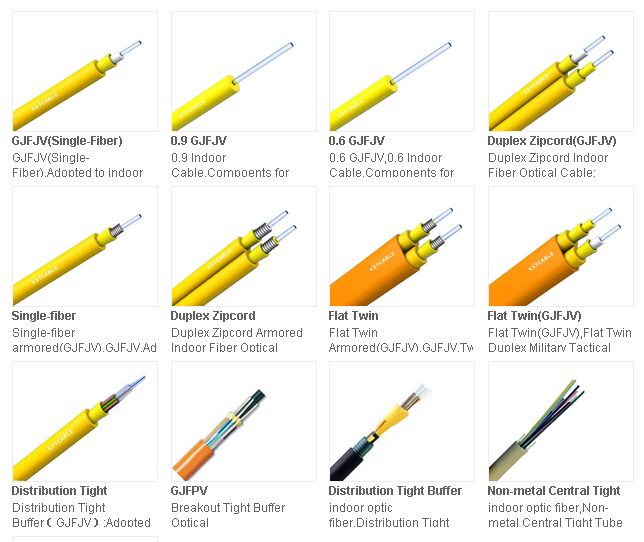
Indoor/Outdoor Fiber Optic Cables Type
Indoor fiber optic cables:
Tight-buffered cables: These are the most common type of indoor fiber optic cables. They have a tight buffer coating around each fiber, which makes them more flexible and easier to handle. They are typically used for shorter distances, such as within a building or a data center.
Distribution cables: These cables contain several tight-buffered fibers bundled together under a single jacket. They are used for longer distances than tight-buffered cables and are typically used to connect different parts of a building or campus.
Breakout cables: These cables have several tight-buffered fibers bundled together under a single jacket, with each fiber having its own individual tight buffer coating. They are used for high-density applications, such as connecting equipment in a server room.
Outdoor fiber optic cables:
Loose-tube cables: These are the most common type of outdoor fiber optic cables. They have a central tube that holds several fibers, which are not tightly bound to the tube. This design allows for flexibility and protection against moisture and temperature changes.
Ribbon cables: These cables contain several fibers arranged in a flat ribbon configuration. They are used for high-density applications, such as long-distance telecommunications.
Armored cables: These cables have an additional layer of metal armor for extra protection against physical damage. They are used in harsh environments, such as underground or aerial installations.
Composite cables: These cables contain both indoor and outdoor cables within a single jacket. They are used to connect buildings or different parts of a campus.
In summary, indoor and outdoor fiber optic cables have different designs and constructions that make them suitable for different environments and applications. Indoor cables are typically tighter buffered and used for shorter distances, while outdoor cables are more rugged and designed for longer distances and harsher environments.
After optical signals are transmitted through optical fiber over a certain distance, attenuation and distortion occur, causing the input optical signal pulses and output optical signal pulses to be different. This manifests as amplitude attenuation and waveform broadening of the optical pulses. The cause of this phenomenon is the presence of loss and dispersion in optical fiber. Loss and dispersion are the most important parameters describing the transmission characteristics of optical fiber, and they limit the transmission distance and transmission capacity of the system. The main characteristics of optical fiber include: loss characteristics of optical fiber, dispersion characteristics of optical fiber, geometric and optical characteristics of optical fiber, nonlinear effects of optical fiber, and mechanical and temperature characteristics of optical fiber.
-
![Optical Fiber Secondary Coating Extrusion Production Line]() Optical Fiber Secondary Coating Extrusion Production LineThe FOCC optical fiber secondary coating extrusion production line is developed by our company for the extrusion production of 1-12 core optical fiber oil-filled loose tube bundles. The extrusion
Optical Fiber Secondary Coating Extrusion Production LineThe FOCC optical fiber secondary coating extrusion production line is developed by our company for the extrusion production of 1-12 core optical fiber oil-filled loose tube bundles. The extrusion -
![GYXTC8Y/GYXTC8S Outdoor Areial Fiber Optic Cable]() GYXTC8Y/GYXTC8S Outdoor Areial Fiber Optic CableGYXTC8S type optical cable is center pipe loosing jacket filling type,steel-PE adhesive jacket,8 font self undertaken type communication outdoor optical cable..
GYXTC8Y/GYXTC8S Outdoor Areial Fiber Optic CableGYXTC8S type optical cable is center pipe loosing jacket filling type,steel-PE adhesive jacket,8 font self undertaken type communication outdoor optical cable.. -
![All Dielectric Self-support Aerial Cable ADSS]() All Dielectric Self-support Aerial Cable ADSSADSS cable is loose tube stranded. Fibers, 250μm , are positioned into a loose tube made of high modulus plastics. The tubes are filled with a water-resistant filling compound. The tubes (and
All Dielectric Self-support Aerial Cable ADSSADSS cable is loose tube stranded. Fibers, 250μm , are positioned into a loose tube made of high modulus plastics. The tubes are filled with a water-resistant filling compound. The tubes (and -
![GYFTA53 Armored Outdoor Optic Cable]() GYFTA53 Armored Outdoor Optic CableThe fibers, 125μm, are positioned in a loose tube made of a high modulus plastic. The tubes are filled with a water-resistant filling compound. A Fiber Reinforced Plastic (FRP) locates in the center
GYFTA53 Armored Outdoor Optic CableThe fibers, 125μm, are positioned in a loose tube made of a high modulus plastic. The tubes are filled with a water-resistant filling compound. A Fiber Reinforced Plastic (FRP) locates in the center -
![Stranded Loose Tube Non-metallic FRP Strength, Non-armored Fiber Optic Cable GYFTY]() Stranded Loose Tube Non-metallic FRP Strength, Non-armore...GYFTY FRP locates in the center of cores as a non-metallic strength member. The cable tubes, which are filled with filling compound, are stranded around the strength member. Then the aramid yarn is
Stranded Loose Tube Non-metallic FRP Strength, Non-armore...GYFTY FRP locates in the center of cores as a non-metallic strength member. The cable tubes, which are filled with filling compound, are stranded around the strength member. Then the aramid yarn is -
![Outdoor Single Mode Armoured Optical Cable GYXTW]() Outdoor Single Mode Armoured Optical Cable GYXTWOutdoor Single Mode Armoured Optical Cable GYXTW is a uni-tube, single jacket and single armor fiber optic cable designed for outdoor communication networks. It uses optical fibers placed in a loose
Outdoor Single Mode Armoured Optical Cable GYXTWOutdoor Single Mode Armoured Optical Cable GYXTW is a uni-tube, single jacket and single armor fiber optic cable designed for outdoor communication networks. It uses optical fibers placed in a loose -
![Unitube Light-armored Fiber Ribbon Cable GYDXTW]() Unitube Light-armored Fiber Ribbon Cable GYDXTWUnitube Light-armored fiber ribbon Cable GYDXTW,Fiber optic cable is an outdoor communication optical cable of metal strength menmber of the central tube jelly-filled structure with embedding
Unitube Light-armored Fiber Ribbon Cable GYDXTWUnitube Light-armored fiber ribbon Cable GYDXTW,Fiber optic cable is an outdoor communication optical cable of metal strength menmber of the central tube jelly-filled structure with embedding -
![Stranded Loose Tube Fiber Ribbon Cable With Steel Tape GYDTS]() Stranded Loose Tube Fiber Ribbon Cable With Steel Tape GYDTSGYDTS. The ribbon 4, 6, 8, 12 fibers are posititioned in a loosetube made of a high modulus plastic. The tubes are filled with a water-resistant filling plastic. The tubes are filed with a
Stranded Loose Tube Fiber Ribbon Cable With Steel Tape GYDTSGYDTS. The ribbon 4, 6, 8, 12 fibers are posititioned in a loosetube made of a high modulus plastic. The tubes are filled with a water-resistant filling plastic. The tubes are filed with a -
![Stranded Loose Tube Cable With Steel Tape( Double Sheaths)GYTY53]() Stranded Loose Tube Cable With Steel Tape( Double Sheaths...Stranded Loose Tube Cable With Steel Tape( double sheaths)GYTY53,The fibers, 250μm, are positioned in a loose tube made of a high modulus plastic. The tubes are filled with a water-resistant filling
Stranded Loose Tube Cable With Steel Tape( Double Sheaths...Stranded Loose Tube Cable With Steel Tape( double sheaths)GYTY53,The fibers, 250μm, are positioned in a loose tube made of a high modulus plastic. The tubes are filled with a water-resistant filling -
![Stranded Loose Tube Fiber Ribbon Cable With Steel Tape GYDTA]() Stranded Loose Tube Fiber Ribbon Cable With Steel Tape GYDTAGYDTA. The ribbon 4, 6, 8, 12 fibers are posititioned in a loosetube made of a high modulus plastic. The tubes are filled with a water-resistant filling plastic. The tubes are filed with a
Stranded Loose Tube Fiber Ribbon Cable With Steel Tape GYDTAGYDTA. The ribbon 4, 6, 8, 12 fibers are posititioned in a loosetube made of a high modulus plastic. The tubes are filled with a water-resistant filling plastic. The tubes are filed with a -
![Stranded Loose Tube Single-steel-wire Armored Cable GYTA53]() Stranded Loose Tube Single-steel-wire Armored Cable GYTA53fiber, 250μm, are positioned in a loose tube made of a high modulus plastic. The tubes are filled with a water-resistant filling compound. A steel wire, sometimes sheathed with polyethylene (PE) for
Stranded Loose Tube Single-steel-wire Armored Cable GYTA53fiber, 250μm, are positioned in a loose tube made of a high modulus plastic. The tubes are filled with a water-resistant filling compound. A steel wire, sometimes sheathed with polyethylene (PE) for -
![GYTS Standed Loose Tube Cable With Aluminum Tape]() GYTS Standed Loose Tube Cable With Aluminum Tapethe Fiber, either of single - or multi-mode type, are positioned in a loose tube made of a high modulus plastic.The tubes are filled with a water-resistant filling compound. A Steel wire sometimes
GYTS Standed Loose Tube Cable With Aluminum Tapethe Fiber, either of single - or multi-mode type, are positioned in a loose tube made of a high modulus plastic.The tubes are filled with a water-resistant filling compound. A Steel wire sometimes


How to Choose the Right Fiber Optical Cable
Choosing a fiber optical cable involves more than deciding between single-mode and multimode fiber. Cable construction, installation environment, mechanical protection, fiber count and transmission requirements all affect which cable is suitable for a network.
Fiber Mode
Select single-mode or multimode fiber according to transmission distance, equipment and network architecture.
Environment
Determine whether the cable will operate indoors, outdoors or across both environments.
Construction
Loose tube, tight buffered, ribbon, distribution and breakout cables support different installation requirements.
Protection
Armored, non-armored and non-metallic constructions provide different levels of mechanical protection.
Installation
Cable construction should correspond to aerial, duct, underground, direct-burial, microduct or FTTH deployment.
Fiber Count
Select fiber count according to existing links, redundancy requirements and planned network expansion.
Fiber Optical Cable by Installation Environment
Installation environment is one of the most useful starting points when selecting optical cable.
Indoor networks, outdoor telecom routes, aerial installations, underground infrastructure and FTTH access networks place different requirements on cable construction.
Indoor Fiber Optic Cable
Indoor fiber optic cable is generally selected for building backbones, telecommunications rooms, equipment rooms, LAN infrastructure, campus buildings and data center connections.
Tight-buffered, distribution and breakout constructions are commonly associated with indoor cabling because individual fibers can be protected and managed within the building environment.
Outdoor Fiber Optic Cable
Outdoor fiber optic cable, also commonly described as outside plant fiber optic cable or OSP fiber optic cable, is used where the cable may be exposed to moisture, temperature variation and greater mechanical stress.
Loose-tube construction is widely used for these applications because the fibers are protected inside buffer tubes rather than being tightly attached to the external cable structure.
Where additional mechanical protection is required, an outdoor single mode armoured optical cable combines single-mode optical transmission with a reinforced outdoor cable structure.
Aerial Fiber Optic Cable
Aerial fiber optic cable is installed above ground between poles or other supporting structures. Its mechanical design must account for cable support, span conditions and external environmental exposure.
An ADSS fiber optic cable uses an all-dielectric self-supporting structure for aerial networks, while the GYXTC8Y/GYXTC8S outdoor aerial fiber optic cable represents another cable construction intended for above-ground deployment.
Underground and Direct Burial Fiber Optic Cable
Underground fiber optic cable and direct burial fiber optic cable require additional consideration of mechanical protection, moisture exposure and route conditions.
A GYFTA53 armored outdoor fiber optic cable is one example of an outdoor armored construction. Cable requirements vary depending on whether the route is directly buried or installed inside a duct.
Duct and Microduct Fiber Optic Cable
Duct systems protect fiber optic cables along underground and campus routes. Where available duct space is limited, smaller-diameter optical cable structures can improve the use of existing pathways.
An air-blown micro fiber optical cable is designed for deployment through microduct infrastructure using air-assisted installation methods.
FTTH Fiber Optic Cable
FTTH fiber optic cable connects the access network toward homes and end-user premises. Drop cables are commonly used in the final section because the optical cable must be routed from the distribution network toward individual subscribers.
A typical configuration is an FTTH drop cable using single-mode fiber.
Fiber Optic Cable Construction Types
Single-mode and multimode refer to optical transmission characteristics, while loose tube, tight buffered,
ribbon and armored describe aspects of the cable construction.
Loose Tube Fiber Optic Cable
Optical fibers are placed inside one or more buffer tubes, a construction widely used for outdoor telecommunications and outside plant networks.
Tight Buffered Fiber Optic Cable
Individual fibers receive a closely applied protective buffer and are commonly used in indoor distribution, breakout and equipment-area cabling.
Ribbon Fiber Optic Cable
Multiple fibers are arranged in a flat ribbon configuration for organized, high-density fiber management.
Armored Fiber Optic Cable
An additional protective layer improves resistance to external physical forces in demanding outdoor, underground or industrial installations.
Non-Metallic Fiber Cable
Non-metallic structures can use materials such as FRP for strength without relying on metallic reinforcement.
Stranded Loose Tube Cable
Multiple loose tubes can be stranded around a central strength member to accommodate larger fiber counts in outdoor networks.
Single Mode vs Multimode Fiber Optical Cable
One of the primary cable selection decisions is whether the network requires single mode fiber optic cable or multimode fiber optic cable.
| Feature | Single Mode Fiber Optical Cable | Multimode Fiber Optical Cable |
|---|---|---|
| Typical Core Diameter | Approximately 9 microns | Typically 50 or 62.5 microns |
| Light Propagation | Designed for a single propagation mode | Supports multiple propagation modes |
| Typical Network Use | Long-distance telecommunications, backbone networks and long-reach optical links | Enterprise networks, LANs and shorter-distance data center links |
Fiber Count in Fiber Optical Cable Selection
Fiber count describes the number of optical fibers contained in a cable. The appropriate count depends on current connections, network topology, redundancy requirements and planned expansion.
Lower-count fiber optic cables can serve individual access connections, while higher-count cables are more commonly used in telecommunications, metropolitan, backbone and distribution networks.
Common Fiber Optical Cable Applications
Telecommunications
Backbone, metro, distribution and access networks requiring optical transmission.
FTTH / FTTx
Optical access networks extending fiber from distribution infrastructure toward subscribers.
Data Centers
Single-mode and multimode optical links for high-density network infrastructure.
Enterprise & Campus
Indoor building networks and outdoor inter-building backbone connections.
Industrial Networks
Fiber communication in environments where additional mechanical protection may be required.
Outside Plant
Aerial, duct, underground, direct-burial and other external optical cable routes.
Fiber Optical Cable Selection Guide
| Application | Common Cable Construction | Key Selection Consideration |
|---|---|---|
| Indoor Building Network | Tight Buffered / Distribution / Breakout | Routing, flexibility and termination |
| Outdoor Telecom Network | Loose Tube | Environmental protection |
| Aerial Route | ADSS / Self-Supporting Cable | Support method and outdoor exposure |
| Underground Route | Outdoor / Armored Cable | Mechanical protection and pathway |
| Direct Burial | Protected Outdoor Cable | Ground conditions and mechanical protection |
| Duct | Outdoor Loose Tube Cable | Duct space and pulling conditions |
| Microduct | Air-Blown Micro Cable | Small diameter and microduct installation |
| FTTH | Drop Cable | Subscriber access and routing |
| Long-Distance Link | Single-Mode Cable | Transmission reach |
| Shorter Data Link | Multimode Cable | Equipment compatibility and distance |
What to Check When Specifying Fiber Optical Cable
Installation Location
Determine whether the route is indoor, outdoor, aerial, underground, duct, microduct or FTTH.
01
Fiber Mode
Select single-mode or multimode according to equipment, transmission distance and network architecture.
02
Cable Construction
Select loose tube, tight buffered, ribbon, distribution, breakout or another suitable structure.
03
Mechanical Protection
Determine whether armor or another reinforced construction is required.
04
Fiber Count
Account for current connections, redundancy requirements and future capacity.
05
Environmental Conditions
Consider moisture, temperature variation, UV exposure and mechanical stress.
06
Fiber Optical Cable Transmission Characteristics
The performance of a fiber optical cable depends on both the optical fiber and the overall cable design. Attenuation reduces optical signal power as transmission distance increases, while dispersion can broaden optical pulses and affect transmission performance.
Mechanical cable construction protects optical fibers during installation and service, while the optical characteristics of the fibers determine how transmitted light behaves over the link. Two cables can therefore use similar optical fibers but employ substantially different external structures for indoor, outdoor, aerial, armored or FTTH applications.
Fiber Optical Cable FAQ
Q: What is a fiber optical cable?
A: A fiber optical cable, also commonly called a fiber optic cable or optical fiber cable, contains one or more optical fibers that transmit information using light. The fibers are protected by coatings, buffers, strength members and an outer cable jacket according to the intended application.
Q: Is fiber optical cable the same as fiber optic cable?
A: In general product usage, fiber optical cable, fiber optic cable and optical fiber cable refer to the same broad category of cables used to protect optical fibers and transmit optical signals.
Q: What is the difference between single mode and multimode fiber optic cable?
A: Single-mode cable typically contains optical fiber with a core diameter of approximately 9 microns and is commonly used for longer-distance transmission. Multimode fiber normally uses a larger 50 or 62.5 micron core and is commonly used for shorter-distance enterprise and data center links.
Q: What is loose tube fiber optic cable?
A: Loose tube fiber optic cable places optical fibers inside protective buffer tubes rather than tightly buffering every fiber directly. This construction is widely used in outdoor optical cable.
Q: What is the difference between loose tube and tight buffered fiber cable?
A: Loose-tube designs place fibers inside buffer tubes with relative freedom of movement and are commonly associated with outdoor cable. Tight-buffered cable applies a protective buffer closely around individual fibers and is widely used for indoor cabling.
Q: When should armored fiber optic cable be used?
A: Armored fiber optic cable is considered where additional physical protection is required, including some underground, outdoor and industrial installations.
Q: What fiber optic cable is used for aerial installation?
A: Aerial networks use cable constructions designed for above-ground deployment. Depending on network requirements, these can include self-supporting cable and ADSS fiber optic cable.
Q: What fiber optic cable is suitable for underground installation?
A: Underground cable selection depends on whether the cable is directly buried or installed inside a duct. Outdoor and armored cable constructions are commonly considered where additional environmental and mechanical protection is required.
Q: What is FTTH fiber optic cable?
A: FTTH fiber optic cable is used in fiber-to-the-home access networks. Distribution sections can use multi-fiber outdoor cable, while drop cable is commonly used for the final connection toward subscriber premises.
Q: What is an air-blown micro fiber optic cable?
A: Air-blown micro fiber optic cable is a compact optical cable designed for installation through microduct systems using air-assisted deployment.
Q: How many fibers should a fiber optical cable have?
A: Required fiber count depends on the number of optical links, redundancy requirements, network topology and expected future expansion.
Q: What is the difference between indoor and outdoor fiber optic cable?
A: Indoor fiber optic cable is designed primarily for protected building environments, while outdoor cable uses a more rugged construction for exposure to moisture, temperature variation and external mechanical conditions.
Q: What should be considered before selecting a fiber optical cable?
A: Key factors include installation environment, transmission distance, single-mode or multimode fiber, cable construction, fiber count, mechanical protection and installation method.
Focc Technology is one of the leading China manufacturers and suppliers providing you with fiber optical cable. Our factory has applied the most advanced equipment and technology to better serve you. Please be free to buy our fiber optical cable products with competitive price. The customized service and the quotation consultation are available.
, bulk fiber cable , Fiber cable , optical fiber cable , fiber optic cable , Fiber optical cables


