At the moment, those who are paying attention to the development of IEEE802.3 will no longer be troubled by the lack of transmission methods, because a large number of partially overlapping solutions are currently being developed or standardized. It is now foreseeable: not all solutions can achieve commercial success.
In this environment, users seem to have a "wait and see" attitude because it is impossible to explain why the fiber backbone is still running at around 10G. This technology has barely changed since 2002. Thanks to the development of new technologies, the backbone network can finally be replaced-through the wavelength division multiplexing technology of multimode fiber. The following will explain the expectation of this new technology.
Do we have optical network investment reserves?
Copper data cables, which are generally considered to have limited transmission potential, are still popular: it not only covers the entire building ’s LAN as an IT infrastructure, but also provides a wireless LAN access point and connects distributed construction technologies to the network Not only that, it can also be used for POE power supply. The local area network is currently designed for 10G (EA type), which is the 10GBase-T standardized technology since 2006.
However, most of the optical fiber facilities and local area networks that provide these horizontal structures operate only at the 10G level, that is, the 10GBase-SR standardized technology since 2002. This is incompatible with the logic of the Ethernet LAN: for the purpose of safe operation, the backbone network should be in a faster "stage" in terms of speed than its access network. This requires the implementation of the latest 40GBase-SR4 technology standardized since 2010.
At present, 40G transceivers are widely used in large data centers or backbone networks, instead of using 4-way 10G transceivers. This mode does not increase the line speed requirements of each fiber pair. This makes sense economically, but technically it is a stopgap measure.
The introduction of 8 multimode fiber parallel cables (with four parallel guided 10Gb / s channels) is a technological leap. Supporting the use of classic two-fiber topology technology will lead to higher complexity and lack of operation and maintenance experience, which cannot meet the long-term performance requirements of MPO connection technology. In addition, another problem is the limited link budget. The timing of 40G deployment has matured, not only because of the hierarchical structure of the network, but also because the 40G transceiver has reached a reasonable price level, creating the premise for these investments.
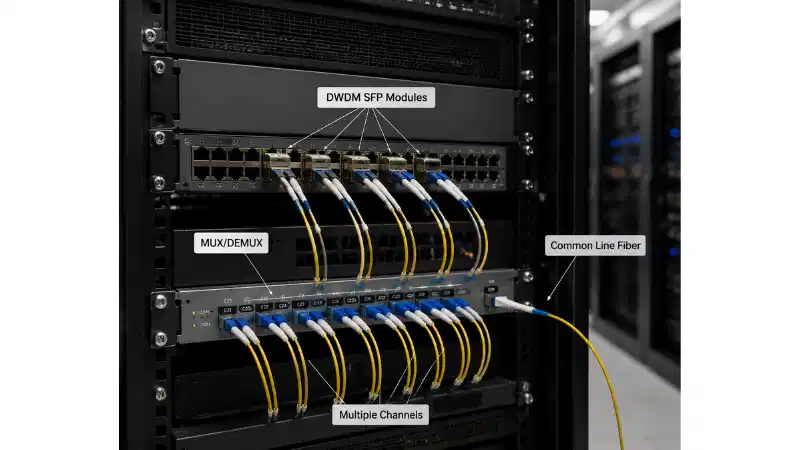
At present we have to admit that our technological development potential has encountered a bottleneck. For example, using a signal source and a receiver on a pair of optical fibers cannot continuously transmit data of more than 100G. In fact, we use multi-channel parallel connection method for processing. In addition to the multi-layer complete transmission path (optical cable-receiver) version, there is also a solution for connecting optical channels in parallel to a fiber channel in all directions. This is the WDM (Wavelength Division Multiplexing) method that has been used in the field of wide area transmission technology for more than 15 years. This technology uses 1550 nanometers as the center wavelength and a fixed interval of 50Ghz or 100Ghz between each wave. Recently, WDM technology has made some progress in the short wavelength of 850nm-950nm, also known as (Shortwave-CWDM) or SWDM.
SWDM's broadband multimode fiber
Today, OM3 and OM4 multimode fiber (MMF) are the medium of choice for Ethernet and Fibre Channel applications (NRZ modulation operates at 850 nm). If you want to increase the data rate, the effective bandwidth is limited by the MMF's modal dispersion and low VCSEL bandwidth. To overcome this limitation, parallel fiber links operating at 10G and 25 Gbps line speeds are needed to increase capacity. However, this approach requires infrastructure based on multi-fiber connection technology (MPO). In order to continue to use the proven two-fiber structure, a solution of 100 Gbps and above, a single MMF can be given priority. In this case, WDM technology can be used. In contrast, OM4-MMF has a higher modal bandwidth, but its wavelength range is relatively narrow, only 850 nm, which limits its WDM capability. The most economical mode of operation for at least four WDM channels (each channel 25 Gbps) should be high-bandwidth wideband MMFs with an extended wavelength range of 100 nanometers. Considering backwards compatibility, the wavelength of 850 nanometers remains unchanged, so an operating window of 850 to 950 nanometers appears (see Figure 1). The performance of MMF in the system is related to the effective bandwidth, which is affected by the effective modal bandwidth (EMB) and dispersion.

To ensure a constant effective bandwidth of 2000 MHz * km, EMB must be 4.700 MHz * km at 850 nm and not less than 2.700 MHz * km at 950 nm (see Figure 2). By optimizing the core profile and optimizing the α parameter in the GI core glass, the peak EMB is converted to 880 nm, and broadband MMFs that meet this specification are realized.
The technical prototype of the broadband MMFs was measured using a tunable titanium sapphire laser in various wavelength ranges from 850 to 950 nanometers. The resulting typical EMB is shown in Figure 2 and compared with OM4-MMF. The curve shows the peak EMB at 875 nm optimized broadband MMFs, while the OM4 standard MMF exhibits a narrower EMB distribution at 850 nm. Therefore, broadband MMFs meet the requirements of the EMB specification, while the standard OM4-MMF cannot meet the requirements at about 900 nanometers.
To demonstrate the WDM capabilities of broadband MMFs in existing and future system applications, BER tests were conducted at 850 and 980 nanometers and 28 Gbps. The bit error rate (BER) evaluation shows that the power reserve required after 100m transmission is reached. In addition, the BER was measured using a commercially available 40 Gbps duplex transceiver with 2 WDM channels (20 Gbps), operating at 850 and 980 nanometers, respectively. Therefore, an error-free transmission of up to 300m (BER <10-12) can be obtained through wideband MMF, which is equivalent to the dual range of the transceiver. In the range of 850 to 980 nanometers, 4 WDM channels (25.8 Gbps) with a distance of 30 nanometers and a capacity of 100G can achieve error-free transmission of 200m.
The capacity can be further increased by implementing advanced modulation formats (such as PAM-4). In the laboratory, 180 Gbps transmission of broadband MMF was successfully achieved (with four 45 Gbps PAM-4 WDM signals), and its BER exceeded 300m, while under OM4-MMF the maximum was only 150m. These results indicate that broadband MMFs achieve performance data of 40, 100, or 200 Gbps without the need for parallel fiber infrastructure.
Cost comparison
For 40GBase-x, users have multiple choices in network operations. Due to the standardized QSFP + shell format, the most cost-effective transceiver version can be plug and play according to different transmission distances. A common pattern has been confirmed:
At the same data rate, the price of the SM transceiver (40Gbase-LR4) is 200% to 400% higher than the price of the MM transceiver (40Gbase-SR4).
The difference between the two transceivers is at least € 600, which doubles the cost of the entire passive wiring (link).
Therefore, if technically feasible, MMF-based fiber backbone is a more economical solution.
Some users worry that the SWDM technology of the transceiver will generate a lot of extra costs. A simple comparison (Figure 3) shows that the basic cost factors are flat or even more economical in some respects.
In this case, the first commercially available SWDM transceiver has become the focus of attention. They have not only widened the choice of transceivers through further improvements, but also allowed the use of proven LC plugs to maintain 2-MMF infrastructure at 40G and 100G power levels.
conclusion
There are already users planning to upgrade to 40GbE and above Ethernet. The vast majority of applications are backbone port-to-port devices. The dual-fiber OM3 of each line has been applied in many cases, and the system upgrade is usually carried out step by step. The aforementioned broadband MMF is fully backward compatible with the previous OM2, OM3 and even OM4 MMFs, and it has no other requirements for connecting hardware than traditional technologies, which is a major advantage. This allows broadband MMF to economically convert existing 10G networks to cost-effective 40G and 100G networks, and can be upgraded to 200G in the future. At the same time, broadband MMF has been identified as the next generation MMF by IEEE802.3, and will be supported in the upcoming formulation of network standards.
For those who cannot ignore the cost of LAN and DC network backbones, MM fiber is irreplaceable. The new broadband MMF technology provides a cost-effective transmission technology that makes LC duplex infrastructure issues easier to deal with. Broadband MMF has become a standard MM fiber under the conditions of IEC and TIA, and will be defined as the OM5 optical cable category in the next revision of ISO / IEC11801. Its first commercial products are already available on the market.