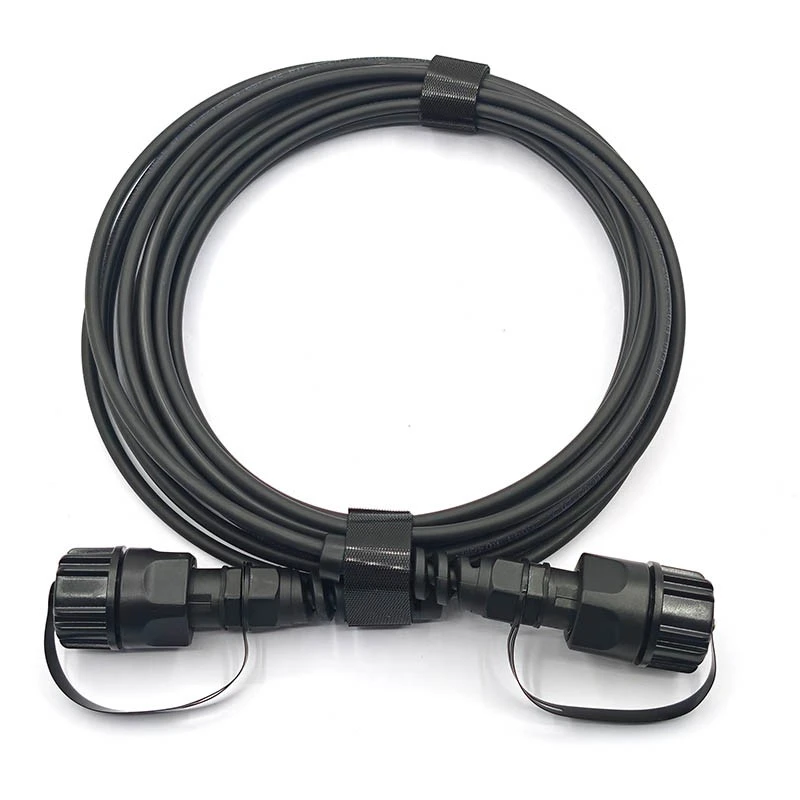
Welcome to buy the odva lc/upc to lc/upc duplex fiber patch cable, 8 m with our factory. As one of the leading manufacturers and suppliers in China, we also welcome the customized orders. Consult the price and the quotation with us now.
An 8 m duplex assembly for defined equipment connections
This cable is supplied as a terminated assembly, with a duplex LC interface inside each ODVA end housing. For a compatible installation, it provides an equipment-to-equipment or equipment-to-enclosure connection without field termination of the cable ends. Selecting the complete assembly brings the cable length, optical interface, and external connector configuration into the same purchase specification.
The two fibers provide separate optical paths within one round cable. In a conventional duplex link, those paths connect the transmit and receive channels of the associated equipment. The required end-to-end polarity must match the equipment arrangement and should be identified on the approved order drawing.
The 8 m version gives installers a defined length to plan around. Check the complete route between connection points, including changes in direction, enclosure entries, and service allowance. The distance measured directly between two devices may be shorter than the cable path actually needed on site.
How the LC interface and ODVA housing work together
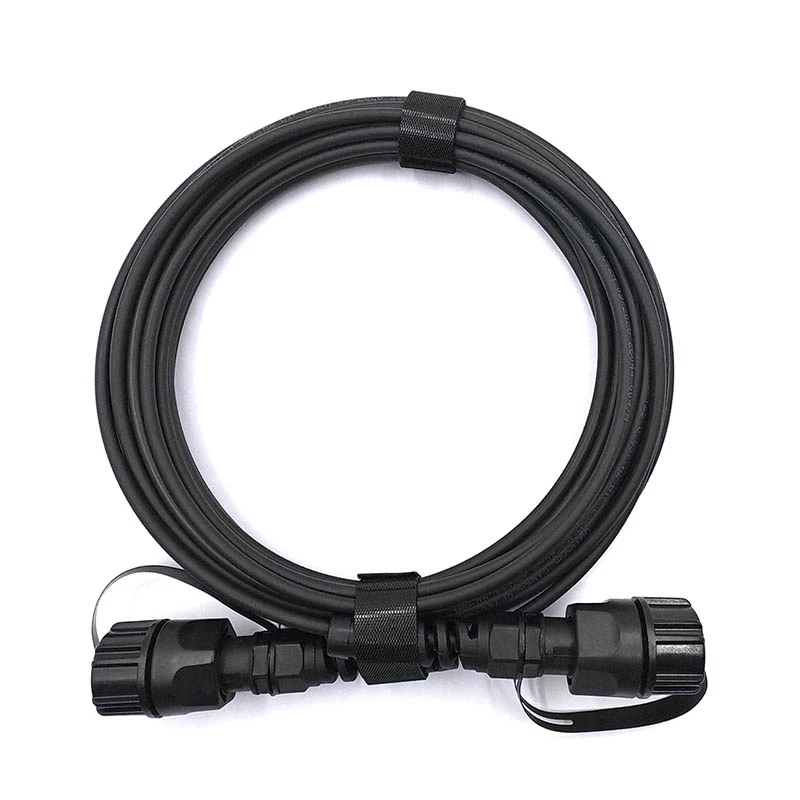
At each end, the internal LC interface establishes the optical connection, while the surrounding ODVA housing provides the external mechanical mating arrangement. The connector photographs show the blue duplex LC components within the larger black housing, making both parts of the connection visible for identification.
This distinction matters when replacing a cable on existing equipment. A match at the LC interface still leaves the external housing geometry, mating arrangement, and available installation clearance to be checked. Start with the receptacle part number, equipment connection drawing, or clear photographs of the existing interface. Compare both ends of the intended link.
Some photographs also show a separate adapter with a blue duplex interface, a threaded body, and a metal retaining nut. That component illustrates the mating side of the connection. Its required mounting arrangement and inclusion in the supply should be specified separately in the quotation.
For LC/UPC installations, confirm that the mating optical components use the appropriate interface and polish. Connector housing color is useful for visual identification, but the part specification remains the basis for selecting compatible components.
Protective caps and the external connection structure
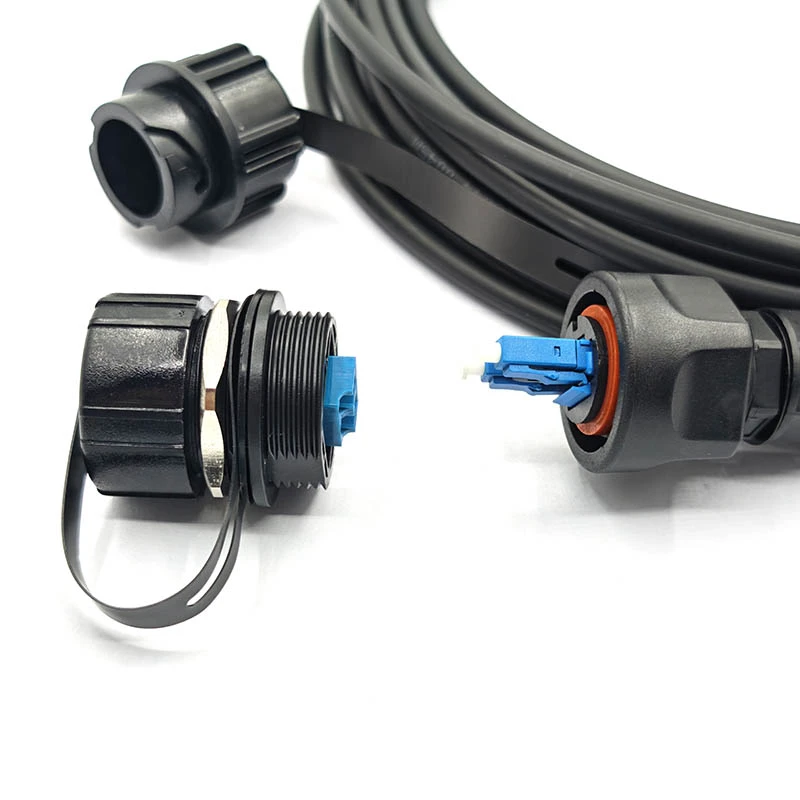
The assembly has protective caps attached by flexible tethers. When a cap is removed, the tether keeps it with the connector, making it easier to retain during installation, inspection, or maintenance. The external housings also give the operator a larger component to handle around the internal optical interfaces.
The close-up photographs show an orange ring around the connector insert and the surrounding mating surfaces. These are useful details to compare when identifying the connector arrangement or checking for visible damage before assembly. Inspect the housing, cap, tether, and accessible mating surfaces before connecting the cable, and follow the instructions for the selected mating hardware.
The engineering drawing identifies the product as an outdoor fiber cable assembly and specifies an operating temperature range of -40 to +75 °C. Outdoor selection also depends on water and dust exposure, sunlight, mounting position, and mechanical loading. If a project requires an ingress protection rating, establish the documented rating and the conditions under which it applies, including the mating hardware and connected or capped state.
Keep the interfaces capped when disconnected. A cap helps cover the connection area during handling and storage, while end-face inspection remains necessary before the next connection.
Inside the 5.0 mm black LSZH cable
The cable construction drawing shows two 0.9 mm tight-buffered fibers, identified in blue and orange, surrounded by an aramid yarn strength layer and a black outer jacket. The specified cable outside diameter is 5.0 mm. The fiber color identification describes the internal construction; the finished assembly's optical polarity should still be documented separately.
The aramid yarn is the strength member within the cable structure. During installation, the complete assembly must be handled within its approved mechanical limits. Pulling force should not be transferred through the LC connectors or their exposed components. Where a cable must be pulled through a route, obtain the permitted pulling method and load for the finished assembly first.
The outer jacket is designated LSZH(UV) in the drawing. LSZH refers to low smoke zero halogen material, and the UV notation identifies the stated jacket designation. For projects with specific fire or sunlight-exposure requirements, match the jacket to the required test classification and supporting documentation. The LSZH description here applies to the outer jacket.
The 5.0 mm diameter is also relevant when selecting cable supports, entry hardware, and routing space. The larger terminated ends require a separate clearance check: an opening that accepts the cable itself may not allow the complete connector assembly to pass through.
Understanding the specified optical performance
The connector parameter table in the engineering drawing specifies insertion loss of ≤0.3 dB and return loss of ≥50 dB, with test wavelengths of 1310 and 1550 nm. These values provide a starting point for defining the optical acceptance requirements for the connection.
Insertion loss describes the optical power lost through the measured connection. Return loss describes the relationship between incident power and reflected power; a higher return-loss value indicates less reflected power under the measurement conditions. Both depend on the defined test arrangement and the condition of the mating interfaces.
The drawing also lists repeatability and interchangeability at ≤0.2 dB. For contractual acceptance, the associated methods and conditions should be agreed. These entries do not establish compatibility with every connector sold under an ODVA or LC description.
When using the specifications in a link budget, establish whether the stated loss limit applies to an individual mated connection or the complete cable assembly. A link budget also needs the contributions of the other fibers, connectors, and splices in the route. The drawing's connector values should therefore be used within the defined measurement scope.
For projects requiring individual test records, state the wavelengths, test scope, acceptance limits, and cable identification requirements in the order. The figures below are drawing specifications, not measurements taken from a supplied test report.
Technical specifications for the 8 m assembly
The product designation and FOCC engineering drawing provide the following configuration and performance information. Confirm the fiber type and grade in the approved order drawing before purchase.
| Parameter | Specification |
|---|---|
| End A | ODVA LC/UPC duplex |
| End B | ODVA LC/UPC duplex |
| Fiber count | 2 fibers |
| Fiber type / grade | To be confirmed in the approved order drawing |
| Nominal cable length | 8 m |
| Length tolerance | +100 / -0 mm for this length range |
| Cable outside diameter | 5.0 mm |
| Outer jacket material | LSZH; designated LSZH(UV) in the drawing |
| Outer jacket color | Black |
| Tight-buffer diameter | 0.9 mm |
| Buffered fiber identification | Blue / orange |
| Strength layer | Aramid yarn |
| Connector insertion loss | ≤0.3 dB |
| Connector return loss | ≥50 dB |
| Specified test wavelengths | 1310 / 1550 nm |
| Repeatability | ≤0.2 dB |
| Interchangeability | ≤0.2 dB |
| Operating temperature | -40 to +75 °C |
| Duplex polarity | Specify in the approved order drawing |
| Mating adapter supply | Confirm in the quotation |
The length tolerance follows the drawing's allowance for assemblies longer than 1 m and shorter than 10 m. Agree on the measurement reference points where connector position or cable fit is critical. The operating temperature entry is the stated operating range; storage and transport requirements should be specified separately where needed.
Selecting the assembly for the intended installation
Equipment-to-enclosure connections. The assembly can be considered where equipment and the associated enclosure have matching ODVA LC connection points. Check the connector access space, the route into the enclosure, and the space available to connect and disconnect the housing during service. Include the required mating adapter in the equipment bill of materials where applicable.
Outdoor communications equipment links. The outdoor designation in the drawing makes the assembly relevant to selection for external communications connections. Suitability depends on the equipment interface and the documented environmental performance of the complete connection. Include the site's exposure conditions in the specification so that the housing, jacket, and mating components can be assessed together.
Industrial equipment connections. Where industrial equipment uses this interface, review the route for movement, vibration, abrasion, and maintenance access. A fixed connection and a continuously moving cable route impose different mechanical requirements. Applications involving repeated motion need suitable qualification for the complete assembly.
Replacement cables. For an existing installation, compare the original cable designation, both mating interfaces, fiber grade, polarity, and length. The equipment's transmitter and receiver specifications remain part of this check. Network speed and transmission distance depend on the complete optical link and cannot be selected from the connector shape alone.
ODVA LC/UPC Fiber Patch Cable FAQ
1. What is an ODVA LC duplex fiber patch cable?
An ODVA LC duplex fiber patch cable combines two LC optical connections with an external ODVA connector housing. The two fibers provide separate optical paths, while the housing provides the mechanical interface to the matching receptacle. This FOCC assembly has ODVA LC/UPC ends, an 8 m cable length, and a 5.0 mm black LSZH outer jacket.
2. Can I connect this cable to a standard LC port?
The complete assembly requires compatible mating hardware. Although the internal optical interface is LC, a standard LC port alone does not establish compatibility with the surrounding ODVA housing. Check the equipment receptacle, housing geometry, LC interface, and duplex polarity together. A receptacle part number or clear interface photograph helps identify the required connection.
3. Is this ODVA LC cable waterproof or rated IP67/IP68?
The supplied drawing describes an outdoor fiber cable assembly but does not state an IP rating. An IP67 or IP68 claim therefore cannot be confirmed from the current documentation. For an installation exposed to water or dust, request the documented protection rating and its applicable conditions, including the mating receptacle and whether the connection must be fully assembled or capped.
4. Does an ODVA LC connector mean the cable is single-mode?
No. The connector designation alone does not identify the fiber type. Match the fiber grade to the equipment optics and the rest of the link, then confirm it on the approved cable drawing. For this 8 m assembly, the fiber designation needs confirmation before ordering; single-mode and multimode descriptions should not be treated as interchangeable.
5. What does the black LSZH jacket mean?
LSZH means low smoke zero halogen and describes the specified outer jacket material. This assembly has a black 5.0 mm jacket marked LSZH(UV) in the drawing. The designation does not by itself establish a particular fire classification, UV service life, or certification for the complete assembly. If a project requires a named material or fire test standard, request the corresponding documentation.
Hot Tags: odva lc/upc to lc/upc duplex fiber patch cable, 8 m, China, factory, suppliers, manufacturers, quotation, customized, price, buy