


Features
● High Extinction Ratio
● High Return Loss
● Low Cost
Applications
● Telecommunications
● Optical Amplifier
● Fiber Lasers Testing Systems
Specifications
| Parameter | Unit | Values | |||
| Centar Wavalength | nm | 1064 | |||
| Operating Wavelength Ranga | nm | 士20 | |||
| Coupling Ratio (for Port 2 0nly) | % | 10% (1x10) | |||
| Min. Retum Loss | dB | 50 | |||
| Min. Extinction Ratio (only for B Type) | dB | 20 | |||
| Min. Extinction Ratio (only for F Type) | dB | 22 | |||
| Max. Excass Loss | dB | 1.0 | |||
| Max.Insertion Loss | dB | 12.5 | |||
| Max. Optical Powar (CW} | mW | 300 | |||
| Max. Tensile Load | N | 5 | |||
| Fiber Type | PM 980 Panda Fiber | ||||
| Oparating Tennpe ratura | ℃ | -5 to +70 | |||
| Storage Temperature | ℃ | -40to+85 | |||
*Above specific ation s are fo r devica without connector
"*For devices with connectors. IL Will be 0.3dB higher. RL Will be 5dB Iower. and ER will be 2dB lower
*The PM fiber and the connector key are aligned to the slow axis."
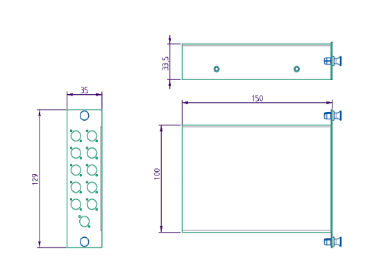
Package Dimensions

Core Operating Principle
Based on the polarization-maintaining properties of polarization-maintaining fiber (PM fiber) and the power splitting/combining principles of fiber couplers, polarization stabilization is achieved through the following key design features:
PM Fiber Basics: PM fiber utilizes special structures (such as panda, bowtie, and elliptical cladding) and stress-induced birefringence to separate the two orthogonal polarization modes (e.g., fast and slow axes) of incident light, suppressing inter-mode crosstalk and ensuring a single polarization state is transmitted along a fixed axis.
Directional Coupling Mechanism: Using the mainstream fused tapering method, the cladding/core of two PM fibers are melted and then stretched to form a light field coupling region between the cores. By precisely controlling the tapering parameters (length and taper angle), a specified power split (e.g., 1:1, 1:9) of the optical signal between the two fibers is achieved. Polarization matching: During the coupling process, the polarization axes of the two polarization-maintaining fibers are strictly aligned (for example, along the "slow axis" or "fast axis") to ensure that the target polarization state of the incident light is transmitted only along the corresponding axis without crosstalk along the orthogonal axis. The polarization state of the final output light is consistent with the incident light.
Mainstream Types (Classified by Structure/Function)
1. Classification by Polarization-Maintaining Fiber Structure
● Panda-Type Polarization-Maintaining Coupler: The most widely used type. Its fiber cross-section contains two symmetrical "stressed zones" (resembling panda eyes), resulting in uniform stress and a high polarization extinction ratio (PER). It is suitable for most polarization-sensitive systems (such as fiber gyros and coherent communications).
● Bowtie-Type Polarization-Maintaining Coupler: Its "bowtie-shaped" stress zone has a higher birefringence coefficient and is suitable for applications requiring extremely high polarization stability (such as high-precision optical sensing), but it is relatively expensive.
● Elliptical-Clad Polarization-Maintaining Coupler: Its birefringence is achieved through elliptical cladding, resulting in good mechanical strength but a slightly lower PER. It is often used in simple polarization systems in industrial environments.
2. Classification by Number of Ports
● 2×2 Polarization-Maintaining Coupler: The most commonly used type, with two input ports and two output ports, enables optical signal distribution (e.g., splitting one light path into two) or beam combining (combining two light paths into one).
● 1×N polarization-maintaining coupler (beam splitter): 1 input port, N output ports (N=3, 4, ...). Used only for power distribution (such as parallel detection of multiple signals in optical sensor networks) and has no beam combining function.
Selection and Usage Notes
1.Key Selection Criteria:
● Prioritize matching the "Operating Wavelength" (must be consistent with the wavelength of the system's light source/detector).
● Determine the "Polarization Extinction Ratio" based on the scenario (communication ≥ 20dB, sensing ≥ 25dB, quantum ≥ 30dB).
● Select the "Port Type" based on the function (2×2 for distribution/combining, 1×N for beam splitting only).
2.Usage Notes:
● Polarization Axis Alignment: When connecting, ensure that the polarization axes (e.g., slow axes) of the input and output fibers are aligned. Otherwise, the PER will drop significantly (a 1° misalignment can result in a 5-10dB drop in PER).
● Environmental Control: Avoid extreme temperature fluctuations and mechanical bending (the bend radius of polarization-maintaining fiber must be ≥ 5cm) to prevent stress-induced damage that could lead to polarization performance degradation.
● Connection Loss: Use dedicated polarization-maintaining fiber connectors (such as FC/APC-PM) to reduce polarization crosstalk and insertion loss during connection.
Hot Tags: 1×10 fc/apc polarization-maintaining fiber coupler, China, factory, suppliers, manufacturers, quotation, customized, price, buy


