

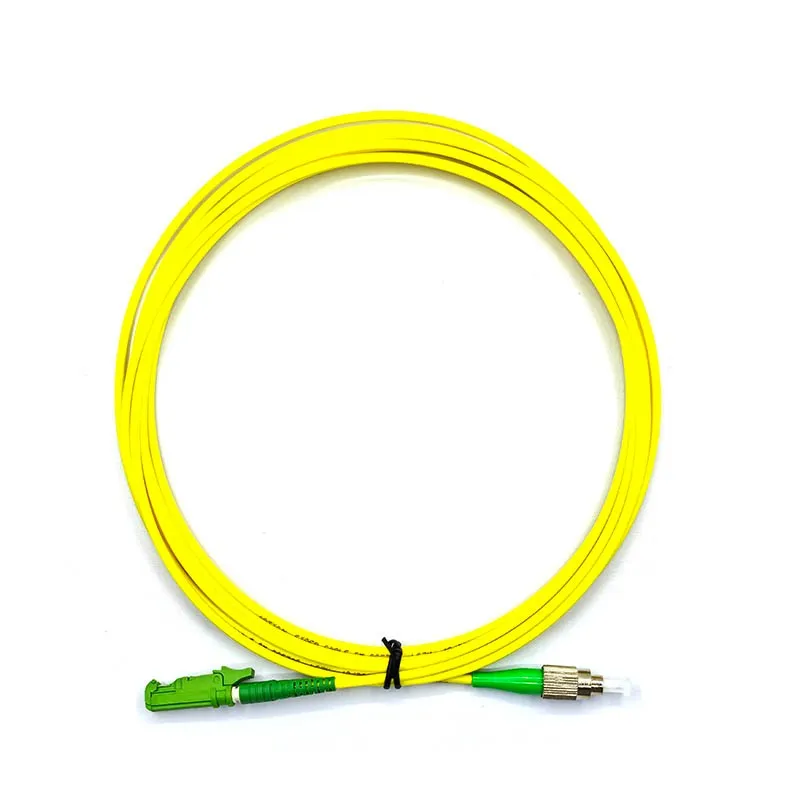
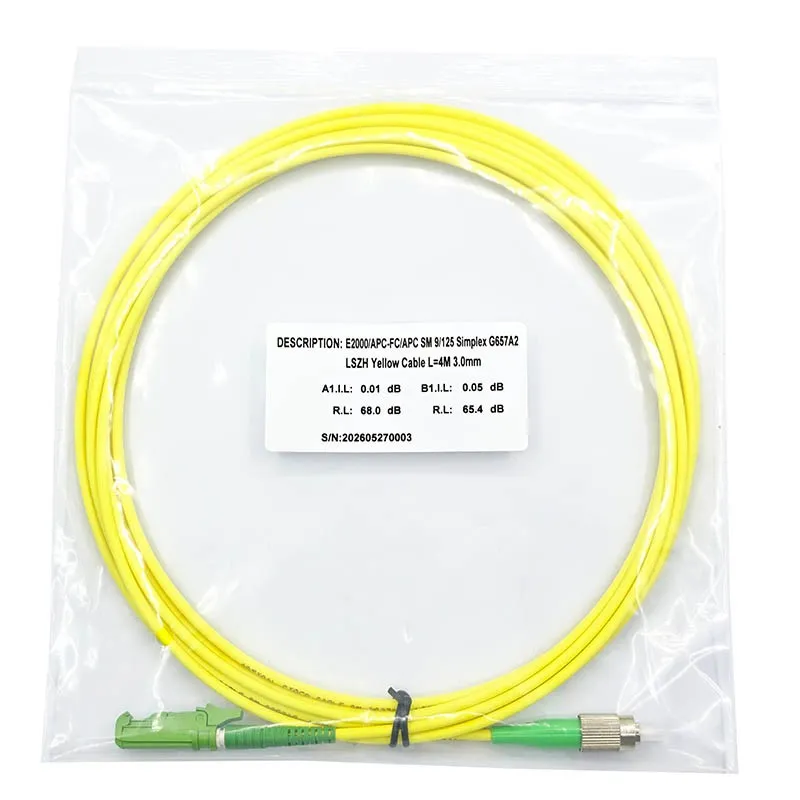
Welcome to buy the e2000/apc to fc/apc single mode fiber patch cable, g.657.a2, lszh yellow, 3.0mm, 4m with our factory. As one of the leading manufacturers and suppliers in China, we also welcome the customized orders. Consult the price and the quotation with us now.
This patch cable combines an E2000/APC connector on one end and an FC/APC connector on the other end. The APC 8° angled polish helps reduce back reflection, making the cable suitable for single mode optical links where return loss control is important. FOCC can supply this cable with customized length, jacket material, connector type, label, packaging, and optical test requirements.
Product Overview
This product is a single mode simplex fiber optic patch cord built with G.657.A2 bend-insensitive optical fiber. Compared with conventional single mode fiber, G.657.A2 provides better bending performance in compact routing environments, making it suitable for fiber distribution frames, wall boxes, equipment rooms, FTTH access points, and narrow cable management paths. FOCC's internal training material classifies G.657 as bend-resistant fiber commonly used in FTTH applications, and single mode fiber is typically used for long-distance communication systems.
The cable adopts a 3.0mm LSZH yellow outer jacket. LSZH material is suitable for indoor communication environments where low smoke and halogen-free performance are required. FOCC's product training materials identify PVC and LSZH as common indoor cable jacket materials, while LSZH is used in important indoor environments because it reduces smoke and toxic gas generation during fire conditions.
The yellow jacket follows the common single mode cable color convention. Internal FOCC training content also notes that single mode indoor cables are generally yellow, while multimode indoor cables are commonly orange or other colors depending on fiber type.
Connector Description
E2000/APC Connector
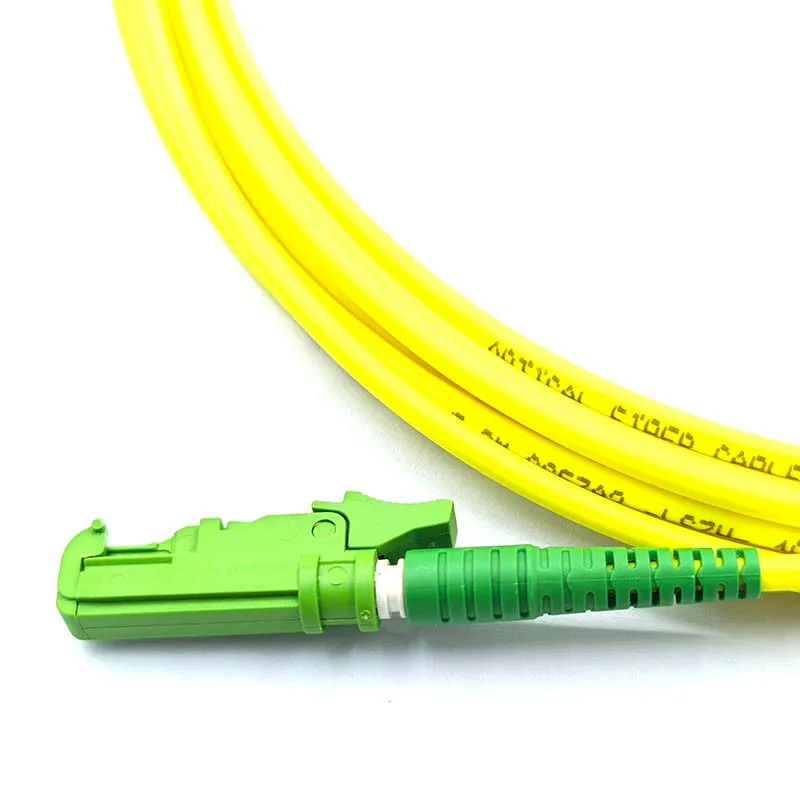
The E2000/APC connector is a push-pull fiber optic connector equipped with a metal automatic shutter. Its mating structure is similar to SC, but it uses a latch-locking mechanism instead of a threaded coupling, making installation and removal more convenient.
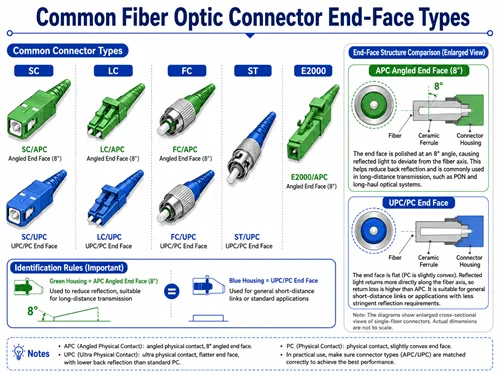
The connector uses a spring-loaded ceramic ferrule. The APC version features an 8° angled polish, which helps achieve very low back reflection. E2000 connector housings are commonly made of metal, and the APC version is usually identified by a green housing or green guiding sleeve coating. The SM/PC version is generally blue. Its self-closing dust shutter protects the ferrule end face from dust contamination when the connector is not mated.
In terms of optical performance, a high-quality E2000/APC connector typically provides an insertion loss of less than 0.3 dB, while APC return loss can commonly reach the ≥50–60 dB level. For mechanical durability, many manufacturer specifications support ≥500 mating cycles, with attenuation variation after repeated mating typically controlled within ≤0.1–0.2 dB, in line with Telcordia GR-326 or IEC 61300 series test requirements.
For maintenance, although the E2000 connector includes a protective shutter, regular cleaning is still required. Before and after operation, the ferrule end face should be cleaned with a fiber cleaning pen or lint-free alcohol swab to avoid fingerprints, oil, and dust. It is also recommended to inspect the end face with a fiber inspection microscope to confirm that there are no scratches or contamination, ensuring stable optical link performance.
FC/APC Connector
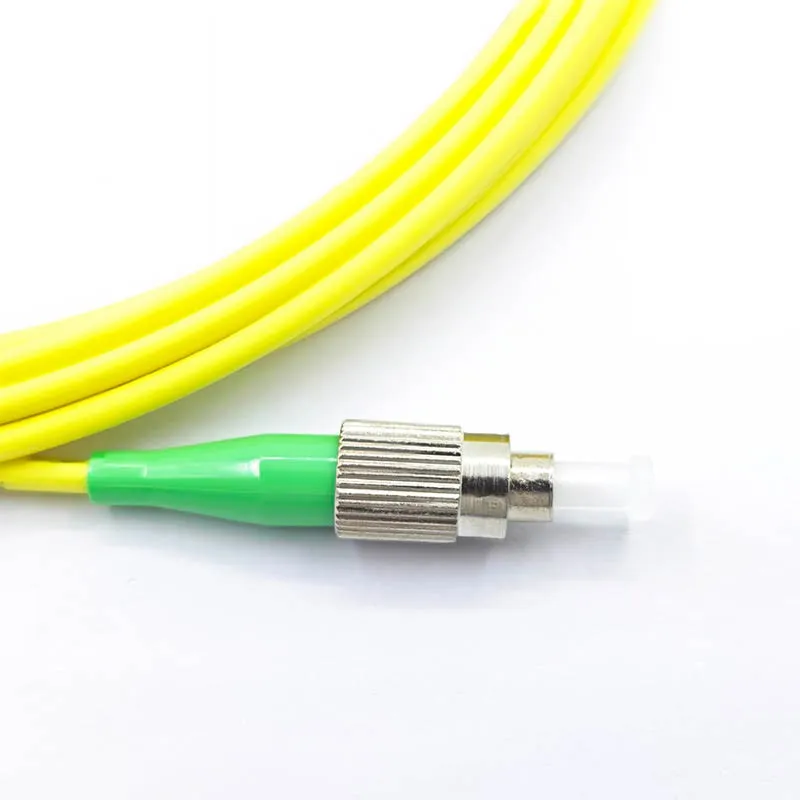
The FC/APC connector is a cylindrical fiber optic connector with a threaded metal coupling structure. It is suitable for applications requiring stable mechanical locking, vibration resistance, and repeated mating.
Its structure includes a threaded sleeve and a precision ceramic ferrule. During installation, the connector is locked by tightening the coupling nut, providing a secure and stable optical connection. This patch cable uses an FC/APC connector, meaning the FC connector is finished with an 8° angled APC polish.
Compared with FC/PC, FC/APC significantly reduces optical reflection through angled end-face polishing, with return loss typically reaching ≥60 dB. It is suitable for CATV systems, PON networks, long-distance transmission links, optical distribution frames, and other single mode applications where low reflection is required. Typical insertion loss is around 0.2–0.3 dB, depending on production grade and test conditions.
The mechanical service life of FC connectors can reach 1,000+ mating cycles under IEC 61300-2-2 durability testing conditions. The connector also offers good reliability under shock, tensile stress, and other environmental stress conditions.
During use, the FC/APC connector should be tightened gradually. Excessive force should be avoided to prevent damage to the ceramic ferrule or adapter sleeve. The connector end face must remain clean, as oil, dust, and particulate contamination can increase insertion loss and degrade return loss performance.
Fiber Type and Bend-Insensitive Performance
This E2000/APC to FC/APC single mode patch cable is built with G.657.A2 bend-insensitive optical fiber, designed for stable performance in compact indoor routing environments. Compared with conventional G.652.D single mode fiber, G.657.A2 offers stronger resistance to macro-bending loss, making it a practical choice for FTTH, FTTx, PON networks, ODF cabinets, wall-mounted fiber boxes, and high-density equipment rooms.
The cable supports standard single mode transmission at 1310nm and 1550nm, while the bend-insensitive fiber design helps reduce additional attenuation caused by tight routing, cable coiling, tray management, or limited installation space. For a short 4m jumper, the fiber attenuation itself is very low; in real network deployment, overall link performance is mainly affected by connector quality, end-face cleanliness, bending control, and insertion loss.
G.657.A2 is compatible with G.652.D single mode systems, allowing this patch cord to be used in existing OS2 single mode networks without changing the transmission platform. This gives engineers more flexibility during cabinet wiring, patch panel connection, and access network maintenance.
Cable Construction and Material Design
The cable uses a simplex round cable structure with a 3.0mm outer diameter. The construction includes a 9/125µm single mode optical fiber, protective coating or tight-buffer layer, aramid yarn strength member, and an outer yellow LSZH jacket.
The aramid yarn reinforcement improves tensile resistance during handling and installation, helping protect the glass fiber from excessive pulling stress. Compared with thinner 0.9mm or 2.0mm cable constructions, the 3.0mm jacket provides better mechanical protection and is more suitable for repeated patching, cabinet routing, and telecom room operation.
The LSZH, Low Smoke Zero Halogen, jacket is suitable for indoor cabling environments where flame-retardant performance, low smoke emission, and reduced halogen gas release are important. It is commonly used in communication rooms, data cabinets, building cabling systems, FTTH indoor distribution points, and other controlled indoor applications.
The yellow jacket follows the standard color identification practice for single mode fiber cables, making it easier for installers and maintenance teams to distinguish single mode links from multimode links during cabling management.
Optical and Mechanical Performance
| Parameter | Specification |
|---|---|
| Product Type | E2000/APC to FC/APC Single Mode Simplex Fiber Patch Cable |
| Fiber Mode | Single Mode, OS2 |
| Fiber Type | G.657.A2 bend-insensitive fiber, compatible with G.652.D systems |
| Core / Cladding | 9/125µm |
| Connector A | E2000/APC |
| Connector B | FC/APC |
| Polish Type | APC, 8° angled polish |
| Cable Structure | Simplex round cable |
| Cable Diameter | 3.0mm |
| Jacket Material | LSZH |
| Jacket Color | Yellow |
| Cable Length | 4m |
| Operating Wavelength | 1310nm / 1550nm |
| Insertion Loss | ≤0.25 dB typical, ≤0.30 dB maximum, depending on production grade |
| Return Loss | ≥60 dB typical for APC end face |
| Minimum Fiber Bend Radius | 7.5mm for G.657.A2 fiber |
| Recommended Cable Bend Radius | Follow installation requirements for finished 3.0mm patch cable |
| Operating Temperature | -20°C to +70°C |
| Tensile Strength | ≥50N typical for handled patch-cord application |
| Mating Durability | ≥500 cycles, or according to project requirement |
| Test Options | Insertion loss, return loss, end-face inspection, visual inspection |
| Custom Options | Length, connector type, jacket material, cable diameter, label, packaging, test report |
Quality Control and Delivery Support
Each cable can be supplied with optical performance testing before shipment. Standard inspection items may include insertion loss, return loss, connector end-face inspection, cable appearance check, length verification, and packaging inspection.
For projects with stricter requirements, test reports and customized labeling can be provided according to the buyer's specification. Available customization includes connector combination, cable length, jacket diameter, jacket material, color, boot style, packaging method, and test documentation.
Common Faults and Troubleshooting Guide
End-face contamination or scratches: This is one of the most common causes of fiber patch cable failure. Regularly clean the connector end face with a fiber cleaning pen, cleaning swab, or other proper fiber cleaning tools. If insertion loss increases significantly, for example above 0.5 dB, or return loss decreases, remove the patch cable and check whether the end face has dust, oil stains, fingerprints, or scratches. Use a fiber inspection microscope for verification. If necessary, replace the connector or re-polish the end face.
Excessive bending or fiber breakage: Check the cable routing path and confirm whether the patch cable has been bent beyond the recommended bend radius or exposed to excessive pulling force. Excessive bending or tension may damage the inner fiber or increase optical loss. Ensure that the cable is routed smoothly, and avoid sharp bends behind cabinets, at wall corners, or around cable-management edges.
Interface mismatch: Confirm that the equipment port type matches the patch cable connector type. Different interfaces, such as APC vs UPC or FC vs SC, should not be directly mated. Incorrect mating may cause high reflection, high insertion loss, or connector damage. Use a suitable adapter or replace the patch cable with the correct connector type when necessary.
Loose mating: Check whether the connector is properly locked. The FC connector nut should be tightened securely, and the E2000 connector should be fully inserted into the locking position. Loose contact may result in high loss, unstable signal transmission, or intermittent link failure.
Fiber breakage: If the optical link has no signal or extremely high attenuation, use an OTDR to locate the fault point. Check whether the fiber core has been broken due to installation damage, sharp impact, or excessive tension. Repair the broken point by fusion splicing where applicable, or replace the patch cable if repair is not practical
Hot Tags: e2000/apc to fc/apc single mode fiber patch cable, g.657.a2, lszh yellow, 3.0mm, 4m, China, factory, suppliers, manufacturers, quotation, customized, price, buy


