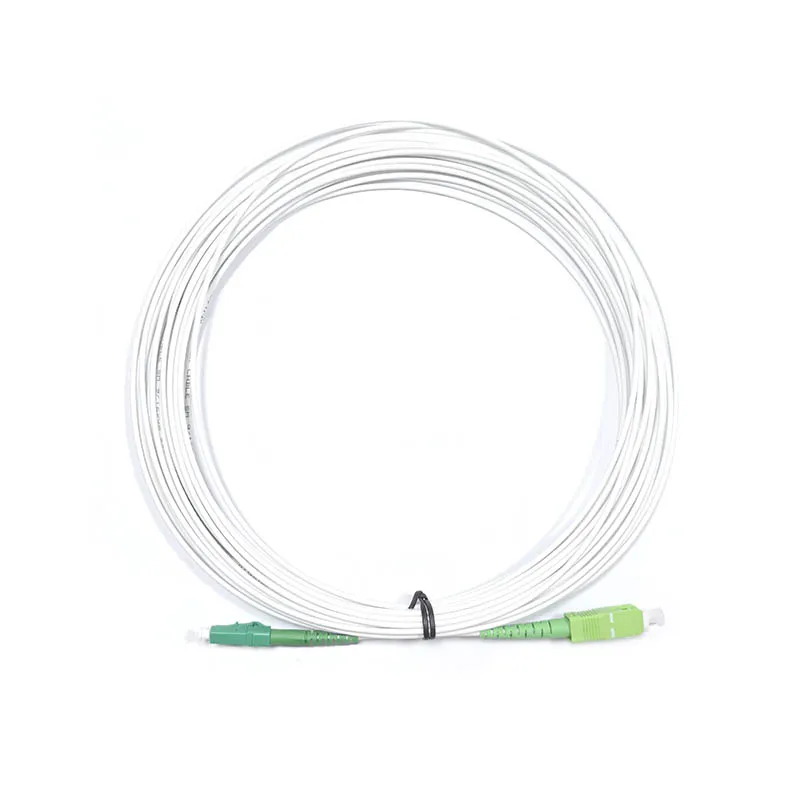
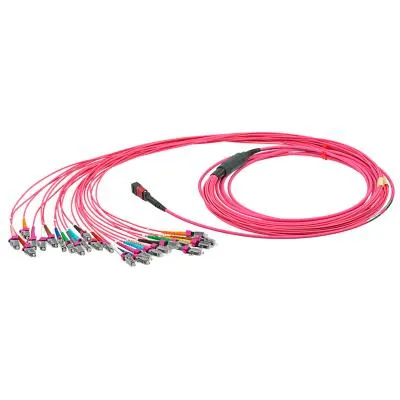
Welcome to buy the armored fiber patch cord for mid-distance indoor routing, 15m with our factory. As one of the leading manufacturers and suppliers in China, we also welcome the customized orders. Consult the price and the quotation with us now.
In actual network installations, cable length is rarely determined by straight-line distance alone. Routing through overhead trays, passing around cabinet structures, following cable management paths, and leaving room for future maintenance all consume additional length. That is why a 15m armored fiber patch cord is not simply a longer patch cable. It is a more practical option for indoor fiber runs that need routing flexibility, installation tolerance, and physical protection.
Product Positioning and Typical Applications
This product is positioned for mid-distance (15m) indoor network routing-longer than standard in-rack patch cords, yet shorter than backbone or campus cabling. Typical routing scenarios include:
- Cross-cabinet interconnection within the same row:
ToR / End-of-Row switches ↔ fiber distribution frames (ODF / patch panels) ↔ servers, storage, and security devices.
A 15m length is commonly used for cross-cabinet routing combined with cable trays and reserved slack.
- Routing within telecom or equipment rooms:
Mid-distance patching inside IDF or equipment rooms, such as connections from racks to wall-mounted cabinets, or from ODFs to core switches and optical modules.
- High-risk cable routing paths:
Under raised floors, along cable tray edges, behind dense rack cable bundles, or through door gaps and corners-areas prone to stepping, compression, abrasion, or potential rodent exposure.
- Indoor industrial environments:
Connections from equipment rooms to edge switches or media converters on production lines, where dust, oil mist, and mechanical friction are present.
(For more demanding conditions, upgrades to TPU jackets and hardened connector systems are recommended.)
Built for Cross-Row, Cross-Zone, and Mid-Distance Indoor Connections
This 15m armored fiber patch cord is designed for indoor applications where the connection path extends beyond adjacent racks. It is well suited for cross-row cabinet interconnection, rack-to-distribution-area links, cable tray routing above aisles, and temporary or transitional network layouts during upgrades. Compared with shorter patch cords, a 15m length provides more routing freedom and helps reduce installation constraints in complex cabinet environments.
Armored Structure and Material System
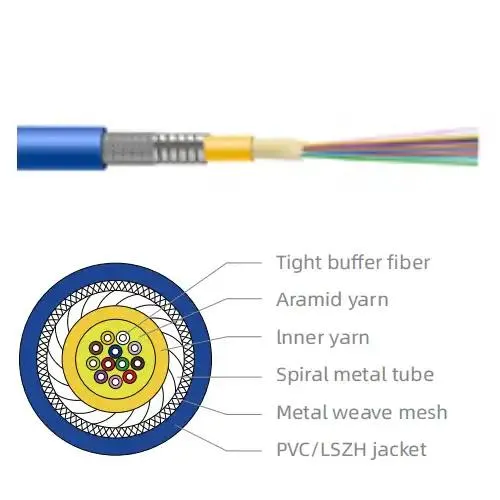
Mainstream Solution: Flexible Steel Tube (Spiral Stainless Steel Tube) Armoring
According to industry definitions of flexible steel tube armored fiber cables, the tube is formed by continuously wrapping steel tape in an interlocked spiral structure, combining both rigidity and flexibility. The armored fiber or fiber bundle is protected mechanically within the tube, while maintaining sufficient internal space to allow controlled fiber movement.
Recommended Tube Material:
Priority is given to corrosion-resistant stainless steel such as 304 grade, with the option to extend to other austenitic stainless steel systems depending on project requirements.
Tube Outer Diameter and Wall Thickness (Key Armoring Parameters):
The outer diameter and wall thickness of the flexible steel tube can be selected based on industry-standard ranges. Typical nominal outer diameters range from 0.60 mm to 7.00 mm, with corresponding wall thickness ranges from 0.10 mm to 0.50 mm depending on classification.
For common 3.0 mm indoor patch cord structures used in 15m applications, the steel tube outer diameter typically falls within:
1.60–3.00 mm (wall thickness approx. 0.15–0.30 mm), or
3.10–4.50 mm (wall thickness approx. 0.25–0.45 mm),
depending on the specific structural design.
Optional Solution: Corrugated Steel Tape Armoring
Corrugated steel tape armoring is typically used in heavier-duty outdoor or rodent-prone environments. It offers superior crush resistance and anti-rodent performance but is generally more aligned with cable engineering applications in terms of bending characteristics and termination methods.
For indoor projects requiring extremely high mechanical protection, a hybrid solution combining steel tape armored cable segments with terminated patch cords can be considered.
Jacket Material, Flame Retardancy, and Color Strategy
Jacket Material Options (Based on Application and Compliance Requirements):
PVC: Cost-effective and widely used for general indoor environments
LSZH / LS0H: Low-smoke, halogen-free, suitable for public buildings and high-occupancy areas
TPU: Enhanced abrasion resistance, oil resistance, and low-temperature performance; suitable for industrial or semi-outdoor environments
Jacket Color Strategy (For Engineering Visibility and Maintenance Efficiency):
Industry practices recommend different jacket colors for fiber identification:
Single-mode indoor cables: typically yellow
Multimode fibers: aqua, violet, or other colors depending on grade
Standardization frameworks also provide guidance on indoor jacket color coding (e.g., B1.3 single-mode as yellow, A1a.3 multimode as violet), although project-specific color and labeling schemes can also be applied.
Translating Mechanical Performance into Engineering Value
Crush Resistance:
For indoor equipment and structured cabling environments, allowable crush load values (N/100mm) can be defined based on industry benchmarks. These values can be used to establish internal quality control and acceptance criteria. Typical targets may include:
Short-term: 3000 N/100mm
Long-term: 1500 N/100mm
(actual values depend on cable diameter class and application scenario)
Tensile Strength:
Allowable tensile load can be specified based on diameter classification, with defined short-term and long-term targets. For example:
For 2 < Φ ≤ 3 mm structures:
Short-term: 150 N
Long-term: 80 N
Higher strength ratings can be achieved through reinforced designs if required.
Bend Radius:
Despite armored construction, minimum bend radius requirements must still be observed. A common engineering guideline is:
Static bend radius: ≥10× cable outer diameter
Dynamic bend radius: typically ≥20× cable outer diameter
These values should be clearly specified in the product datasheet to ensure proper installation and long-term performance.
You have not enough Humanizer words left. Upgrade your Surfer plan.
Extra Routing Slack for More Flexible Installation Planning
One of the main advantages of a 15m fiber patch cord is the ability to preserve routing slack in non-linear cable paths. This added installation margin helps avoid over-tensioned runs, reduces the risk of length miscalculation, and supports cleaner routing through trays, corners, and cable management systems. In retrofit or expansion projects, that flexibility often translates directly into lower rework risk and smoother on-site deployment.
How 15m Differs from Standard Shorter Patch Cord Lengths
| Length | Typical Deployment Range | Best-Fit Scenario | Main Value |
|---|---|---|---|
| 2.5m | Short direct link | Same rack or very close device connection | Compact cable management |
| 5m | Standard cabinet link | Adjacent rack interconnection | Balanced reach and control |
| 10m | Extended cabinet routing | Multi-rack areas and more complex paths | More flexibility in dense layouts |
| 15m | Mid-distance indoor routing | Cross-row cabinets, tray routing, retrofit projects | Extra installation margin and lower rework risk |
FAQ for 15-meter armored fiber optic patch cord
Why choose a 15m armored fiber patch cord instead of a shorter length?
A 15m length is better suited for indoor cable routes that involve overhead trays, cabinet turns, distribution points, or cross-row connections. It provides additional routing margin and helps reduce the risk of installation rework caused by insufficient cable length.
Is a 15m armored patch cord suitable for rack-to-rack interconnection?
Yes. It is especially suitable when the connection is not limited to adjacent racks and the routing path requires extra length for structured cable management.
What is the advantage of armored construction in indoor fiber routing?
Armored construction helps improve mechanical protection in environments where the cable may encounter compression, friction, pulling stress, or accidental contact during installation and maintenance.
Can this 15m fiber patch cord be used in retrofit or expansion projects?
Yes. It is a practical option for network upgrades, cabinet relocation, and temporary reconfiguration where cable paths are less predictable and installation flexibility is important.
What connector and fiber options are available?
This product can typically be supplied with different connector types such as LC, SC, FC, and ST, along with single mode and multimode fiber options depending on project requirements.
Hot Tags: armored fiber patch cord for mid-distance indoor routing, 15m, China, factory, suppliers, manufacturers, quotation, customized, price, buy