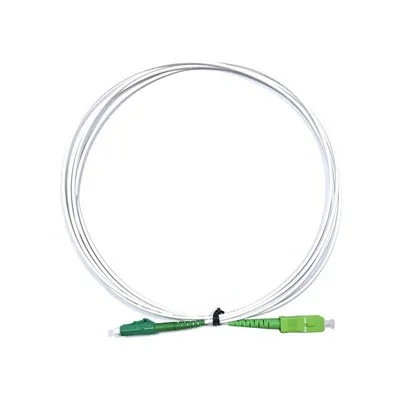
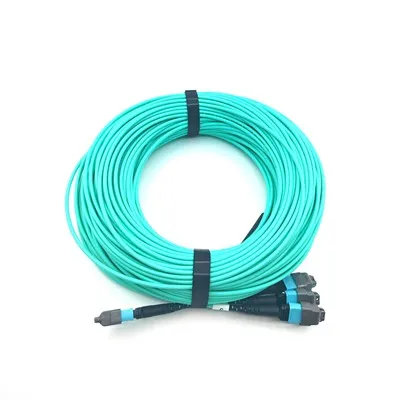
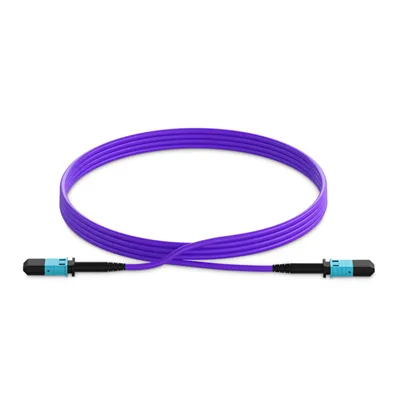
Welcome to buy the armored simplex fiber patch cord lc/apc to sc/apc for stable rack-to-rack optical links, lszh, anti-rodent, 10m with our factory. As one of the leading manufacturers and suppliers in China, we also welcome the customized orders. Consult the price and the quotation with us now.
Structure and Material Design Driven by Network Stability
The core value of an armored fiber patch cord is not simply being "stronger," but transforming common failure modes-such as compression, tension, excessive bending, twisting, and rodent damage-from events that directly impact the fiber core (causing micro-bending loss) into stresses that are absorbed and controlled by the cable structure.
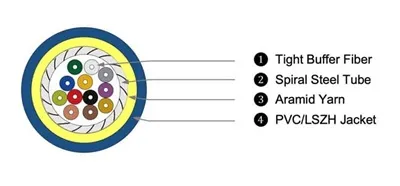
A mature industry design typically adopts a layered construction:
- Stainless steel tube (interlocked or spiral structure)
- Aramid yarn tensile reinforcement
- Outer protective jacket
In this configuration, the internal metal tube provides crush resistance and a physical anti-rodent barrier, while also enforcing a minimum bend radius. The aramid yarn layer absorbs tensile forces, and the outer jacket protects against abrasion and supports identification.
Anti-Rodent Design Logic: Physical Barrier First
From an engineering perspective, anti-rodent performance should be understood as a physical barrier priority.
In real deployments, relying solely on jacket additives for rodent resistance is inconsistent and difficult to verify. In contrast, metal armor (such as steel tape or steel tubing) provides a direct and measurable protective layer.
Industry documentation from leading manufacturers indicates that long-term testing consistently shows that metal armor (e.g., corrugated steel tape) is among the most effective solutions for improving rodent resistance. Stainless steel is also widely used in such designs, with cost-performance trade-offs depending on the application.
This provides a clear and technically grounded rationale for combining armored structure with anti-rodent capability.
Bending Performance and Stability: Dual-Layer Protection Mechanism
The first layer is the fiber itself. If ITU-T G.657.A2 single-mode bend-insensitive fiber is selected, the standard explicitly targets space-constrained scenarios such as "high-density fiber management systems and data center networks," and specifies a minimum design radius of 7.5mm for A2 (10mm for A1). Furthermore, G.657.A is described as a subset of G.652.D (compatible in interconnection and transmission properties), facilitating collaboration with the existing OS2 ecosystem.
The second layer is the cable structure. The metal conduit and outer sheath of the armored patch cord increase the "permissible bending radius" to a more engineering-controllable value, and structural limitations prevent bending below the recommended radius, thereby reducing additional attenuation and long-term stress damage caused by micro-bending/macro-bending.
Low Insertion Loss and High Return Loss (Core of APC Stability)
APC (Angled Physical Contact) connectors typically feature an approximately 8° angled end face, which geometrically redirects reflected light toward the cladding, reducing reflection back to the source.
In engineering practice, "APC ≥ 60 dB return loss" is often used as a target for high reflection suppression (generally higher requirements than UPC). This is why APC is commonly selected for high-stability data center links and reflection-sensitive systems such as PON/CATV.
LSZH (Low Smoke Zero Halogen) and Data Center Safety Stability
The value of LSZH is not only "environmental friendliness," but also reducing the "scope of downtime" in data center incident scenarios.
The background of IEC 60754-1 clearly states that certain cable materials release acidic gases when burned, which can cause widespread damage to electrical and electronic equipment beyond the fire itself. The standard provides methods for determining halogen acid gas content, forming the basis for cable specification limits.
Combined with the IEC 61034 series (smoke density measurement) and IEC 60332 flame retardancy testing system, LSZH brings fire-related risks-corrosion, smoke, and flame spread-into a verifiable compliance framework.
EMI Immunity (Applicability Note)
Fiber optics transmit signals using light rather than electrical current, and the medium is non-conductive. Therefore, at the link level, fiber is inherently immune to electromagnetic interference (EMI).
In environments such as high-density racks, parallel routing with power cables, or areas with electromagnetic noise in data centers, this characteristic directly improves the stability limits of bit error rates and link jitter.
Reduce Link Failure Points with a Continuous 10m Optical Path
In structured cabling systems, every additional connection interface introduces potential signal loss, instability, and long-term maintenance risk.
A 10-meter armored simplex fiber optic patch cord is designed to eliminate unnecessary connection points, creating a more stable and efficient optical link.
How It Improves Network Stability
Fewer Connection Interfaces: A single continuous 10m cable replaces multiple short patch cords and adapters, reducing physical failure points.
Lower Insertion Loss Accumulation: Each connection typically introduces 0.2–0.3 dB loss. Eliminating extra interfaces helps maintain optimal signal strength.
Consistent Return Loss Performance: APC connectors (8° angled polish) ensure stable return loss, minimizing signal reflection across the entire link.
End-to-End Signal Integrity: A continuous fiber path avoids discontinuities, ensuring smoother optical transmission in high-demand environments.
Application Scenarios and High-Density Deployment Recommendations
Data center topology and redundancy design emphasize that any single point of failure can escalate into business risk. Therefore, at the patch cord level, maintainability and redundancy must be properly engineered. ANSI/TIA-942-C defines the minimum telecommunications infrastructure requirements for data centers and computer rooms, including concepts of redundancy and availability tiers. ISO/IEC 24764 also explicitly covers fiber and copper structured cabling within data centers.
Within this framework, armored LSZH anti-rodent patch cords are positioned to provide a more reliable "last 10 meters" physical layer assurance for critical interconnections.
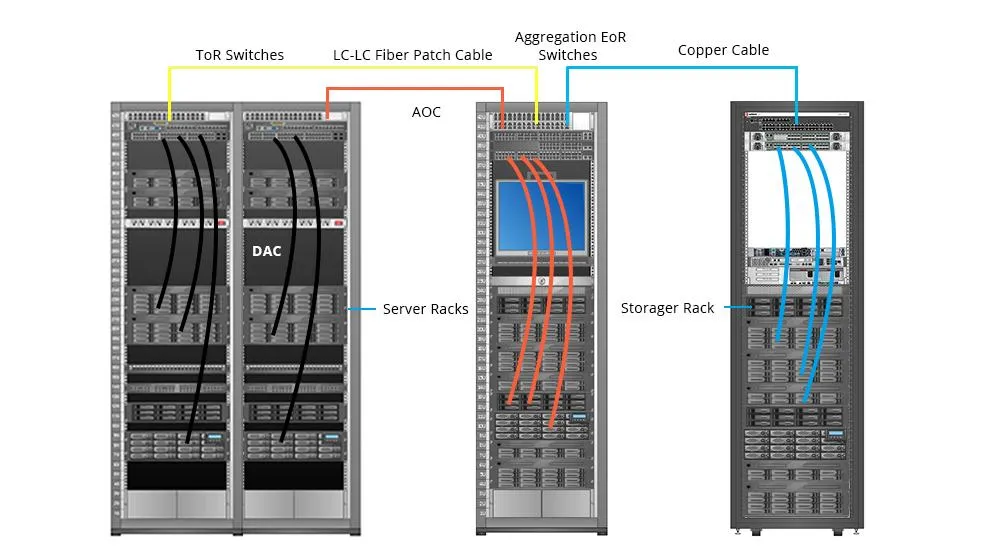
Typical Applications Include:
Cross-connections between patch panels/ODFs and ToR switches or optical modules within a rack (or between racks in the same row)
Short-distance interconnections in high-density patch panels
Routing from ODF to equipment in conduits or environments where additional conduit installation is difficult
End-to-end patching components in A/B redundant link architectures
The illustration highlights two key stability principles:
Place the "high-density port side" on the LC connector to enable higher port density and better cable management, while using the SC connector on the distribution side for standardized ODF operation.
Deploy armored patch cords in areas most prone to compression, bending, stepping, or accidental pulling-such as inside racks and near-end routing zones-while ensuring that backbone pathways follow data center standards for physical separation and redundancy.
Hot Tags: armored simplex fiber patch cord lc/apc to sc/apc for stable rack-to-rack optical links, lszh, anti-rodent, 10m, China, factory, suppliers, manufacturers, quotation, customized, price, buy